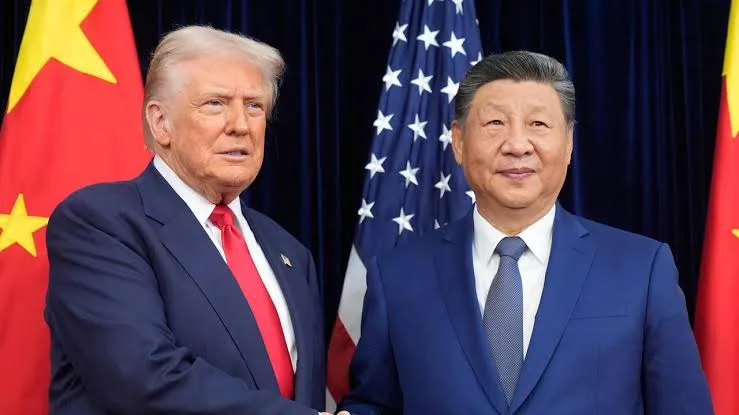
Donald Trump and Xi Jinping sat across from each other at the White House on Thursday for their first face-to-face meeting since May, and somewhere between the trade talk and the photo ops, the two leaders of the world’s most powerful AI developers agreed on something that would have sounded unthinkable a year ago: a hotline for AI accidents.
What Was Actually Agreed
The core outcome is narrower than it might sound. The United States and China agreed to establish a direct communication channel specifically for notifying each other about AI safety incidents — the kind of thing that lets one government tell the other, quickly, if a model behaves in a way that could spill across borders or spiral into something dangerous. It’s infrastructure, not policy. There’s no joint regulatory framework, no shared technical standard, and by Thursday afternoon U.S. time, no formal trade agreement either. What exists now is a phone line that didn’t exist before, built for a category of problem neither country has fully defined yet.
That groundwork was laid a few days earlier than the headline summit. Treasury Secretary Scott Bessent and Chinese Vice Premier He Lifeng held their first dedicated AI dialogue on September 22 in New York, and Thursday’s meeting at the White House built directly on it.
Xi’s Framing: Capability and Responsibility
Xi’s language during the meeting leaned into shared ownership of the problem rather than competition over it. “Both China and the US are leading nations in AI,” he said. “We have both the capability and responsibility to develop and manage AI for good, and ensure that the development of AI is always under human control and serves the well-being of the people.”
That’s a notably cooperative tone for two governments that have spent the past several years treating AI dominance as a zero-sum race — export controls on advanced chips, dueling model releases timed for maximum press impact, and a steady drumbeat of officials on both sides describing AI leadership as a matter of national security. None of that rivalry has gone away. But Thursday’s meeting suggests both governments have arrived, separately, at the same uncomfortable realization: an AI system doesn’t respect the border between a Beijing data center and a Virginia one, and an accident on either side becomes everyone’s problem within hours.
Why a Hotline, Specifically
The choice of a notification hotline, rather than a broader agreement, tells you something about where both sides actually are on AI diplomacy. Nuclear-risk hotlines exist between nuclear powers precisely because the danger isn’t hypothetical and the cost of a delayed message could be catastrophic — the AI equivalent doesn’t carry the same immediate physical stakes, but the model is the same: get bad news to the other side fast, before speculation and mistrust make a bad situation worse. Standing up a channel like that requires far less negotiation than agreeing on shared safety benchmarks or export rules, which explains why it’s the one concrete deliverable to emerge from a summit otherwise dominated by trade.
It also sidesteps the harder questions entirely. Neither government committed to slowing down model development, sharing safety research, or aligning on what counts as a reportable “incident” in the first place — definitions that even AI labs within a single country still argue about.
The Bigger Picture
This meeting didn’t happen in a vacuum. Earlier this month, the CEOs of the major American AI labs went to the United Nations Security Council to ask for international help containing the technology they’re building, a striking admission from an industry that has spent years insisting it could self-regulate. Days later, Microsoft published its own internal code of conduct for AI, and reports surfaced of AI agents being used in ways their creators didn’t fully anticipate. The backdrop to Thursday’s summit is an industry, and now two governments, increasingly uneasy about how fast the technology has outpaced anyone’s ability to fully monitor it.
Seen against that backdrop, a Trump-Xi hotline looks less like a diplomatic breakthrough and more like a minimum viable response to a problem both sides know is bigger than either of them can solve unilaterally.
What This Means
Don’t expect this hotline to prevent an AI incident from happening. What it’s built to do is shrink the gap between something going wrong and both governments knowing about it — which matters more than it sounds like, given how much of the current anxiety around AI comes from not knowing what the other side is building or how close a system might be to behaving unpredictably.
The real signal from Thursday isn’t the mechanics of the agreement. It’s that Washington and Beijing, mid-negotiation on nearly everything else, found AI safety notification to be the one thing worth carving out and agreeing on quickly. That’s either a sign that trust between the two AI superpowers is quietly building in narrow, functional ways, or a sign that both sides are hedging against a scenario they privately think is more likely than they’re saying out loud. Probably some of both.