The Trump administration’s revision of Iran war casualties is landing like a gut punch among veterans who see it as a deliberate attempt to blur the human cost of the conflict. In a low-profile data update, the Pentagon shifted some of the dead and wounded from the Iran war into a vague “Overseas Operations” category — a move critics say shows huge disrespect for the fallen and their families.
What the Pentagon just changed
Over a quiet weekend update to the Defense Casualty Analysis System (DCAS) — the military’s public database of war dead and wounded — the Department of Defense, now formally renamed the Department of War under Donald Trump, added more than 140 wounded service members linked to the Iran war.
But the shift wasn’t just about adding numbers. The department also created a new casualty category called “Overseas Operations” covering personnel killed and wounded “starting July 7.” That fresh label splits the tally off from the official count tied to the start of the US-Israel war on Iran, separating the latest bloodshed from the war’s main ledger.
Four US service members killed in action by Iranian forces now fall into that catch-all category rather than being listed directly under the Iran war itself: 1st Lt Tyler James Feehan, Pvt Isabella Gonzales, Sgt Angel S. Rampersad and Sgt Michael Emmanuel Swinton.
For many veterans, that bookkeeping tweak feels intentional — an attempt to keep the official Iran war death toll artificially lower, and to shield the president from the political heat that comes with mounting casualties.
Veterans see a ‘huge disrespect’ to the fallen
Michael E Smith, a retired rear admiral who served combat tours in Iraq, Bosnia and Kosovo, called the reclassification “such a huge disrespect for the families,” arguing that it is simply “ludicrous” to pretend these troops were not killed as a result of the Iran war.
His frustration goes deeper than language. For Smith and many others, the change looks like classic political damage control carried out on the backs of service members. He likened the move to data manipulation tactics that shadowed the Vietnam era, when casualty reporting became entangled with White House efforts to control public perception.
“The only reason they died was because Donald Trump decided to do this illegal war,” Smith said, framing the conflict as one launched without lawful authorization and now being obscured further by creative accounting in the casualty database.
That sense of erasure hits especially hard for veterans who know exactly what it means when a name is added to a casualty roll. Each entry represents a family whose life just split into a before and after.
One young Marine, and the weight of a line in a database
Tristeza Ordex, a Marine Corps veteran who served in Afghanistan and now works as a national organizer with the advocacy group VoteVets, remembers standing on airfields for ramp ceremonies — the solemn rituals held before a flag-draped casket is flown home.
Among those now classified only as an “overseas” casualty is Pvt Isabella Gonzales, a 19-year-old from Carrollton, Texas, not far from where Ordex lives outside Dallas. Gonzales was not even born when Ordex first enlisted in 2004.
“Thinking about it now makes me emotional, to think about how we have people coming home now … 19 years old,” Ordex said, describing the sting of seeing someone so young — and from her own wider community — shunted into a category that doesn’t clearly mark her as a casualty of the Iran war she died in.
Ordex also underscored the intersectional pain: Gonzales was Latina, and she sees the reclassification as emblematic of a broader pattern where Latino communities are heavily represented in the ranks yet often sidelined in how their sacrifices are remembered and recorded. To her, leaving Gonzales and others outside the core Iran war casualty count “feels like erasure.”
How a legal clock became a political escape hatch
Under the War Powers Act of 1973, any US president who sends troops into hostilities has just 60 days to secure congressional authorization or wind down the operation. Congress has not granted such authorization for Trump’s Iran war.
The administration’s lawyers have tried to thread that needle by arguing that the April ceasefire with Iran effectively “paused” the 60-day clock as of 1 May, resetting the legal horizon for the conflict’s initial period. The new casualty category, which begins counting from 7 July, tracks neatly with that interpretation.
In practice, it creates two parallel ledgers: one set of casualties directly linked to the acknowledged opening phase of the US-Israel war on Iran, and another labeled as generic overseas operations — even when those troops were killed by Iranian forces in the same broad campaign.
That legal parsing matters because casualty numbers have long been a blunt but powerful measure of political accountability. As the toll climbs, public patience tends to erode, and members of Congress feel more pressure to demand answers about strategy, legality and endgames.
By separating out post-July 7 deaths and wounds, the administration appears to be insulating its core Iran war narrative from the full human cost of what is happening on the ground.
Casualty counts, political optics and the shadow of Vietnam
Smith’s comparison to Vietnam isn’t accidental. In that war, the Pentagon’s body counts and casualty metrics were notoriously massaged to paint a picture of progress that often bore little resemblance to reality. Veterans of that era came home to a deep mistrust of official numbers — a skepticism that now hangs over the Iran conflict as well.
Today’s digital databases may be more transparent than paper ledgers, but the logic of managing optics is unchanged. Leaders understand that Americans may not follow every battlefield development, but they do pay attention to how many of their own have been killed.
For a president who has openly compared his Iran war to Korea and Vietnam, and who is acutely sensitive about being tied to high casualty figures, the temptation to create a softer set of numbers is clear. One way to do that is not by reducing deaths, but by redefining what counts as a war death at all.
The newly minted “Overseas Operations” label gives the administration a tool to do exactly that. Those four names — Feehan, Gonzales, Rampersad and Swinton — now appear in an ambiguous bucket that obscures why and where they died. On a spreadsheet, the Iran war may look marginally less costly. For their families, nothing has changed.
Why veterans say this is about more than numbers
Veterans groups and former officers are quick to stress that this isn’t just a semantic squabble with the Pentagon’s data team. It’s about whether the government is willing to be honest with the public about the real consequences of its decisions.
Ordex frames the issue as fundamental accountability. Casualty lists are one of the few concrete, public-facing ways citizens can track the toll of a war they did not personally choose. When those lists are sliced, redefined or partially hidden behind generic labels, it becomes harder to have a real debate about whether the conflict is justified and how long it should continue.
The reclassification also sits uncomfortably alongside growing concerns over how much say Congress has actually had in the Iran war. With no explicit authorization vote and a White House argument that a ceasefire can pause a legal clock written in the 1970s, the sense that the executive branch is stretching both law and language to its limits is hard to ignore.
Even in Trump’s own party, this has raised alarms. Republican lawmakers, including Kentucky’s Thomas Massie, have criticized aspects of the administration’s handling of the conflict and its broader resistance to congressional checks on war powers. The casualty data shift is landing in that same context: one more reminder that when wars are fought on murky legal ground, the record of who paid the price can become murky too.
The human stakes of a bureaucratic decision
On paper, the Pentagon’s change is an administrative update — a tweak to labels in a federal database. But for those who have watched friends loaded onto aircraft under a flag, those labels are anything but abstract.
When a death is clearly marked as a casualty of a specific war, it becomes part of the public memory of that conflict. It is counted in news reports, invoked in congressional hearings and etched into the eventual story the nation tells itself about why the war was fought at all.
Shifting those deaths into a generic “overseas operations” category risks pushing them to the margins of that story. Over time, the fear among veterans is that fewer people will know that Feehan died facing Iranian forces, that Gonzales was just 19 when she was killed in the same war, or that Rampersad and Swinton lost their lives because a president chose to pursue a campaign that many see as unauthorized.
For communities that already feel underrepresented — especially Latinos and other minorities who serve at high rates — that erasure lands even harder. Public recognition is not symbolic fluff; it is one of the few tangible ways the country acknowledges a debt it can never fully repay.
What This Means
The Trump administration’s revision of Iran war casualties may look like a technicality, but veterans are treating it as a warning. If the government can quietly reclassify the dead of an ongoing war into a softer category, it can just as quietly soften public resistance to continuing that war.
The core demand from critics is simple: call these losses what they are. If US troops are being killed by Iranian forces in a war the president ordered, their deaths should be counted, plainly and directly, as casualties of that war — not tucked into an administrative gray zone.
How the country handles those four names, and the more than 140 newly added wounded, will signal whether the human cost of the Iran war is something to be confronted or something to be managed away. For the families left behind, and for the veterans who see themselves in those ramp ceremonies, that distinction is everything.
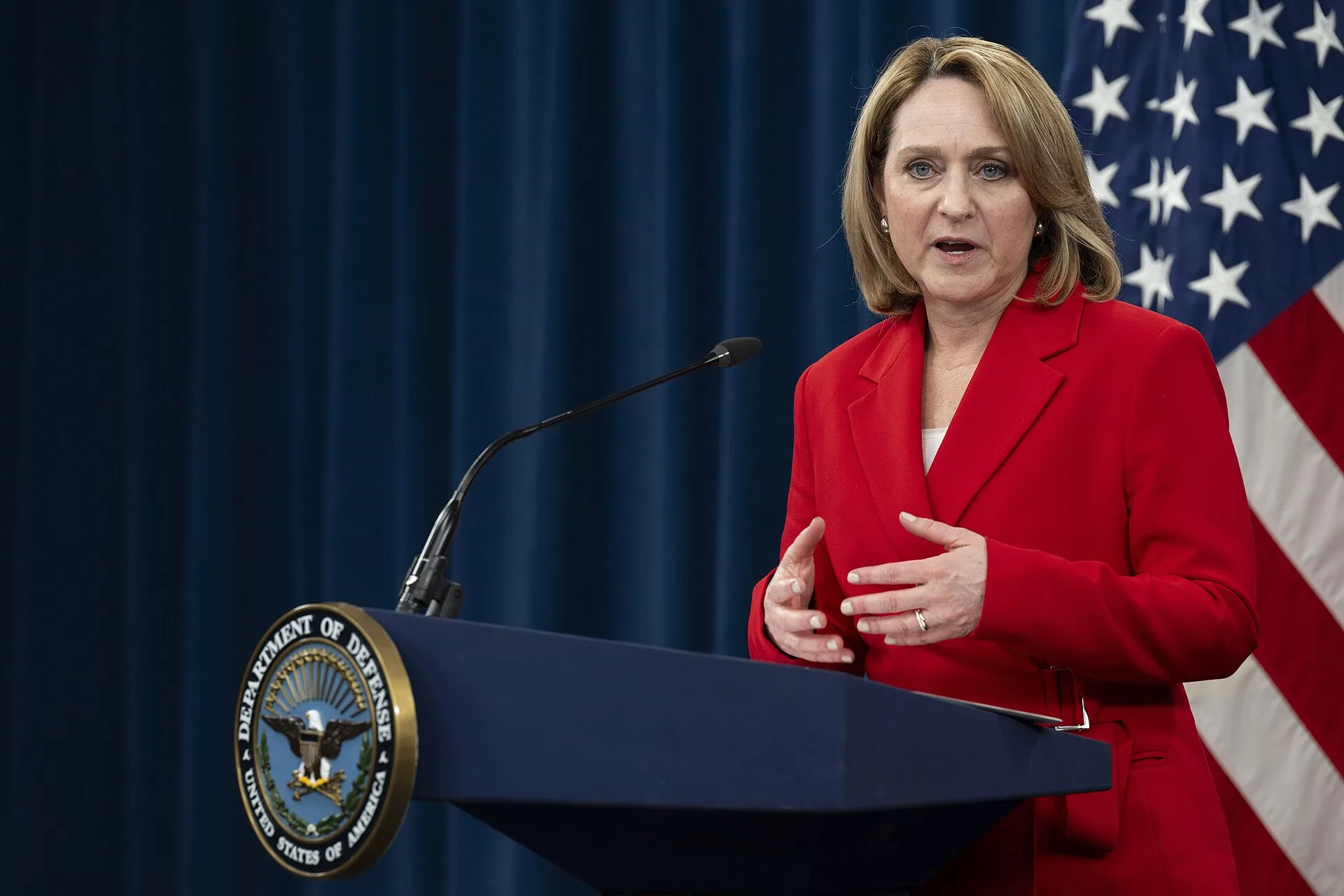
Photo: U.S. Deputy Secretary of Defense Kathleen H. Hicks / Public domain via Wikimedia Commons