Donald Trump says the Iran war is about one thing: stopping Tehran from ever getting a nuclear weapon. New intelligence suggests his strategy may be doing the opposite — supercharging Iran’s nuclear ambitions instead of killing them off. If that analysis is right, the war the White House sold as a nonproliferation crusade is pushing Iran closer to the bomb, not further away.
Trump’s stated goal vs. the new reality
From the first strikes, Trump cast the Iran campaign as a hard reset on Tehran’s nuclear program — a decisive show of force meant to eliminate any path to a weapon. He even went so far as to declare that Iran’s nuclear capabilities had been “obliterated” after the initial round of airstrikes.
But fresh assessments by U.S. intelligence paint a more troubling picture. Analysts now judge that Iran’s new supreme leader, Ayatollah Mojtaba Khamenei, is significantly more inclined to pursue a nuclear weapon than his father was. That is a profound shift at the very top of the system that controls Iran’s nuclear decision-making.
Mojtaba Khamenei took power after his father, the longtime supreme leader, was killed in U.S. offensives during the war. Rather than frightening Iran’s leadership away from the bomb, the campaign appears to have elevated a successor who is more interested in it.
Ayatollah Mojtaba Khamenei changes the nuclear calculus
The focus keyword in this debate — Trump Iran nuclear ambitions — comes down to one man’s intent. Intelligence officials say most of what they know about Mojtaba Khamenei’s views dates from before the war, and they stress that the picture is incomplete. Since being injured in the conflict, he has rarely appeared in public, a choice driven by both security concerns and worries about how those injuries could affect his image at home.
Even with those caveats, the trend line is alarming. A more nuclear-hungry leader, traumatized and empowered by war, now presides over a system that has spent decades building the expertise needed to move quickly if it chooses. Intent matters as much as technology. Installing a hardliner who sees nuclear weapons as a shield against U.S. power is exactly the opposite of what a war to stop the bomb was supposed to deliver.
That raises a core strategic question: if the military campaign helped produce a leadership change that tilts Iran toward weaponization, did Trump’s war fundamentally undercut its own rationale?
Has Iran actually restarted its nuclear program?
So far, U.S. officials do not believe Iran has fully restarted its nuclear weapons program. That distinction matters — interest is not the same thing as an active dash to a bomb. But the space between those two points is where miscalculation thrives.
Tehran has long tried to keep its nuclear work just below the line that would trigger a massive international response. War scrambles those calculations. In a conflict where major research sites have already been hit, the incentive grows to move critical equipment out of sight and deepen the country’s ability to withstand future strikes.
That is exactly what new intelligence suggests is happening.
The mystery of “Pickaxe Mountain”
Israeli intelligence has reportedly tracked Iran moving centrifuges — the high-speed machines used to enrich uranium — to a secret underground facility that U.S. officials refer to as “Pickaxe Mountain.” The name is unknown to the public, but the logic is clear: bury the sensitive hardware somewhere conventional airstrikes will struggle to touch.
By contrast, earlier phases of the war focused on known nuclear sites like Fordo, Natanz, and Isfahan, facilities that had long been on Western target lists. Those attacks damaged infrastructure, but they also forced Iran to adapt. Shifting equipment to a more hardened, hidden location is the classic next step.
Trump has already talked openly about striking Pickaxe Mountain. That kind of public threat is meant to project resolve. It also advertises that Iran’s leadership is succeeding at something crucial: building nuclear resilience under fire.
If the campaign began by smashing aboveground facilities and is now chasing buried ones, it’s moving into the same spiral that defined past efforts to slow other nuclear programs — each strike buys a little time but also pushes the target state to get smarter, tougher, and more determined.
Why “obliterated” nuclear claims don’t hold up
The gap between the president’s rhetoric and the emerging intelligence picture is stark. After the first wave of airstrikes, Trump told the country that Iran’s nuclear capabilities had effectively been wiped out. Yet the core capacities that matter most in any nuclear program are harder to bomb than a fuel plant or a cluster of buildings.
Those enduring capabilities include:
- The scientific and engineering expertise to design and run advanced centrifuges.
- The institutional know-how inside Iran’s nuclear establishment.
- The political will at the top to bear economic and military costs for a weapons option.
War can damage infrastructure and delay production, but it cannot erase knowledge or permanently reset intent. If anything, a conflict sold as existential by both sides tends to entrench the belief that only a nuclear deterrent can prevent future attacks. That’s the core paradox of Trump’s Iran nuclear ambitions: the more he tries to bomb away the threat, the more rational a bomb can start to look in Tehran.
Trump’s strategy is teaching Iran how to survive strikes
A campaign built around airpower sends a clear technical lesson. Iran’s planners are watching what gets hit, what survives and how fast they can move equipment under pressure. Every raid becomes a tutorial on U.S. targeting priorities and strike capabilities.
Over time, that kind of feedback loop encourages exactly the behaviors now coming into focus: relocating centrifuges to deeper tunnels, decentralizing key operations, and tightening control around the supreme leader’s circle. If the intelligence community is right that Mojtaba Khamenei is personally more inclined to pursue a weapon, that hardened inner ring matters even more.
At the same time, the war has narrowed the political space for compromise. Iranian factions that once debated the costs of a nuclear confrontation can now point to a supreme leader injured in U.S. attacks and a map of destroyed facilities as proof that restraint does not guarantee safety.
Escalation risks around Pickaxe Mountain
The next flashpoint in the Trump Iran nuclear ambitions saga is likely to be that underground facility. Signaling that it could be the target of a future strike raises several dangers at once.
First, it increases the incentive for Iran to rush work into the site before it can be hit, reinforcing the idea that only speed and secrecy can preserve a nuclear option. Second, it tempts the White House to believe that one more “decisive” blow can finally settle the issue, even though past rounds of strikes didn’t end the program — they pushed it deeper.
A strike on a site explicitly designed to survive air attack would also test how far Trump is willing to go militarily. Short of ground operations or specialized bunker-busting campaigns, there are limits to what airpower alone can do to a deeply buried target. Crossing those thresholds would make the war bloodier and riskier without any guarantee that it prevents Iran from preserving its most sensitive work elsewhere.
Intel gaps and the danger of wishful thinking
There is another uncomfortable layer to this story: officials acknowledge that much of the intelligence about Mojtaba Khamenei’s nuclear views is dated and incomplete. Since the war, his physical absence from the public stage has reduced opportunities to read his speeches, watch internal maneuvering, or assess how battlefield losses are shaping his thinking.
That ambiguity should make Washington cautious. Instead, the political imperative to claim success pushes the administration toward confident, absolute statements — like insisting that Iran’s capabilities have been erased. When those assurances collide with classified assessments warning of a more nuclear-hungry leadership and more hardened facilities, the risk of miscalculation spikes.
Wars built on worst-case scenarios about other countries’ intentions have a way of drifting into self-fulfilling territory. If Trump continues to insist that only force can contain Iran while intelligence suggests force is deepening Iran’s desire for a weapon, policy and reality are on a collision course.
What This Means
The emerging picture of Trump’s Iran nuclear ambitions is not of a war that solved a proliferation problem. It’s of a campaign that killed an old supreme leader, helped elevate a successor more interested in the bomb, drove nuclear equipment into a secret underground facility, and failed to erase the expertise or will that matter most.
None of this guarantees that Iran will build a nuclear weapon. But it does make one thing clear: you cannot bomb away intent. You can damage factories, crater runways, and proclaim “obliteration” from a podium. If the person at the top of the Iranian system concludes that a nuclear deterrent is the only way to stop the next round of strikes, then the war has already failed on its own terms.
That’s the uncomfortable verdict lurking inside the latest intelligence. A conflict launched to keep Iran from the bomb may be giving Tehran every reason to want one — and teaching it how to protect that ambition underground.
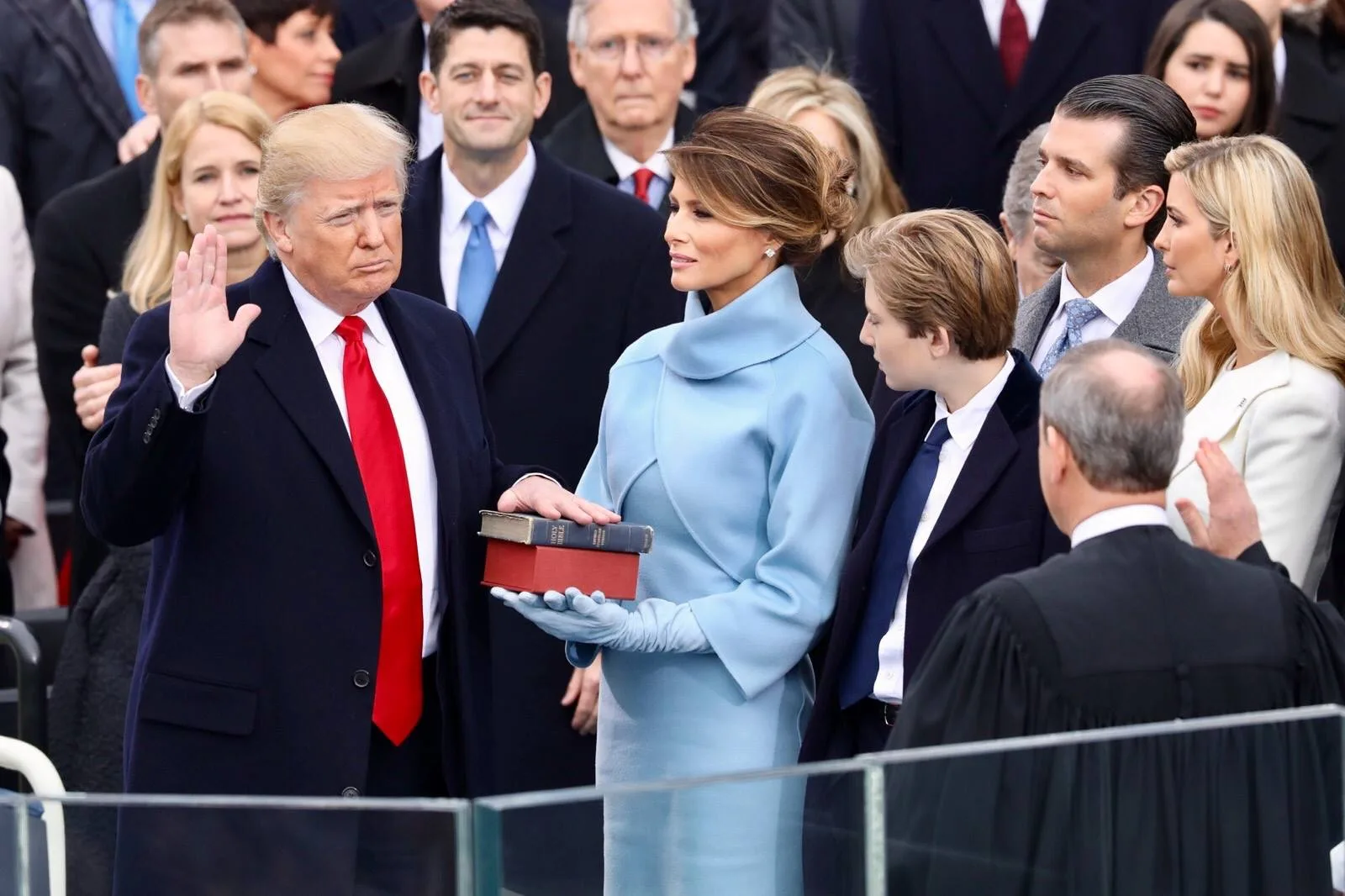
Photo: The White House / Public domain via Wikimedia Commons | Photo: Joyce N. Boghosian / Public domain via Wikimedia Commons