The Mount Toba eruption has long been cast as a near-apocalypse for early humans. But new evidence suggests the Toba supereruption, while enormous, may have been far less of a climate catastrophe than the legend implies.
For years, the “Toba catastrophe” hypothesis has argued that this supervolcano eruption 74,000 years ago triggered a volcanic winter, plunging the planet into deep chill and nearly wiping out our species. The latest high-resolution climate record from East Africa now points in a very different direction: short-lived cooling, modest climate disruption, and no sign of a world on the brink of human extinction.
What the new Toba study actually found
The focus keyword for this story is the Toba eruption, but the real star is a small lake in East Africa that acts like a natural stopwatch. A research team examined mud from the bottom of Lake Chala, a steep-walled crater lake on the flank of Mount Kilimanjaro, to search for the eruption’s fingerprint.
Lake Chala is unusually good at keeping time. Its deep water rarely mixes all the way to the bottom, leaving the lake floor almost motionless and starved of oxygen. That calm setting lets sediment settle into ultra-thin, annual layers known as varves—light bands rich in silica from algae called diatoms, and darker bands of fine soils and clays. Stack thousands of these couplets and you get a year-by-year climate diary.
By tracking those layers across 450 years that straddle the Toba ash horizon, the team could watch climate shift on the exact timescale that volcanic winters play out: one to three years. That is the kind of precision most ocean and lake cores can’t deliver, because the mud usually gets stirred and smeared across decades.
How a supereruption cools the planet (and why size stops mattering)
Volcanic climate disruption starts high above our heads. Explosive eruptions blast sulfur dioxide into the stratosphere, where it forms a haze of sulfate droplets that scatter sunlight back to space. More sulfur usually means more cooling, so it seemed reasonable to assume that the Toba eruption—far bigger than anything humans have ever witnessed—must have been devastating.
Mount Toba expelled thousands of cubic kilometers of magma in roughly two weeks, about a thousand times more than the 1991 eruption of Mount Pinatubo. On simple scaling arguments, that should translate into a staggering pulse of sulfur and a years-long global chill.
But the atmosphere doesn’t follow simple rules forever. At some point, when an eruption becomes truly gigantic, the mechanics of sulfate particles change. Larger aerosol droplets fall out of the sky faster. Their size and weight make them less effective at hanging in the stratosphere and reflecting sunlight. The result: beyond a certain point, bigger eruptions stop producing proportionally bigger climate impacts.
Before this work, estimates of Toba’s sulfur release were all over the map. Climate models fed with the largest numbers produced a planet plunged into cold and darkness. Plug in more modest estimates and you get a nasty but survivable cold snap. Without precise real-world data, the debate never really settled.
Lake Chala’s year-by-year record of the Toba eruption
The new study leans on something far more tangible than model assumptions: ash and algae caught in mud. Earlier work had already pinpointed Toba’s glassy volcanic shards in the Lake Chala core. They’re too sparse to form a visible ash layer, but under the microscope they spike sharply at a thin horizon about 0.3 millimeters thick—a fraction of a sheet of paper.
That spike marks the arrival of Toba ash, almost certainly from direct fallout rather than reworked material, because the shards appear abruptly and then disappear just as fast.
From there, the researchers analyzed the sediment in fine detail, every two to three years across centuries before and after the ash horizon. They combined microscope imagery, chemical scans, isotope measurements, and diatom counts to reconstruct how the lake—and by extension the local climate—responded.
In the roughly 260 years leading up to the Toba eruption, the picture is stable: a warm, wet climate with the lake remaining relatively calm through the year. Then the ash arrives, and with it something strange.
Right inside and just above the ash-rich layer, the team found two ultra-thin green films only a few hundredths of a millimeter thick. They don’t contain intact algae remains, so they’re not simply bits of undecomposed plant material. Instead, the researchers interpret them as substances secreted by stressed diatoms—essentially a panic signal from light-hungry algae under an abruptly dimmed sky.
That fits what you’d expect from a brief volcanic haze: less sunlight reaches the lake surface, photosynthetic organisms struggle, and the ecosystem leaves a chemical trace of that stress.
How much did the Toba eruption actually cool the climate?
What happens next in the mud is the key to dismantling the catastrophe narrative. The first dry season after the Toba eruption produced a pale silica-rich layer about 1.2 millimeters thick—substantially thicker than usual, and packed with diatoms. That kind of bumper bloom points to unusually deep and prolonged mixing of the lake water.
Cooler surface waters tend to stir the water column more effectively, pulling nutrients up from depth and supercharging diatom growth. So that fat pale layer is a fingerprint of a chilled lake surface and a pronounced, but short, change in local conditions.
Sitting above it is a darker layer that is thinner and fainter than the pre-eruption norm. A weak dark band suggests that the following rainy season faltered. One likely explanation: a somewhat cooled Indian Ocean sending less moisture inland, muting regional rainfall for a time.
And then? The record snaps back toward the baseline. Within roughly two years, the lake’s varves look like business as usual again. No drawn-out sequence of oversized layers, no repeating stressed-algae markers, no sign of a prolonged deep freeze.
Taken together, the Lake Chala data point to a cooling of around half a degree Celsius at most, and only for a short window. The Toba eruption seems to have created a notable, but surprisingly limited, volcanic winter—in stark contrast to the multi-year, multi-degree nightmare that earlier catastrophe scenarios envisioned.
Rewriting the “Toba catastrophe” story
The cultural story of the Toba eruption has long outrun the data. It has been invoked to explain supposed genetic bottlenecks in early humans and to paint a picture of a species clinging to survival in the aftermath of a single blast. The new East African record doesn’t just nudge that story—it undercuts its core premise.
If a lake directly downwind of the Indian Ocean monsoon system only registers about two years of modest disturbance, it becomes much harder to argue that Toba plunged the entire globe into a decade of darkness. The Toba eruption was still the largest in the last 2.6 million years, but size alone no longer guarantees a near-extinction climate shock.
This doesn’t mean the event was harmless. Even half a degree of short-term cooling can disrupt rainfall patterns, vegetation, and food webs. For early humans living in Africa and Asia, that could have meant tougher years, shifting resources, and migration pressures. But that is a far cry from a planet rendered barely habitable.
The Lake Chala record also highlights just how easy it is to over-interpret low-resolution data. Many sediment cores blur together years or even decades of change, smearing out short, sharp shocks into fuzzier climate bumps. When you finally get a stopwatch instead of a calendar, some of the scariest spikes turn out to be brief flashes.
What it tells us about supervolcano risks today
It’s tempting to read the new Toba results as a free pass on supervolcanoes. That would be a mistake. A Toba-scale eruption today would still be a global disaster, especially for modern infrastructure and agriculture. Even a half-degree drop in global temperatures, glued onto existing climate change, would tangle with food production, supply chains, and geopolitics in ways early humans didn’t have to worry about.
But the Lake Chala mud does matter for risk planning. It suggests that even the biggest explosive eruptions may have a built-in ceiling on how much long-lived climate damage their sulfate aerosols can do. Beyond a threshold, more magma doesn’t automatically mean a darker, colder world for decades.
That nuance matters for everything from hazard assessments around modern caldera systems to geoengineering debates about injecting sulfate into the stratosphere. If sulfate particles grow too large, they fall out faster and lose efficiency. Nature may already have experimented with the upper bound of this mechanism during the Toba eruption.
Perhaps the most sobering lesson is about humility. For decades, the Toba eruption was treated as a kind of natural parable about how close humanity once came to vanishing. As the evidence sharpens, that story looks less like a warning about a single supervolcano and more like a case study in the limits of our data.
What This Means
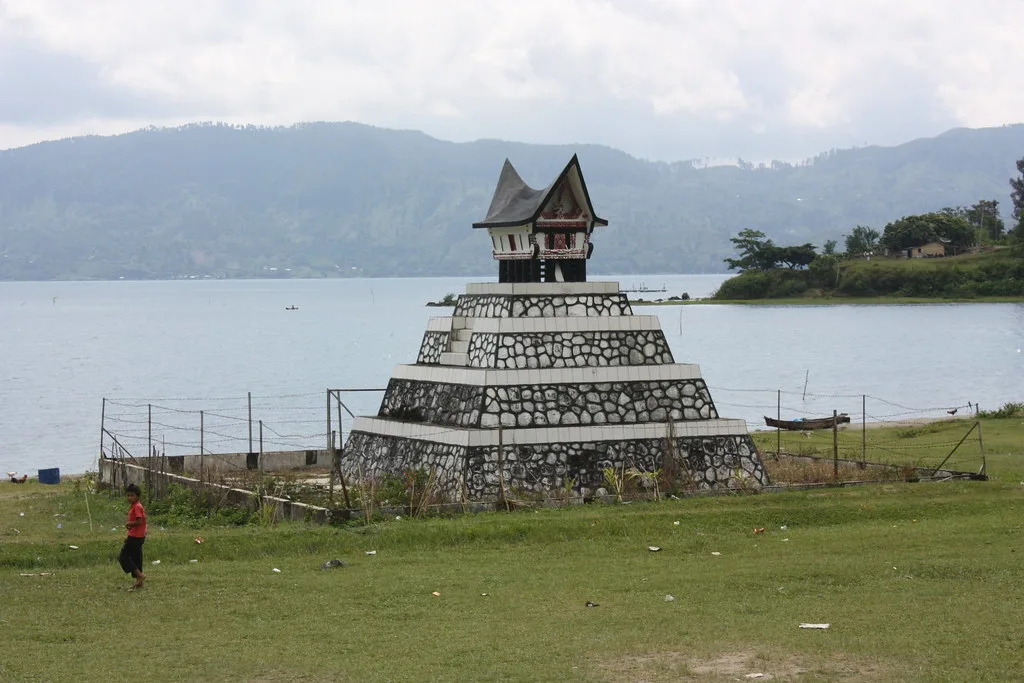
The Toba eruption was still extraordinary: the biggest blast of the last 2.6 million years, carving out a vast caldera now filled by Lake Toba on Sumatra. But extraordinary is not the same as apocalyptic. The best high-resolution record we have so far says the climatic disruption was sharp, real, and surprisingly brief—about two years and roughly half a degree of cooling.
That finding takes some of the sting out of one of the great doomsday stories in Earth science. It reminds us that not every supervolcano eruption is a guaranteed species-level threat, and that climate responses can saturate even when the geologic forcing keeps ratcheting up.
Most of all, it shows the value of digging into the mud with a finer scalpel. As more lakes like Chala are cored and read with this kind of precision, we’re likely to keep revising the stories we tell about past catastrophes—and, by extension, what we fear most about the future.
Photo: Arian Zwegers / BY via Openverse