For the first time, astronomers have picked up a direct radio signal coming from a planet outside our solar system, and before anyone gets ahead of themselves, no, it’s not a message. It’s something arguably more useful for science: proof that a planet 64 light-years away is generating its own magnetic field, and a demonstration that we now have the tools to detect that field from Earth. That capability matters a lot more than it might sound like at first, because magnetic fields are one of the key ingredients that can make a planet habitable in the first place.
What the Telescope Actually Picked Up
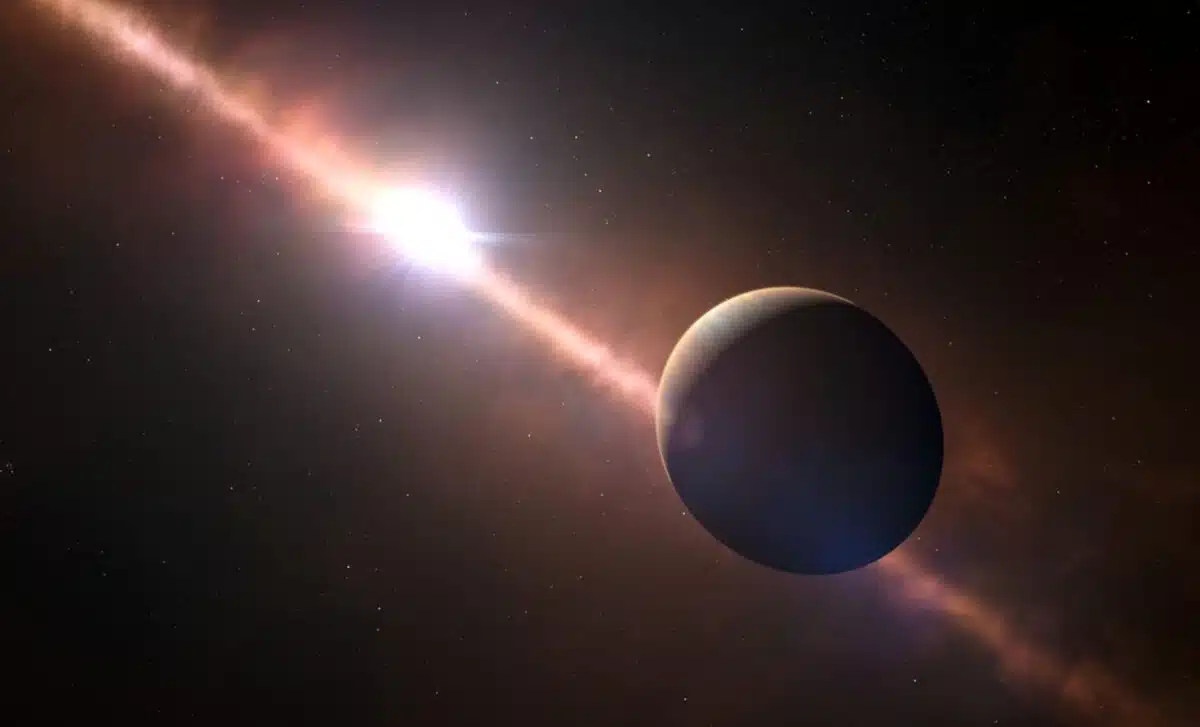
The target is Beta Pictoris b, a massive gas giant roughly ten times the mass of Jupiter, orbiting a young star in the Beta Pictoris system. Using the MeerKAT radio telescope array in South Africa, a team led by Kevin Ortiz Ceballos at the Harvard and Smithsonian Center for Astrophysics picked up rapid, repeating bursts of radio emission coming from the planet’s location. The tricky part of any claim like this is ruling out the obvious alternative explanations, interference, background noise, or emission actually coming from the host star rather than the planet itself.
The team handled that by comparing the signal’s position against distant background quasars, extremely bright, extremely stable reference points that let astronomers pin down a source’s location with enough precision to distinguish “this came from the planet” from “this came from somewhere nearby that looks like the planet from this distance.” That cross-referencing is what elevates this from a tentative detection, the kind that’s been floated before for other exoplanets and never quite held up, to what Oxford astrophysicist Suzanne Aigrain called “the first truly convincing direct detection” of its kind.
So Where’s the Signal Actually Coming From?
The radio bursts are generated the same way they are on Jupiter: auroras. Charged particles streaming off the host star slam into the planet’s upper atmosphere, and the interaction between those particles and the planet’s magnetic field produces radio emission, essentially the exoplanetary equivalent of the northern lights, just detected in radio waves instead of visible light. It’s a completely natural process, well understood from decades of studying Jupiter’s own aurora-driven radio emissions, just never confirmed before at this kind of interstellar distance.
A Magnetic Field Hundreds of Times Stronger Than Jupiter’s
Once the detection was confirmed, the team used the characteristics of the signal to estimate the strength of Beta Pictoris b’s magnetic field, and the number is startling: approximately 1,250 gauss. For comparison, Jupiter’s magnetic field, already the strongest of any planet in our solar system, measures about 4.3 gauss. Earth’s is roughly 0.5 gauss. Beta Pictoris b’s field isn’t just stronger, it’s in an entirely different category, nearly 300 times more powerful than Jupiter’s.
- Beta Pictoris b: approximately 1,250 gauss
- Jupiter: approximately 4.3 gauss
- Earth: approximately 0.5 gauss
Part of that difference comes down to the planet’s youth and mass. Beta Pictoris b is still radiating leftover heat from its formation and is significantly more massive than Jupiter, both factors that are thought to drive stronger magnetic field generation in gas giants. But the sheer scale of the difference is still a useful data point for scientists trying to build models of how planetary magnetic fields form and evolve over a planet’s lifetime.
Why Anyone Should Care About a Gas Giant’s Magnetism
Magnetic fields do more than produce pretty auroras. They act as a planet’s shield against the stellar wind, the constant stream of charged particles a star throws off, which can strip away a planet’s atmosphere over time if nothing is deflecting it. Mars is the textbook cautionary example: scientists believe it lost most of its atmosphere, and with it any chance of remaining habitable, after its magnetic field weakened billions of years ago. Understanding how magnetic fields form, how strong they get, and how long they last is directly relevant to figuring out which exoplanets might actually hold onto breathable atmospheres long enough to support life.
Being able to detect and measure those fields directly, rather than inferring them indirectly, gives researchers a genuinely new tool for narrowing down which distant worlds are worth the enormous expense of further study. A planet with no detectable magnetic field is a planet whose atmosphere, if it has one, is far more vulnerable to being blasted away over geological time.
What Comes Next
Beta Pictoris b is a massive, scorching gas giant with essentially no chance of hosting life itself, so this detection isn’t about finding a new habitable world. It’s about proving the method works. The next-generation Square Kilometre Array, currently under construction, is expected to be sensitive enough to attempt the same kind of measurement on smaller, cooler, rocky planets, the kind where a magnetic field could genuinely make the difference between a world that holds onto its atmosphere and one that doesn’t.
What This Means
This detection is less a discovery about one specific planet and more a proof of concept for an entirely new observational technique, one that could eventually let astronomers assess a rocky exoplanet’s habitability prospects without ever needing to send a probe anywhere near it. It took a repeating radio burst, a precisely triangulated position against distant quasars, and a research team willing to rule out every mundane explanation before making the claim, but the payoff is a genuinely new way of asking whether a distant world has what it takes to hold onto an atmosphere. For a field that spends most of its time working with faint light from objects nobody will visit in any of our lifetimes, that’s about as concrete a win as it gets.