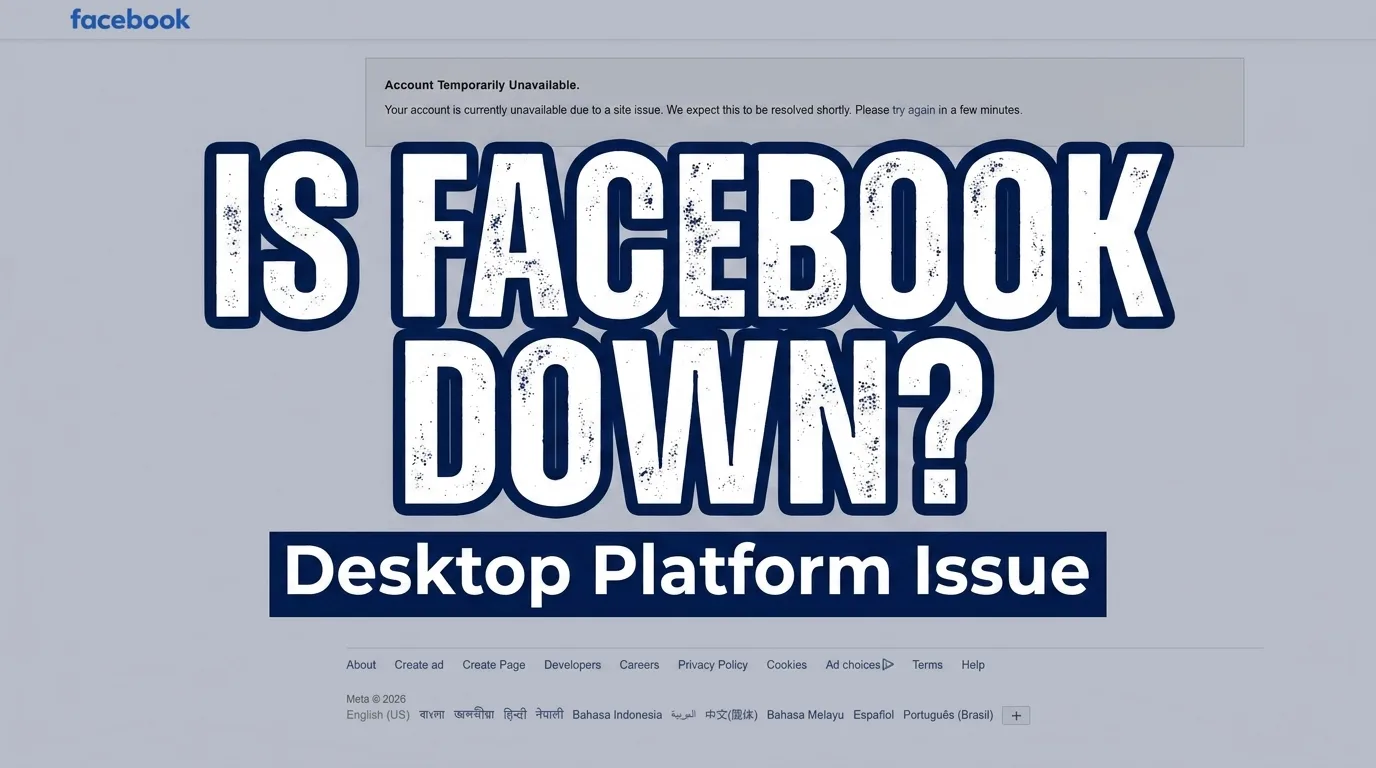
You open a laptop, type facebook.com out of habit, and instead of a feed you get a gray box telling you your account is temporarily unavailable due to a site issue. The phone app might still half-work. Everything else on your Wi-Fi loads fine. And within about ninety seconds, half of X is asking the same question you are.
That loop has replayed several times in 2026 already, and the pattern is consistent enough now to be worth breaking down properly. Facebook’s failures no longer look like the catastrophic, DNS-obliterating blackouts of the past. They look like something messier — partial, lopsided, and hardest on desktop.
What the “site unavailable” message actually means
The error most people hit reads roughly like this: your account is currently unavailable due to a site issue. It should be resolved shortly; please try again in a few minutes. It’s a deliberately vague message, and that vagueness is the point. It’s a catch-all served when Facebook’s front end can reach the platform but can’t get a usable response from the other service that owns your session or feed.
That’s meaningfully different from the site simply being offline. In a true blackout, facebook.com doesn’t resolve at all, and your browser throws a connection error. Here, the page loads, the branding renders, and the app itself politely tells you it can’t do its job. It’s an application-layer failure, not a network one — which is exactly why the outage can hit you and skip your friend two suburbs over.
Users have also reported a second flavor of the same breakdown: repeated “unexpected error” and “query error” prompts, sudden logouts, and login attempts rejected despite correct passwords. Same underlying story. Authentication and data retrieval on Meta’s side stop cooperating, and the interface improvises an apology.
Why desktop takes the harder hit
The complaint that comes up over and over in these incidents is that the browser version dies while the mobile app limps along. There’s a reasonable technical explanation.
The Facebook mobile app maintains a long-lived authenticated session and aggressively caches. It can render your last-loaded feed, keep your login token warm, and quietly retry failed requests in the background — meaning you may not notice a short server-side hiccup at all. The desktop web experience rebuilds far more of itself on each visit, leaning on a live round trip to Meta’s authentication and content services. When those services stall, the browser has nothing to fall back on except an error card.
That asymmetry is why “is Facebook down on desktop but not mobile” has become its own recurring search query. It’s usually not two separate faults. It’s one fault, exposed more brutally on the surface with the least to hide behind.
The 2026 outage record so far
Three incidents this year account for most of the noise, and they rhyme without repeating.
| Date | Primary symptom | Scope |
|---|---|---|
| March 3, 2026 | “Account currently unavailable due to a site issue” error blocking logins | Partial, roughly three hours, tens of thousands of reports at peak |
| April 8, 2026 | Blank white screens, login failures across app and desktop | Widespread, concentrated on the US East Coast |
| June 12, 2026 | Mass logouts, “unexpected error” and “query error” messages, dead feeds | Global — US, Europe, Asia, Middle East; Instagram and Messenger also affected |
June 12 was the significant one. Reports came in from Australia, Belgium, the Philippines and across the United States, with heavy clusters in New York, Chicago and San Francisco. Facebook’s desktop site, its app, Messenger, and parts of Instagram’s feed and login systems were all degraded at once. Meta communications chief Andy Stone acknowledged on X that people were having trouble accessing the company’s services and said the team was working on it — which, as public incident communication goes, is about as detailed as Meta ever gets in the moment.
Worth flagging: Meta’s public status page is oriented toward business and advertising products. During consumer-facing outages, it has repeatedly shown all-clear while millions of people stared at broken feeds. Don’t treat it as ground truth for whether your account is working.
How to tell if it’s Facebook or if it’s you
Before you start resetting anything, run through this. It takes under a minute.
- Check a crowd-sourced tracker. Downdetector and similar sites spike within minutes of a real incident. A flat graph means the problem is local to you.
- Test a second Meta property. If Instagram, Messenger and Threads are also misbehaving, it’s a platform-wide fault. If only Facebook is broken, it’s a narrower issue.
- Try a different network. Switch from Wi-Fi to mobile data. If the error follows you, it’s server-side.
- Search X for “Facebook down.” Crude, but it’s still the fastest real-time signal on the internet.
If it is server-side, a VPN won’t rescue you, a different browser won’t rescue you, and reinstalling the app definitely won’t. There is nothing to fix on your end.
The one thing you should not do
Do not repeatedly reset your password during an outage. It’s the single most common mistake, and it’s a genuinely bad idea for two reasons. First, hammering authentication endpoints that are already failing can flag your account for suspicious activity and lock you out for longer than the outage itself. Second, every large Meta outage is followed by a wave of phishing emails and texts offering to “restore” your account — targeting exactly the people who are anxious and clicking fast. Meta will not message you a recovery link during a service disruption. Ignore anything that shows up in your inbox mid-outage.
The uncomfortable structural problem
Facebook’s outages get outsized coverage not because Facebook is uniquely fragile, but because of what’s downstream of it. Small businesses run storefronts on it. Publishers route traffic through it. Community groups organize on it. In parts of South Asia, Southeast Asia and Africa, Facebook functions as a substantial share of what people mean when they say “the internet.”
Meta has also spent years consolidating Facebook, Instagram, WhatsApp and Threads onto shared infrastructure — shared identity services, shared ad systems, shared backend plumbing. That consolidation is efficient, which is why the company can ship cross-app features fast. It’s also why a single failure in an authentication service now takes down four platforms simultaneously, rather than one. Every incident this year has bled across app boundaries. That’s not a coincidence, and it’s not going to stop being true.
What This Means
For most users, the practical takeaway is boring and useful: when Facebook throws a site-unavailable error, wait. These incidents have consistently resolved in under three hours, and every action you take in the meantime carries more downside than upside.
For everyone who depends on the platform commercially, the takeaway is sharper. Three notable disruptions in roughly four months is a pattern, not bad luck, and a business whose entire customer relationship lives inside Meta’s apps is a business with no failure mode. Owned email lists, a website you control, and a presence on at least one platform outside Meta’s stack aren’t paranoia at this point. They’re basic operational hygiene.
Facebook will go down again. The only real question is what breaks on your side when it does.