Google has never been great at keeping secrets, but this year the company didn’t even need help. Weeks before the Pixel 11 is due on stage in New York, Google published the entire lineup on its own Amazon storefront — prices, colors, storage tiers, battery capacities, the lot — and then quietly pulled the pages down after screenshots had already spread across the internet. What those listings showed is a Pixel generation that gets meaningfully faster, adds the first genuinely fun piece of Pixel hardware in years, and costs more money than the one before it.
The event itself is locked in: Made by Google returns to New York on Wednesday, August 12, with the keynote starting at 6 p.m. ET / 3 p.m. PT. That’s a week earlier than last year’s Pixel 10 launch and unusually late for Google, which typically kicks off these events in the early afternoon. Pre-orders open the same day.
Google confirmed the name — and teased the headline feature
For a few days after the invite went out, Google played coy, describing the lineup only as “the next generation of Pixel.” That ended on July 15, when the company posted its first teaser and dropped the pretense entirely. The Google Store landing page now says it outright: Pixel 11, August 12.
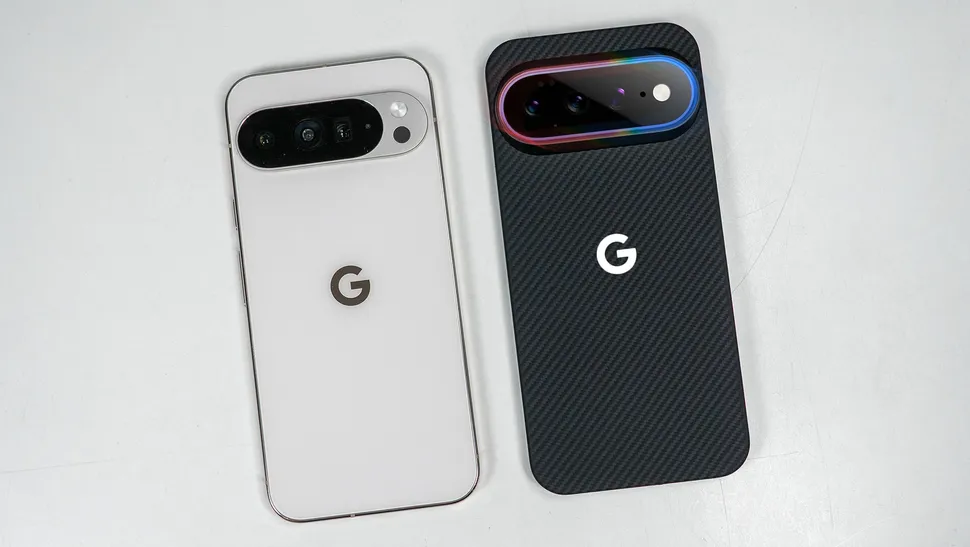
The teaser video is short, but there’s a lot in it. Two phones sit edge-on in a shiny gold finish — a deliberately loud, reflective gold that phone makers have largely abandoned in favor of muted titanium tones. More interesting is what’s happening in the camera bar. Where the flashlight and the old temperature sensor used to sit, a small circle of light cycles through a spectrum of colors.
That’s Pixel Glow, and it’s been the most persistent rumor of this cycle.
What Pixel Glow actually does
Strings buried in Android 17 beta builds described a system that pulses colored light on the back of the phone when it’s face-down on a table. It’s meant to handle notifications, incoming calls, and battery status, with different animations tied to Gemini — one look for when the assistant is listening, another for when it’s responding.
The obvious comparison is Nothing’s Glyph interface, and it’s a fair one, though Pixel Glow is a single LED array in the camera visor rather than a full light strip across the back panel. Reports suggest it can display up to eight distinct colors mapped to the system’s active theme.
It also comes at a cost: the body temperature sensor Google shipped on recent Pro models appears to be gone, with Pixel Glow taking its place in the camera bar. Given how few people ever used the thermometer, that’s a trade most buyers will make happily.
Tensor G6 goes to 2nm, and beats Apple to it
The silicon story is the one that actually matters for daily use. Tensor G6 — codenamed Malibu — is reportedly built on TSMC’s 2nm N2 node, which would make the Pixel 11 the first phone on the market using that process. Apple’s next A-series chip is expected to land there too, but slightly later.
This is Google’s second Tensor built at TSMC after last year’s G5 moved off Samsung Foundry’s 4nm line. The leaked configuration is unusual: seven cores rather than the standard eight, split into one ARM C1-Ultra core clocked at 4.11GHz, four C1-Pro performance cores at 3.38GHz, and two efficiency cores at 2.65GHz. Graphics come from a PowerVR C-Series GPU, connectivity from a MediaTek M90 5G modem, and a new dedicated TPU is handling on-device AI work.
That modem swap deserves attention. Pixel phones have been dogged by patchy cellular performance for years, and moving to MediaTek silicon is Google’s most direct attempt to fix it.
The prices Google accidentally published
Here’s where the leak gets uncomfortable for Google. The 128GB entry model is no longer available across the board. Every Pixel 11 now starts at 256GB — which sounds generous until you look at what it does to the sticker.
| Model | Storage | Leaked US price |
|---|---|---|
| Pixel 11 | 256GB | $899 |
| Pixel 11 | 512GB | $1,019 |
| Pixel 11 Pro | 256GB | $1,099 |
| Pixel 11 Pro | 512GB | $1,219 |
| Pixel 11 Pro | 1TB | $1,449 |
| Pixel 11 Pro XL | 256GB | $1,299 |
| Pixel 11 Pro XL | 512GB | $1,419 |
| Pixel 11 Pro XL | 1TB | $1,649 |
| Pixel 11 Pro Fold | 256GB | $1,899 |
| Pixel 11 Pro Fold | 512GB | $2,019 |
| Pixel 11 Pro Fold | 1TB | $2,249 |
The base Pixel 11 climbing to $899 is a $100 increase on entry pricing, softened somewhat by the doubled storage. The Fold is harder to defend. Two grand for a 512GB foldable puts it squarely against the most expensive hardware in the category, and the leaked spec sheet doesn’t obviously justify it.
The RAM situation is a genuine downgrade
Buried in the same listings is a change nobody asked for. On the Pixel 10 Pro line, every storage configuration shipped with 16GB of RAM. This year, the 256GB Pro and Pro XL are listed at 12GB, with 16GB reserved for the 512GB and 1TB tiers.
Memory prices have been climbing across the industry, and Google is not the only company quietly rationing RAM. But it means the cheapest Pro is now measurably less capable than its predecessor at a higher price — an awkward thing to explain when your entire pitch is on-device AI.
What the leaked spec sheets show
- Pixel 11: 6.3-inch 120Hz OLED, 4,985mAh battery, 13MP front camera, 204g, in Frost, Pistachio, Hibiscus, and Obsidian
- Pixel 11 Pro: 6.3-inch display, 4,850mAh battery, 120x digital zoom, Canyon and Obsidian finishes
- Pixel 11 Pro XL: 6.8-inch 120Hz OLED at 2,992 x 1,344, 5,115mAh battery, 226g
- Pixel 11 Pro Fold: 6.5-inch 120Hz cover screen, 4,750mAh battery, 239g, folded to 0.4 inches thick
All four are listed with Bluetooth 6 and Wi-Fi 6E. The Fold’s battery is the odd one out — at 4,750mAh it would be smaller than last year’s model, which is either a real regression driven by the thinner chassis or placeholder data in an unfinished listing. Several other fields on those pages looked incomplete, so treat that number with caution.
What This Means
The Pixel 11 is shaping up as a solid, unglamorous upgrade with one flashy hook. The 2nm Tensor should finally close the efficiency gap that has haunted this line since the first Tensor chip, the MediaTek modem addresses the other long-running complaint, and Pixel Glow gives Google something visually distinctive at a moment when every Android flagship looks like every other Android flagship.
The pricing is the problem. Google built the Pixel’s reputation on undercutting Samsung and Apple while matching them on camera quality and software. An $899 starting point with a RAM cut on the base Pro chips away at that. Doubling the storage is a reasonable defense, but only if buyers actually wanted 256GB more than they wanted the lower price.
The real question for August 12 isn’t what the hardware does — we already know. It’s whether Google can make a case for spending more.