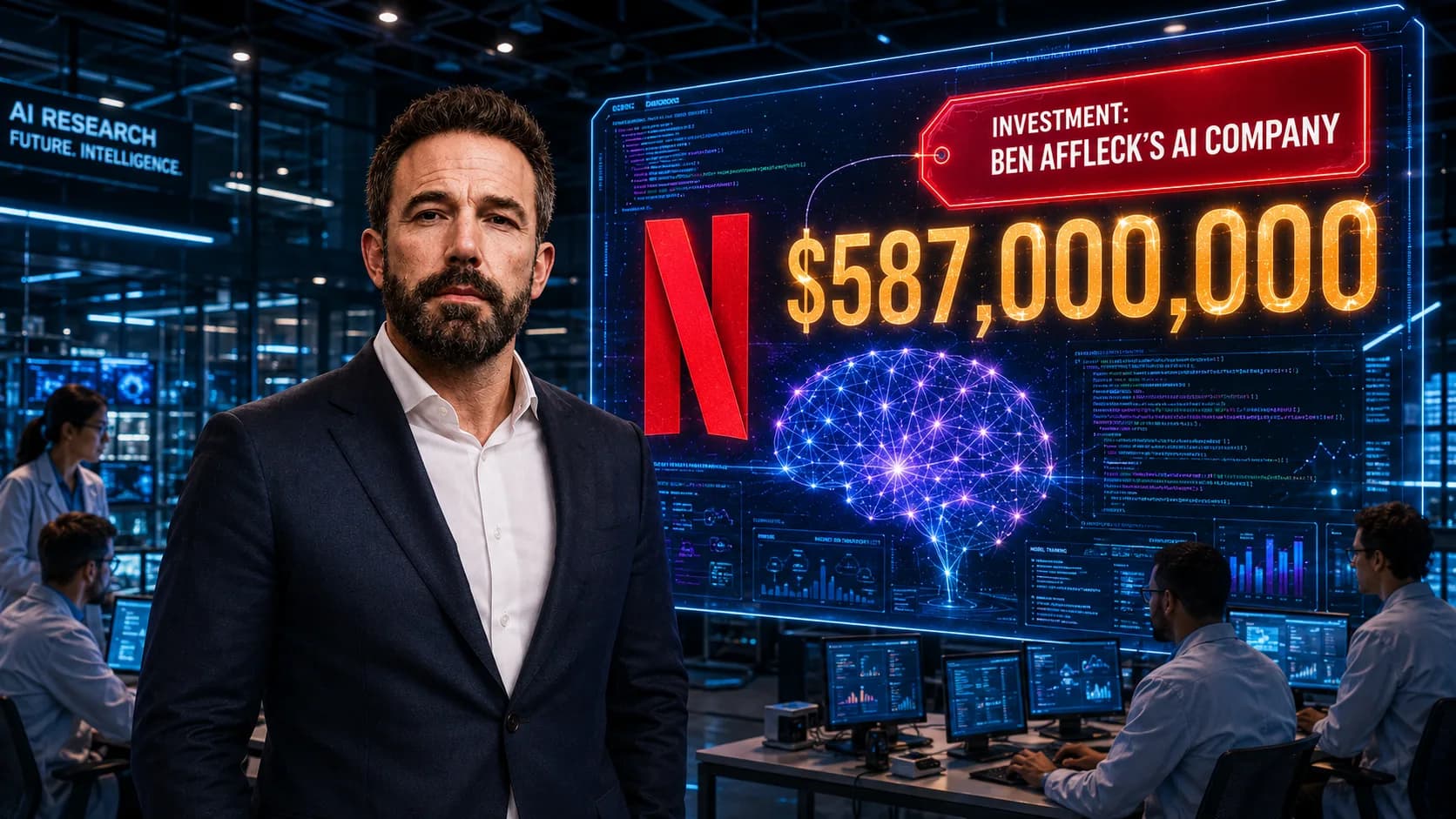
For four months, Hollywood has been arguing about a number nobody could confirm. Netflix bought Ben Affleck’s secretive AI startup InterPositive in March, said nothing about what it cost, and let the rumor mill run. Now the answer is buried in a footnote of a quarterly securities filing, which is exactly where a company puts a number it doesn’t want to headline: $587 million. All cash.
That figure landed on a Friday, one day after Netflix used its second-quarter earnings call to talk up how much money generative AI is saving it. The juxtaposition is hard to miss. The streamer spent more than half a billion dollars on tools whose central selling point is doing expensive work cheaply.
What the Filing Actually Says
Netflix’s Form 10-Q describes an acquisition completed in March 2026 accounted for as a business combination, with a total purchase price of roughly $587 million in cash consideration. The document doesn’t name InterPositive anywhere. But Netflix announced the deal on March 5, and it’s the only acquisition of that scale on the books for the quarter, so the arithmetic isn’t complicated.
The number also settles an earlier report that pegged the deal at up to $600 million. That higher figure included performance-based earnouts for Affleck and InterPositive’s backers on top of the base price. So both numbers were right, depending on what you were counting.
The Company Nobody Knew Existed
Affleck founded InterPositive in 2022 and ran it in near-total stealth. He was the sole founder and served as CEO. No product launches, no funding announcements, no conference keynotes. When the Netflix deal broke, most of Hollywood learned simultaneously that the company existed and that it had already been sold.
That secrecy is part of why the reaction was so sharp. Affleck had spent years positioning himself as an AI skeptic in public. He told Joe Rogan earlier this year that he didn’t believe the technology could write anything meaningful or generate a film from scratch. In November 2024, at a CNBC conference, he’d talked about AI stripping out the more laborious and less creative parts of filmmaking. Read back-to-back, those comments look less like a contradiction and more like a man describing his own product without mentioning that he owned it.
He’s stayed on at Netflix as a senior advisor.
How the Tech Actually Works
This is the part that gets flattened in most coverage, and it matters. InterPositive is not a Sora or Veo competitor. Affleck has been blunt about that: it isn’t about text prompting or conjuring footage from nothing.
Instead, the system trains a bespoke model on a production’s own dailies — the raw footage a crew has already shot — and then uses that model to handle the grinding technical passes downstream:
- Removing stunt wires
- Reframing shots that didn’t quite land
- Reconstructing coverage a production missed
- Reshaping lighting after the fact
- Enhancing or extending backgrounds
- Color grading and continuity fixes
Netflix’s chief technology and product officer has framed the appeal as controllability. Because the model is anchored to one production’s specific visual data, the output stays consistent with what the director already shot in a way general-purpose video models struggle to match. Affleck has said the system was built with constraints designed to keep creative decisions with the artists rather than the software.
That’s the pitch. The pitch is also the problem.
The 300-Title Number
On Thursday’s earnings call, Netflix disclosed that roughly 300 titles used generative AI somewhere in their production process this year, concentrated heavily in post-production. Ted Sarandos called out specific projects: the Indian crime series Glory, the Brazilian documentary Brasil 70: A Saga do Tri, and the docuseries The American Experiment, which contains 17 minutes of AI-enhanced footage.
His claim about that last one is the number worth remembering. Those sequences, he said, were produced twice as fast and at half the cost of the alternatives, enabling scope the series couldn’t otherwise have afforded.
Sarandos was careful about the framing. He rejected the idea that AI replaces filmmakers, arguing that great work still requires great artists and that the tools simply let creators execute their vision. Any savings, he added, would be plowed back into more content. He’s also said elsewhere that faster and cheaper is worthless if the result isn’t better.
Netflix positions InterPositive as one piece of a wider stack that includes its Eyeline visual effects research group and an in-house animation lab.
Where the Money Actually Lands
Here’s the tension nobody at Netflix wants to say out loud. The tasks InterPositive automates — rotoscoping, compositing, relighting, continuity cleanup — are the exact tasks that employ enormous numbers of people in India, South Korea, the Philippines, and Latin America. More than two million professionals work in visual effects worldwide, and the bulk of that labor is frame-by-frame technical work, not concept design.
SAG-AFTRA’s four-year agreement with the studios, reached May 2, added new guardrails around synthetic performers. Those protections cover unionized actors. They don’t cover the offshore VFX pipeline. IATSE, the main union for Hollywood’s technical crews, has declined to comment on the acquisition at all.
Meanwhile the broader industry has been moving in the same direction. Disney put $1 billion into OpenAI in December 2025, licensing more than 200 characters from Marvel, Pixar, and Star Wars to Sora. Netflix has said it will keep InterPositive’s tools internal rather than licensing them to rival producers — a competitive moat, and a signal of how much strategic value it assigns to the technology.
Netflix’s Quarter, For Context
| Metric | Q2 2026 |
|---|---|
| Revenue | $12.56 billion |
| Year-over-year growth | 13% |
| Adjusted EPS | $0.80 |
| Stock buybacks | $4.7 billion |
| Titles using generative AI | ~300 |
| Annual content budget | ~$20 billion |
| 2026 ad revenue target | ~$3 billion |
Shares dropped as much as 9% after hours on a slight revenue miss and worries about decelerating growth. Against a $20 billion content budget, $587 million is roughly 3% of a single year’s spend — real money, but not a bet-the-company move.
What This Means
The $587 million doesn’t look expensive if you think of it as buying a permanent structural discount on visual effects across hundreds of productions a year, forever, with no licensing fees to an outside AI vendor. Amortized across a decade of content, it’s cheap. That’s almost certainly how Netflix’s finance team modeled it.
What the disclosure really confirms is that the argument about whether AI belongs in filmmaking is over, at least at Netflix. Three hundred titles is not an experiment. It’s a standard operating procedure, disclosed to shareholders as a cost line and a quality claim in the same breath.
The open question is the one Sarandos keeps answering slightly sideways. He says savings get reinvested into more content. Reinvested with whom? If the efficiency gain comes from work that used to be performed by compositors in Hyderabad and Manila, then “reinvestment” describes a transfer, not a wash. Affleck built a tool that genuinely does keep directors in control of their own footage. He also built one that makes a large category of skilled labor optional. Both things are true, and Netflix just paid $587 million because it understood that.