The wildfires tearing through British Columbia aren’t just another bad fire season. They’re the moment Canada’s climate future roared into the present — and the federal government has been forced to step in as entire communities run for their lives from out-of-control flames.
As of Sunday, British Columbia was battling 102 active wildfires across the province, with nearly half classified as out of control. Roughly 22,000 people have already fled, many in chaotic overnight evacuations, and about 10,000 more have been told to be ready to leave at a moment’s notice. For residents jolted awake by alerts, the phrase “BC wildfires” now means panic, packed bags, and taillights disappearing into smoke-clogged highways.
Ottawa steps in as evacuations snowball
With local resources stretched and communities emptying out, Canada’s federal government moved to provide emergency help. Eleanor Olszewski, the minister of emergency management and community resilience, said she approved a formal request from British Columbia for federal assistance to shelter and house evacuees.
Federal officials, led by the Government Operations Centre at Public Safety Canada, have been tasked with coordinating support so it reaches displaced residents quickly. That support is expected to focus on basic but critical needs: places to sleep, food, medical care, and help for people who may not be able to return home anytime soon.
The scale of the displacement is staggering. The entire community of Summerland — about 50km south-west of Kelowna and home to roughly 12,000 people — was ordered to evacuate overnight on Saturday. Another 8,000 people around nearby Peachland were also told to get out. For thousands, there was no time to hesitate.
Residents like Summerland’s Jennifer Pascoa described how fast the threat escalated. One moment, they were coming home from the beach. The next, a plume of smoke had turned into thick, black skies and visible flames licking the nearby mountains. Within about an hour, they were packing up and leaving.
‘Like a bomb going off’: Bald Range fire explodes in size
At the center of the current crisis sits the Bald Range wildfire, now a symbol of how quickly modern fires can turn catastrophic. Detected late Friday evening, the blaze ballooned in a matter of hours to more than 100 square kilometers — nearly twice the size of Manhattan — as it raced roughly 15km toward Okanagan Lake.
That kind of growth used to sound hypothetical in wildfire models. Now it’s a lived reality. British Columbia premier David Eby declared a provincial state of emergency late Saturday, describing the Bald Range blaze as being “like a bomb going off.” His words aren’t hyperbole; they’re a blunt reflection of how violently the fire has moved through forests and toward homes.
The BC Wildfire Service has thrown significant resources at the inferno. Ten helicopters and a night-vision helicopter have been working the flames, but their efforts are being undercut by heavy smoke, turbulence, and the size of the fire itself. Aircrews are flying into conditions that are both physically dangerous and constantly shifting.
The Royal Canadian Mounted Police are also investigating a possible fatality connected to the fire near Summerland, underscoring how quickly this has escalated from a property and infrastructure emergency into a life-or-death situation.
Why ‘nighttime relief’ from fire is disappearing
For decades, firefighters relied on nighttime as their slim margin of advantage. Cooler, more humid air would typically slow fire behavior, giving ground crews a chance to catch up, dig lines, and reassess. This time, there’s almost no break.
Prolonged hot, dry weather across southern BC has created what fire officials describe as unprecedented, “explosive” conditions. Fuels — trees, brush, deadfall, even the top layer of soil — are so dried out that nearly everything burns instantly. One wildfire expert described walking through forests that “crunch” underfoot, where it feels like looking sideways is enough to start a blaze.
When conditions are this extreme, fire doesn’t respect traditional limits. Flames run through slopes overnight. Embers travel farther, igniting new spot fires well ahead of the main front. And the kind of erratic wind shifts driven by large fire systems can turn an accessible route into a deadly trap without much warning.
That’s the backdrop for the 78 wildfires that ignited just in the past week — a statistic that speaks less to bad luck and more to a system under stress. Each new ignition lands on a landscape already bone dry, meaning more fires are able to escape initial attack and grow into large, complex incidents.
Climate change is turning the dial on BC wildfires
To anyone watching Canada’s wildfire seasons over the past decade, the trend is impossible to ignore: fires are larger, faster, harder to control, and more likely to threaten communities. Experts point directly to human-driven climate change as the key factor turning BC’s fire seasons from difficult to extreme.
Southern British Columbia and the US Pacific Northwest have seen little to no meaningful rain over the past six weeks. Heat and drought don’t just dry out forests; they reset the baseline. Each hot, dry summer builds atop the last, making fuels more flammable and fire seasons longer and more intense.
Wildfire researchers say we are now firmly in the era of “high-intensity fires” — burns that move fast, throw off their own weather, and outpace the strategies that were developed for a cooler, wetter climate. Shorter windows of favorable weather make every decision at the fire line more consequential. Wait too long to evacuate, and the fire can be at the city limits before roads are clear.
Lightning, forecast from approaching thunderstorms this week, threatens to add another layer of risk. In a landscape this dry, a single lightning strike can become a major incident within hours. And when dozens or hundreds of strikes hit across a region, it’s like rolling the dice over and over again.
Communities living with a go-bag by the door
For the tens of thousands of people under evacuation orders and alerts, this isn’t a distant climate conversation; it’s a scramble to figure out what life looks like when your town may or may not still exist next week.
Families in Summerland and Peachland had minutes to decide what to grab: passports, medications, pets, irreplaceable photos. Some packed methodically after seeing flames approach the mountain ridges. Others woke to pounding on the door or emergency alerts on their phones, bundled kids into cars, and left with whatever fit in the trunk.
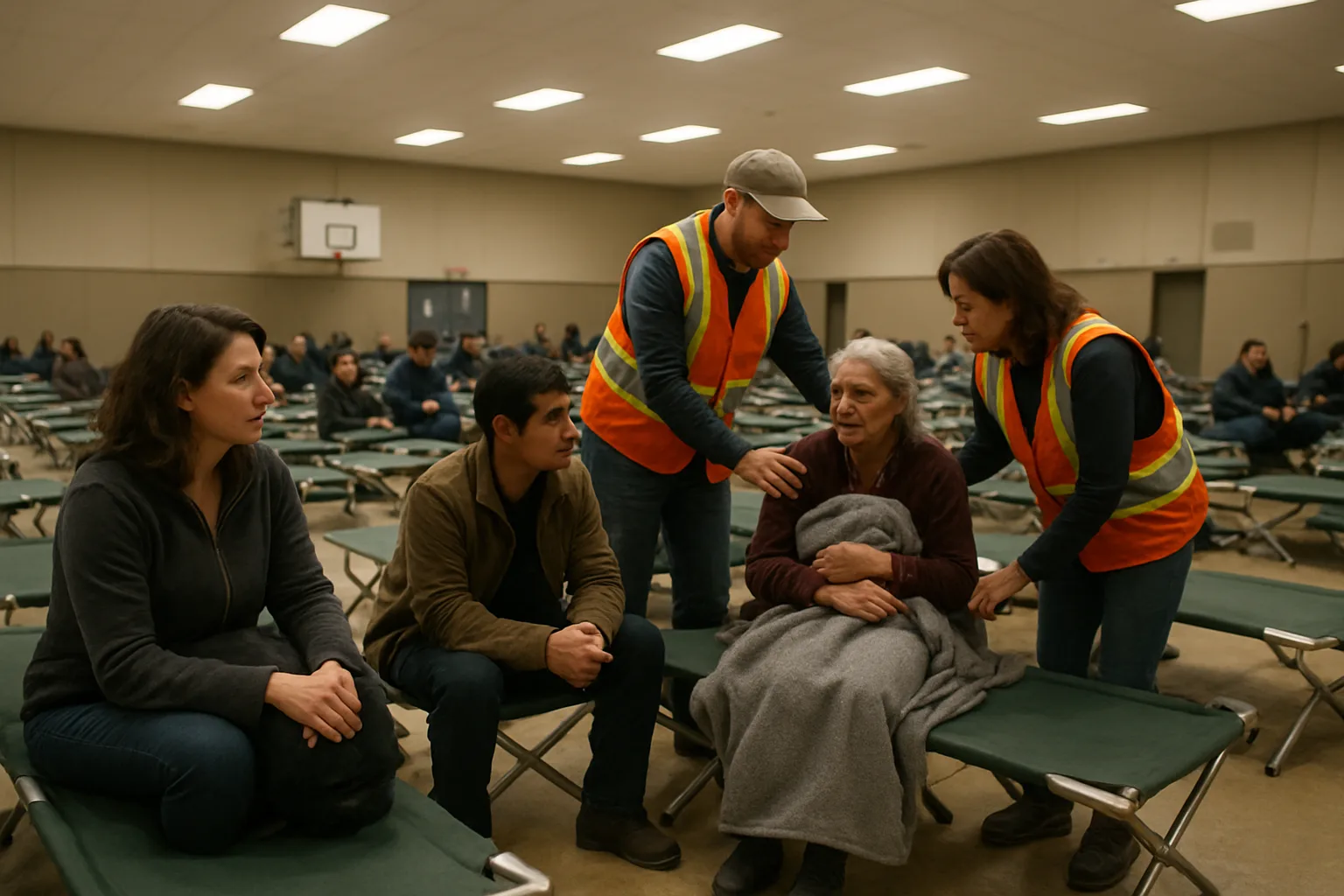
Evacuation centers are now grappling with the human side of this disaster. Housing 22,000 displaced people isn’t just a matter of floor space. It means finding cots, blankets, food, and psychological support for residents who have watched their skies turn black and their neighborhoods disappear in the rearview mirror.
Meanwhile, about 10,000 others sit in a kind of suspended limbo under evacuation alerts, bags half-packed, vehicles fueled, waiting to see if their street will be next. Even if their homes ultimately survive, the mental toll of that waiting period is enormous.
Firefighting on the edge of what’s possible
What’s happening in British Columbia also highlights a hard truth for emergency services: there is a limit to what even the most dedicated firefighters can do when weather and fuel conditions align against them.
With 102 active BC wildfires burning at once, incident commanders are forced into brutal triage. They have to decide which fires to hit hardest, which communities to prioritize, and where to pull back because conditions are simply too dangerous for crews. A fast-growing, high-intensity fire like Bald Range can quickly outrun bulldozers, engines, and hand crews, especially when visibility drops and winds begin to swirl.
Helicopters and aircraft — dramatic and highly visible — are only one part of the response. Thick smoke can ground them or make drops far less effective. Turbulence over a large fire can turn a flight into a risky gamble. And even the best aerial attack can’t hold a line if winds shift and embers jump containment.
The breakneck pace of the current fires is also exhausting crews. When nights no longer offer relief, firefighters lose their natural window to rest and reset. Resources coming from other provinces or the federal government can help, but the core problem remains: the fires are moving faster than the systems built to contain them.
What this tells us about Canada’s new normal
British Columbia has been here before, but the scale and speed of this year’s crisis offer a stark preview of what many experts say will become increasingly common across Canada. More fires starting in a shorter time. More communities under threat. More evacuations that play out in the dead of night.
Federal assistance is critical for the thousands who are now living out of suitcases, but it’s also a reminder that response alone isn’t enough. Canada is already paying the price of a warming climate in overtime hours for firefighters, disaster relief funds, and lost homes and livelihoods.
For residents in Summerland, Peachland, and the wider Okanagan region, that debate may feel abstract. Their reality is smoke in their lungs, phone calls to insurance companies, and kids asking when they can go home — or if there will be a home to return to at all.
Yet even as this emergency unfolds, it’s also quietly rewriting the country’s risk map. Places that once saw fire as a distant threat are now living with go-bags by the door and evacuation routes memorized. That’s the definition of a new normal.
What This Means
The BC wildfires burning right now are a climate story, a public safety story, and a political story all at once. The immediate priority is clear: keep people alive, support evacuees, and give firefighters every possible tool to hold the line where they can.
But as the Bald Range fire and dozens of other blazes continue to test the limits of Canada’s emergency systems, the bigger question is how long the country will treat each of these seasons as an aberration instead of a baseline. Federal intervention can cushion the blow for communities fleeing this week. It can’t stop the next “out of control” fire from lighting up the map unless it’s paired with serious, long-term action on climate, land management, and how — and where — we build.
Photo: BC Gov Photos / BY-NC-ND via Openverse