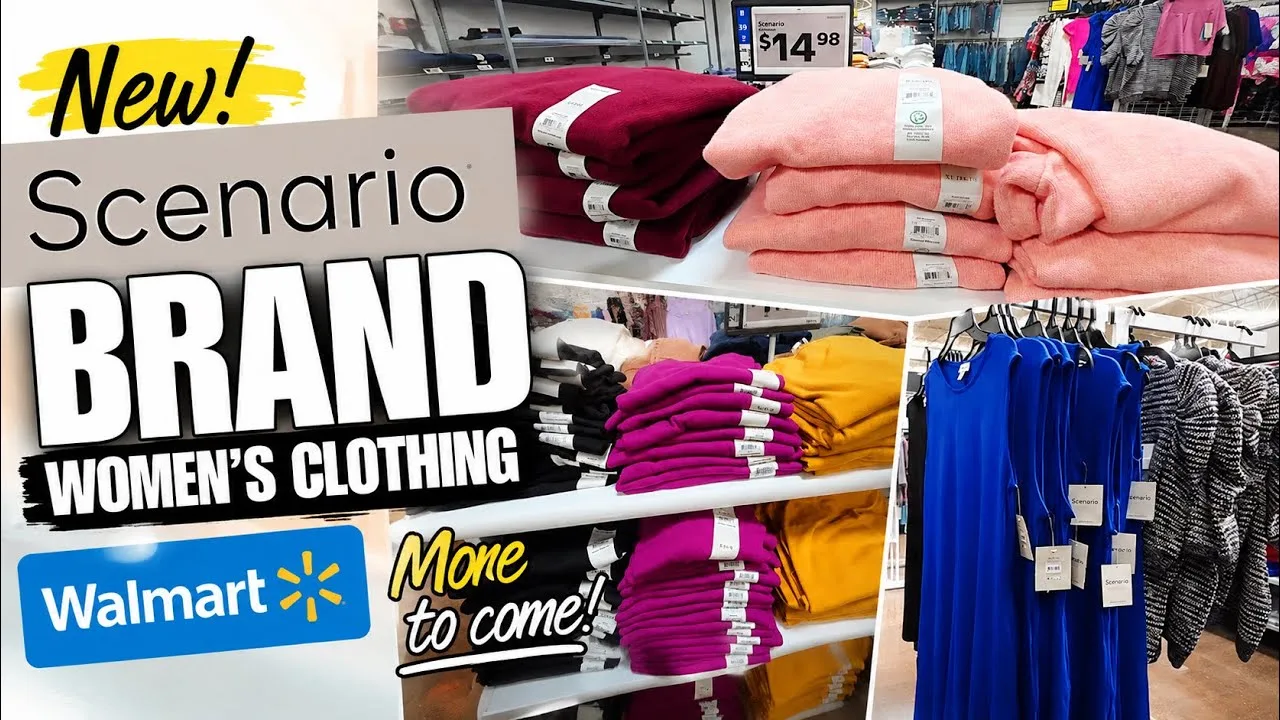
Walmart just slipped a new clothing brand onto its racks without so much as a press conference, and it might be the most telling apparel move the company has made in years. The line is called Scenario, and if you’ve wandered through the women’s section at your local store recently, there’s a decent chance you’ve already walked past it without realizing you were looking at Walmart’s latest bet on becoming a place people actually want to shop for clothes.
What Scenario Actually Is
Scenario is a women’s fashion label built around what shoppers and early coverage keep describing as “elevated basics” — the kind of wardrobe staples that lean toward Anthropologie or Madewell in look and feel, minus anything close to those price tags. Think waffle-knit henleys, chunky sweater vests, puff-sleeve tops, woven hobo bags, and knit clogs, all wrapped in a muted, fall-forward color palette.
The brand covers more ground than a typical apparel drop, too. Alongside clothing, Scenario includes:
- Footwear, including clogs and boots
- Handbags and accessories like scarves and gloves
- Jewelry, including layered chain necklaces
- Seasonal outerwear pieces
Pricing lands squarely in Walmart’s comfort zone, even if the styling doesn’t always read that way at first glance.
| Item Type | Example Price |
|---|---|
| Printed square scarf | $6.97 |
| Knit gloves | $5.97 |
| Sweater vest | $22.97 |
| Fringe shawl | $22.97 |
| Faux suede fedora | $17.97 |
| Knot clogs | $26.98 |
| Woven hobo bag | $39.96 |
That spread puts Scenario in roughly the same lane as Walmart’s other in-house labels, but the finishing and silhouettes are getting noticeably more attention from shoppers who admit they weren’t expecting to be impressed.
The Rollout Has Been Deliberately Quiet
Here’s the odd part: Walmart hasn’t made a big splashy announcement about Scenario the way it has for some of its other brand launches. It’s shown up gradually — first spotted in physical stores, then trickling online in limited quantities. Several bloggers and shoppers describe it as something they simply stumbled across while browsing, rather than something Walmart pushed out with a marketing campaign.
That quiet approach isn’t unusual for Walmart when it’s testing a new concept before committing fully. Give it a soft launch, watch how the assortment performs in real stores, then scale it up once the data backs the bet.
Why Walmart Keeps Doing This
Scenario isn’t a one-off. It’s the latest entry in a fashion buildout that’s been running for the better part of a decade, driven largely by Denise Incandela, Walmart U.S.’s EVP of Fashion. Incandela came from twenty years in the luxury and specialty retail world — stints at Saks Fifth Avenue and Ralph Lauren — before taking a chance on Walmart, and her fingerprints are all over what’s happened since.
Since 2020, Walmart has launched or relaunched roughly ten private apparel brands, including Free Assembly, Scoop, No Boundaries, Sofía Jeans by Sofía Vergara, and the tween-focused Weekend Academy. It brought in Brandon Maxwell, a Project Runway judge with a real design résumé, as creative director for two of its labels. It debuted a ready-to-wear collection at New York Fashion Week, a first for the company. It’s even dabbled in celebrity partnerships, including a clothing line tied to Millie Bobby Brown that landed in hundreds of stores, and a limited collaboration built around The Devil Wears Prada.
None of this is happening for nostalgia’s sake. Walmart’s former CEO once admitted publicly that the company had underperformed in apparel “maybe forever,” and that admission seems to have lit a fire under the fashion division. During its most recent earnings call, fashion was singled out as a genuine bright spot, helping carry general merchandise growth at a time when other categories were sluggish. A meaningful chunk of that growth is coming from households earning six figures — not exactly Walmart’s traditional customer base, and exactly the kind of shopper a brand like Scenario seems designed to win over.
Is Scenario Replacing Time and Tru?
This is the question circulating the most among Walmart shoppers right now, and the honest answer is: nobody outside the company knows for certain yet. Time and Tru has been Walmart’s flagship women’s apparel brand since 2018, and its shelf space is exactly where Scenario keeps popping up. Several YouTube shoppers and deal bloggers have floated the theory that Scenario is a soft replacement rather than a standalone addition, but Walmart hasn’t confirmed or denied it either way.
Given how the company has handled brand transitions before — the ground-up refresh of No Boundaries in 2024 is a good template — a slow, unannounced handoff wouldn’t be out of character. Walmart tends to let sales data decide before it makes any public statement.
How Shoppers Are Responding
Reaction so far skews enthusiastic, with a side of frustration over availability. Deal-hunting bloggers have compared pieces favorably to considerably pricier brands, and more than one has noted their favorite items sold out within days, both online and in physical stores. The complaints that do exist are mostly about inconsistency — some pieces show up in stores but never make it to the website, and vice versa, which tracks with a brand still finding its footing during an early rollout.
What This Means
Scenario by itself isn’t a seismic event. It’s one more private label in a portfolio that already includes a dozen others, at price points Walmart has been working for years. But it’s a useful data point for anyone tracking where the retail giant is headed. Walmart isn’t trying to be the discount clothing aisle anymore — it’s actively courting shoppers who’d normally default to Old Navy, Anthropologie, or Amazon for their basics, and it’s willing to test new brand names quietly rather than force a splashy relaunch that might flop in public.
If Scenario keeps performing the way early sales suggest, don’t be surprised if it either absorbs Time and Tru outright or becomes the brand Walmart leans on to chase the exact demographic it’s been courting since Incandela walked through the door: fashion-conscious shoppers who didn’t think Walmart was for them. The company has already proven with No Boundaries and Free Assembly that a name change plus real design investment can move the needle. Scenario looks like the next test of that formula, and so far, it’s passing.