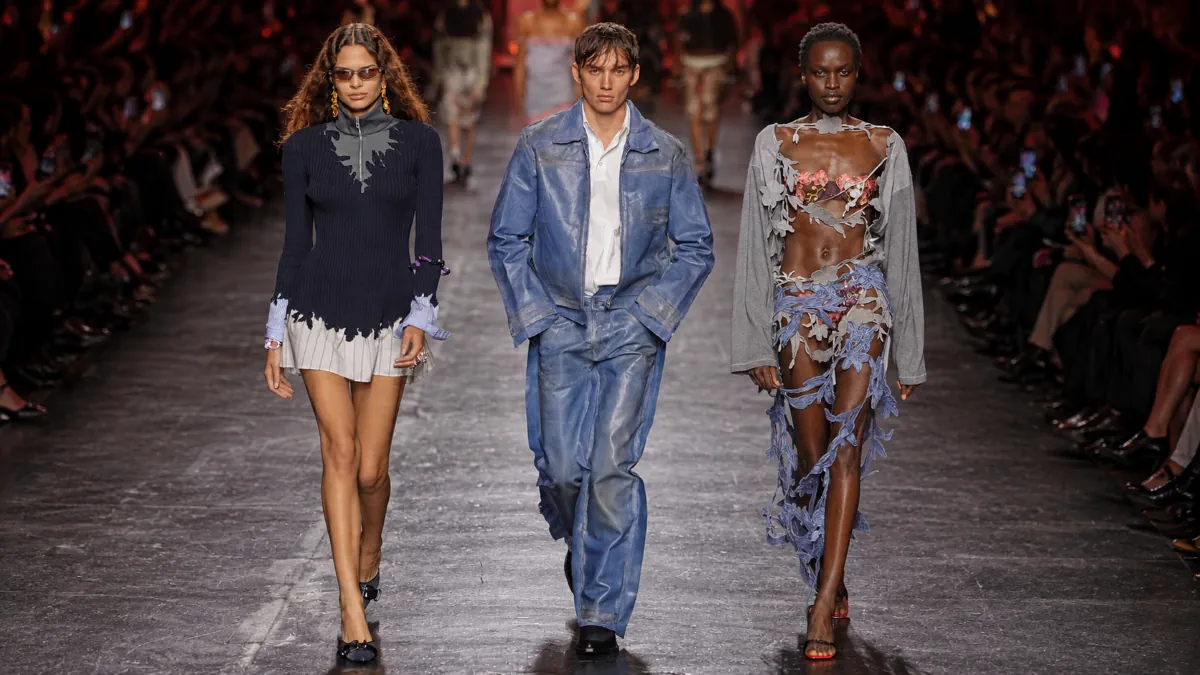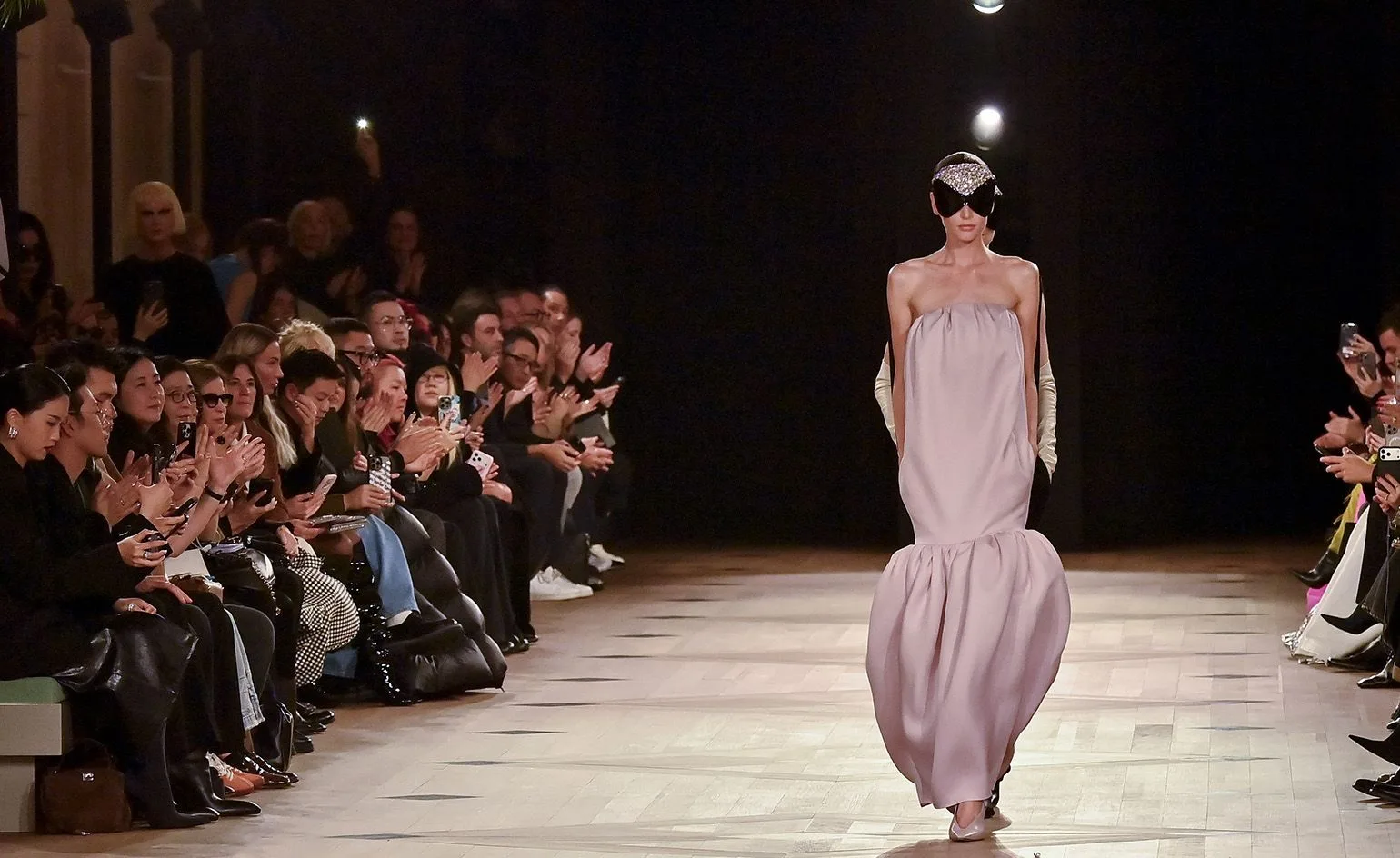
Pierpaolo Piccioli’s second outing at Balenciaga just answered the question everyone was quietly asking after his debut: was that a one-off reinvention, or the start of an actual direction for the house? Spring 2027 makes the case firmly for the latter, taking the everyday wardrobe staples people already own and running them through a couture-level construction process most designers reserve for red carpet gowns.
Couture Logic Applied to Your Closet
The entire collection is built on a deceptively simple premise: take the most ordinary garments imaginable — a white button-down, a plain T-shirt — and rebuild them using the exacting tailoring and draping techniques typically reserved for one-of-a-kind couture pieces. The result is clothing that reads as familiar from across the room and reveals itself as something far more considered up close, with exaggerated proportions and sculptural volumes that transform basics into statement pieces without losing the essential shape everyone recognizes.
This isn’t a new idea in fashion generally, but it’s a notably different register for Balenciaga, a house whose recent history has swung between shock-value streetwear and avant-garde silhouette experimentation. Piccioli’s version feels less interested in shocking anyone and more interested in proving that extraordinary craftsmanship doesn’t require extraordinary garments to showcase it.
The Showstopper Everyone’s Talking About
The single piece drawing the most attention from the collection is a draped T-shirt, rendered in a soft light pink, that transforms into a full evening gown complete with a dramatic, flowing train. It’s the kind of garment that encapsulates the entire collection’s thesis in one look: the most casual piece in anyone’s closet, elevated through pure construction technique into something you’d wear to a gala. That single transformation — Hanes to haute couture, essentially — is doing a lot of work to establish exactly what a Piccioli-era Balenciaga is trying to say.
Going Back to Cristóbal’s First Principles
Piccioli has been explicit about drawing from founder Cristóbal Balenciaga’s original design philosophy, which treated the human body as the actual foundation of every garment rather than a mannequin to be obscured or exaggerated for shock value. That’s a meaningful departure from some of the house’s more recent aesthetic eras, and it shows up throughout the collection in pieces built around fluid, organic forms rather than rigid structure. Hand-draped leather and cotton pieces throughout the show emphasized movement and body-consciousness over the harder, more architectural silhouettes some might have expected from a Balenciaga collection.
Why This Approach Is a Risk
Returning to a founder’s original philosophy sounds safe on paper, but it’s actually a bold bet in practice. Balenciaga built a huge chunk of its recent cultural relevance on being provocative and internet-meme-worthy — oversized silhouettes, deliberately ugly-chic pieces, collaborations designed to generate double-takes. Piccioli’s quieter, craft-first approach trades viral shock value for something harder to market in a thirty-second video: genuine technical mastery that rewards close attention rather than a scroll-stopping first glance.
The Accessories Doing the Commercial Heavy Lifting
No fashion house survives on ready-to-wear runway pieces alone, and Piccioli clearly understands that bags are where the real revenue lives. The collection introduced two new silhouettes: the Nodo, a knotted tote arriving in both soft leather and silk, and the Silhou Tote, positioned alongside heritage pieces like the brand’s enduring City bag.
The Nodo in particular is being rolled out across an unusually wide color range for a debut-season bag — lilac, periwinkle, burgundy, white, and black, plus neon mini versions aimed squarely at a younger, trend-driven customer. That spread suggests Balenciaga is thinking carefully about hitting multiple price points and style preferences with a single new silhouette, maximizing the odds that at least one version becomes the “it” bag photographed outside fashion week shows for the next year.
What Made the Front Row and Reviews Notice
- The color palette throughout the collection drew consistent praise, striking a balance between wearable neutrals and the kind of statement shades that photograph well.
- The new bag silhouettes were singled out repeatedly as the collection’s most immediately covetable, commercially-minded pieces.
- Some observers noted overlap with design language from other luxury houses currently exploring similarly fluid, body-conscious silhouettes, suggesting Piccioli’s vision, however personal, is also riding a broader industry-wide moment rather than existing in total isolation.
Second Collections Are Where Directions Get Proven
Debut collections at a new house always get graded on a curve — critics and buyers alike are watching for signs of direction rather than full execution. A second collection is a different test entirely. It’s where you find out whether a designer’s opening statement was a genuine point of view or a one-time flourish built for maximum press attention. Piccioli’s sophomore Balenciaga outing reads as confirmation that the restraint and craft-first philosophy from his debut wasn’t a fluke — it’s the actual plan, reinforced and expanded with a stronger commercial backbone in the form of new bag silhouettes built to sell well beyond the runway.
What This Means
Balenciaga under Piccioli is shaping up to be a genuinely different house than the one that spent the last several years defined by viral shock pieces and internet discourse. Spring 2027 doubles down on craftsmanship over spectacle, betting that customers and critics alike are ready for a Balenciaga that impresses through technique rather than through its capacity to generate a reaction online. Whether that bet pays off commercially will depend heavily on how those new bags perform once they hit boutiques, but creatively, the message from this collection is unambiguous: Piccioli isn’t passing through Balenciaga. He’s building something meant to last.