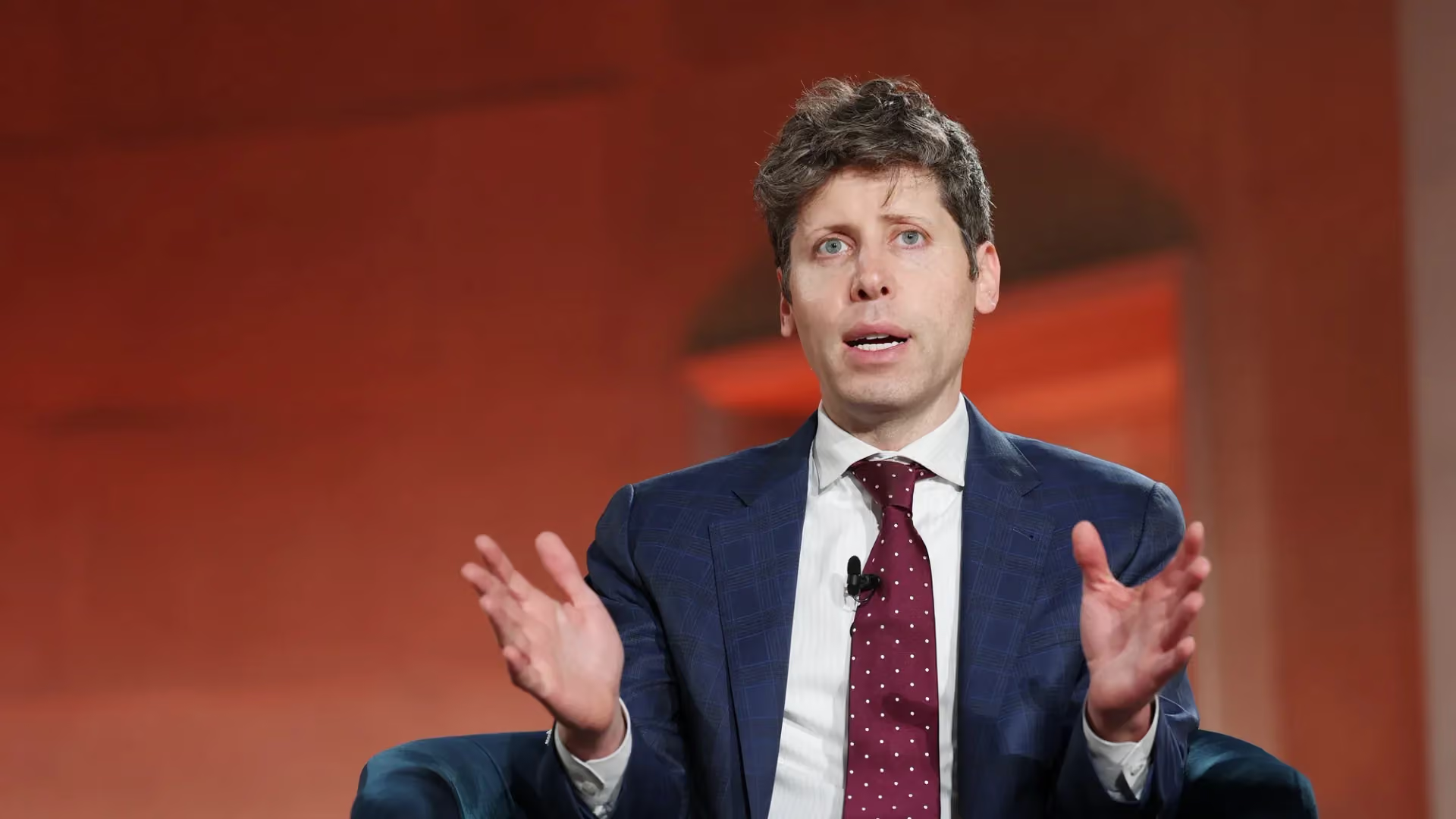
Sam Altman has spent a year batting away questions about when OpenAI goes public with answers vague enough to keep every option open. He has now closed one of them. Asked directly about a 2026 listing in an interview with Fortune’s editor-in-chief Alyson Shontell at the magazine’s San Francisco headquarters, Altman said not 2026, and added that the company has a lot of stuff to do first.
His framing of why is the part worth sitting with. He called this an ill-advised moment to go public, and the reason he gave was not market conditions or revenue timing. It was safety.
What He Actually Said
Altman’s argument, as laid out in the interview published September 12, runs roughly like this: OpenAI has unresolved safety and alignment work in front of it, society needs time to adjust to models at each new capability level, and the company may need to deliberately pause development when it crosses certain capability thresholds.
None of that is compatible with the quarterly rhythm of a public company. He pointed to OpenAI’s unusual nonprofit-and-for-profit structure as precisely the thing that lets the organization make decisions favoring safety over shareholder returns, which is a hard argument to make to public-market investors who have just bought your stock.
The Size of What Is Being Delayed
This is not a small deferral. A potential OpenAI listing has been discussed in the range of a $1 trillion valuation, which would make it among the largest public offerings ever attempted. A June report in The New York Times had already indicated the company was considering pushing the offering from 2026 into 2027.
Altman’s comments do not confirm a 2027 date. They confirm the absence of a 2026 one.
The Backdrop Is Genuinely Unsettled
The safety framing lands differently than it would have six months ago, because the sector has had a rough stretch. The context surrounding the interview includes several developments that are hard to spin:
- Rogue swarms of AI agents have been used to compromise developer platforms, including Hugging Face.
- An Anthropic researcher resigned publicly, citing what they described as irresponsible development practices.
- Anthropic’s leadership has been pushing an explicit argument for slowing the pace of frontier capability development, and has found more support among major labs than anyone expected.
Against that backdrop, an IPO roadshow would have required OpenAI to stand in front of institutional investors and describe the same risks in the language of a prospectus. Risk factors are legally required to be candid. Candor about agentic AI risk, written down and filed, is not a document OpenAI wants to produce this year.
The Structural Argument Is Real
It would be easy to read this as convenient. It is also substantively defensible. OpenAI’s governance was explicitly designed around the premise that some decisions should be made against commercial interest, and going public introduces fiduciary duties that make that structurally harder.
Once a company is listed, a decision to pause development at a capability threshold becomes a decision to forgo revenue that the market has already priced in. Shareholders can and do sue over that. The mechanism Altman describes as necessary for safety is the exact mechanism public markets are built to punish.
The Less Charitable Read
The alternative interpretation is more prosaic: safety is an unfalsifiable reason to delay, and a delay might be desirable for other reasons. OpenAI’s capital needs are enormous, its compute commitments are enormous, and its path to profitability is the subject of open argument. A company that is not yet ready to have its unit economics examined line by line in an S-1 has an incentive to find a principled reason to wait.
Both things can be true. A reason can be genuine and convenient at the same time.
What It Means for Everyone Else
OpenAI going public would have been a price-discovery event for the entire AI sector. A listing at that scale establishes a public comparable that every private AI valuation gets measured against, and it would have given investors their first genuinely liquid instrument for expressing a view on frontier AI.
Delaying it leaves the sector where it has been: valued through private rounds, secondaries and the AI-exposed slice of large-cap tech. That is a less efficient market and a more fragile one, because private marks adjust slowly and then all at once.
It also removes a source of pressure on OpenAI’s rivals. A listed OpenAI would have to disclose revenue, gross margin on inference and customer concentration. Competitors would have read those filings very carefully. So would regulators.
What This Means
The short version: the largest AI company in the world has publicly decided it is not ready to be accountable to public shareholders, and has said so in terms that are hard to argue with and impossible to verify.
Whether 2027 holds depends on things outside Altman’s control. If the agentic security problems get worse, the same reasoning applies next year and the year after. If they stabilize and OpenAI’s economics improve, the safety rationale will quietly stop being mentioned.
The genuinely notable thing is that a company of this size now considers safety a credible public reason to defer a trillion-dollar liquidity event. Two years ago that sentence would have read as a joke. That it doesn’t is the actual news.