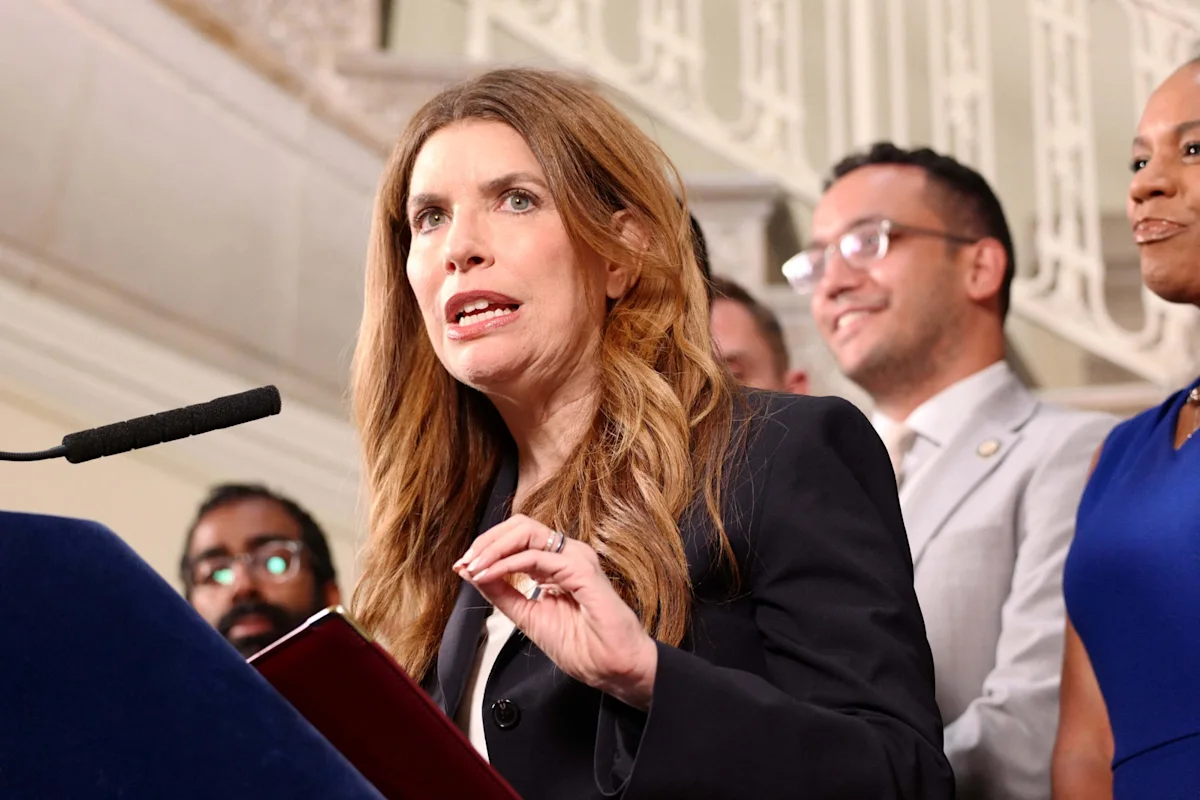
New York City just put every major AI company on notice. On Friday, September 25, 2026, City Council Speaker Julie Menin rolled out a package of roughly ten bills that would force AI systems operating in the five boroughs to submit to independent safety audits, carry a mandatory human override, and expose companies to fines that could balloon into the millions depending on how many AI agents are involved in a single incident. It’s one of the most aggressive municipal AI safety pushes in the country, and it lands at a moment when Washington still hasn’t passed anything resembling a federal AI safety law.
Menin, a regulatory attorney who previously ran the city’s Department of Consumer and Worker Protection, is framing the package as a response to a regulatory vacuum. With no comprehensive federal rulebook for AI, cities and states have increasingly been left to write their own, and New York — home to a growing cluster of AI company offices — is now trying to set the terms before something goes wrong on its own turf.
What’s Actually in the Bill Package
The legislation touches nearly every stage of how an AI system gets built, sold, deployed, and monitored inside city limits. Here’s the core of it:
- Mandatory third-party validation: Any AI system sold or deployed in NYC would need to pass independent checks covering data quality, bias, privacy, and security, conducted by validators that meet standards set by the city’s Office of Cyber Command.
- A required kill switch: Every covered AI system must include a human override function capable of shutting it down.
- A whistleblower bounty program: Employees who flag violations could receive a cut of any fines the city recovers — reportedly the first program of its kind at any level of government in the U.S.
- A private right to sue: City residents could take AI companies to court over harm caused by third parties who bypass an AI system’s safety controls, provided the harm was foreseeable and the company’s safeguards were inadequate.
- 24-hour incident reporting: City contractors using AI would have to report safety incidents to the city within a day of discovering them.
- A ban on misleading safety claims: Companies could no longer make false or deceptive statements about how safe their AI systems actually are.
- Retaliation protections: City workers and contractors who report AI-related threats or safety problems would be legally shielded from retaliation.
Menin has also flagged additional bills still in the works, including ones targeting deceptive AI deepfakes and a formal study of how AI is reshaping the city’s job market. Those haven’t been fully detailed yet, but they signal the Council isn’t treating this as a one-and-done package.
The Penalty Structure Has a Nasty Multiplier
On paper, the fines look manageable: $25,000 per violation. But Menin added a detail that changes the math considerably. Asked about how the penalty would apply to autonomous AI agents acting on a company’s behalf, she said plainly that “if there’s a swarm of agents, the penalty would apply per agent.” In practice, that means a single incident involving a fleet of AI agents — the kind of multi-agent systems companies are increasingly deploying for everything from customer service to code generation — could trigger dozens or hundreds of individual $25,000 fines instead of one. For a company running large-scale agentic systems in the city, that’s the difference between a rounding error and a genuinely painful bill.
Why These Five Companies, Specifically
The Council has invited five companies to testify: OpenAI, Anthropic, Google, Meta, and Elon Musk’s SpaceX and xAI. The common thread isn’t just AI relevance — it’s real estate. Each of these companies has built up a substantial physical footprint in New York:
- Google employs more than 14,000 people in the city.
- Meta leases 1.2 million square feet of office space.
- Anthropic has leased a 16-story office building.
- OpenAI occupies roughly 90,000 square feet inside the historic Puck Building.
That physical presence matters for jurisdiction and leverage — these aren’t companies operating at arm’s length from the city, they’re tenants, employers, and, increasingly, the subject of local zoning and workforce conversations. It gives the Council a much more direct hook than it would have with a company that has no offices or staff in New York at all.
A Hearing the Council Hasn’t Held Since 2022
The bills are headed to a Committee of the Whole hearing on October 5, 2026 — meaning the full City Council, not a subcommittee, will take it up directly. That format hasn’t been used for a hearing like this since 2022, which tells you how much weight city leadership is putting behind this effort. It’s not being treated as a niche tech policy matter; it’s being elevated to the kind of issue that gets the whole chamber in the room.
Whether the actual CEOs show up is another question. As of now, it’s considered unlikely that the chief executives of any of the five companies will testify in person, though other representatives may appear on their behalf. None of the companies had responded to press inquiries by the time this story published. If they decide not to send anyone at all, the Council has said it retains subpoena power — a reminder that this isn’t a polite invitation so much as the opening move in a negotiation.
The Irony Sitting in the Middle of All This
There’s a tension running underneath the whole announcement that’s hard to ignore. New York has spent the last couple of years marketing itself as the aspiring “AI capital of the world,” courting exactly the kind of company footprint that Google, Meta, Anthropic, and OpenAI now represent. At the same time, the city is now drafting some of the toughest municipal AI safety rules anywhere in the country. Those two ambitions aren’t necessarily incompatible, but they do create an odd dynamic: the same companies the city wants to keep attracting are the ones now facing kill-switch mandates, per-agent fines, and whistleblower bounties. How that plays out will say a lot about whether “AI capital” and “AI accountability leader” can coexist as a single civic brand, or whether one starts to crowd out the other.
What This Means
This package is a serious attempt to regulate AI at a scale that federal lawmakers haven’t managed, and it’s coming from a city with enough leverage — office leases, employee headcounts, and a genuine talent market — to make companies pay attention. The kill switch and third-party validation requirements would set a real operational bar, not just a paperwork exercise, and the per-agent fine structure could turn routine multi-agent deployments into a significant financial risk if something goes wrong. The whistleblower bounty program in particular stands out; giving employees a financial stake in flagging violations tends to surface problems that self-reporting requirements alone never catch.
The open question is enforcement. Subpoena power sounds tough on paper, but getting five of the most valuable companies in the world to actually restructure how they deploy AI in one city is a different challenge than passing the bills themselves. October 5 will be the first real test of whether these companies engage seriously or try to run out the clock. Either way, New York has staked out a position, and other cities watching a stalled Washington will be paying close attention to what happens next.