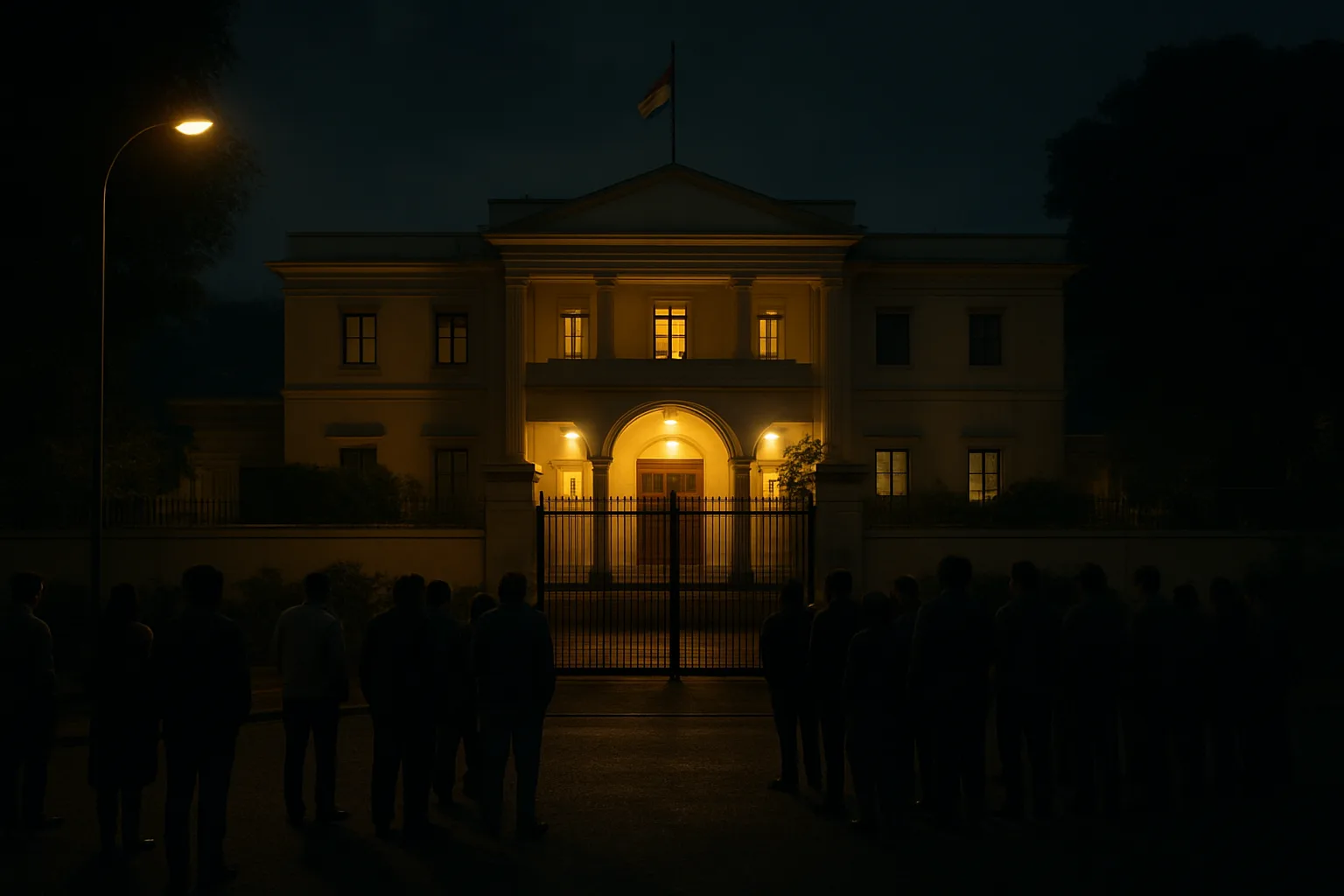
TMC MP Mahua Moitra’s account of being asked to vacate a government circuit house close to 10 pm, while a crowd shouted slogans outside, has turned into a test case for how India treats its women parliamentarians. Her letter to Lok Sabha Speaker Om Birla doesn’t just challenge a bureaucratic order — it asks whether women in politics can rely on the state for basic safety and dignity.
The incident, centred on Moitra’s Krishnanagar constituency in West Bengal’s Nadia district, has quickly escalated into a wider political fight, with Opposition MPs rallying behind her and framing the late-night eviction as a symbol of a deeper problem: the vulnerability of elected women leaders in a climate of street-level intimidation.
Mahua Moitra’s allegation: ‘Asked to leave at 9.47 pm’
The flashpoint began on Friday night when Mahua Moitra checked into the state-owned circuit house in Krishnanagar, a facility she says she is entitled to use as an elected MP. She reached the property around 6:15 pm. Hours later, she says, the accommodation was abruptly taken away.
According to Moitra, at 9:47 pm the additional district magistrate of Nadia called to tell her she needed to vacate the premises. At 10:52 pm, she received a WhatsApp message carrying an official “order” claiming that existing reservations could not be honoured due to “annual cleaning”.
Outside the gates, a crowd had already formed. Moitra has alleged that the group demanded she leave and shouted “Jai Shree Ram” slogans after she refused. She was staying alone inside the circuit house.
In her letter to Speaker Om Birla, Moitra called the sequence of events a direct attack on the rights and safety of a woman MP. A sitting member of Parliament, she argued, should not be asked to abandon her allotted government accommodation late at night under pressure of a hostile crowd gathering outside.
Letter to the Speaker: safety, dignity and women MPs
The focus keyword in this political storm is simple: Mahua Moitra letter to Speaker. In that letter, Moitra urges Om Birla to treat her case as a benchmark for how Parliament protects its women members.
“A woman MP, staying alone, being asked to vacate her rightful accommodation at 9.47 pm not only gravely violates her rights, but brings into question the safety and security accorded to women by the ruling dispensation,” she wrote.
The core of her argument stretches beyond one guest house booking. Moitra links the incident to the broader promise of increasing women’s representation through a proposed women’s reservation bill, pointing out that such initiatives ring hollow if the existing cohort of women MPs — she cites 74 — cannot rely on institutional protection.
She has asked the Speaker to “urgently” look into the matter and “set an example” that upholds the dignity of women parliamentarians across the country. In other words, she’s pushing for a formal recognition that personal safety, official protocol and parliamentary privilege are tightly bound together.
Taking it global: appeal to the Inter-Parliamentary Union
Moitra hasn’t kept the dispute confined to New Delhi’s power corridors. She also reached out to the Inter-Parliamentary Union (IPU), a global body that tracks and advocates for the rights and roles of legislators worldwide.
On X, she described herself as “a sitting woman MP in India” who was asked by the government to vacate her room in an official guest house at 21:47 hours and then again at 22:52 hours, “while a BJP crowd is baying for my blood outside the gates”. She tagged the IPU and framed the episode as a snapshot of “the state of democracy in India on Independence Day”.
That international framing does two things. It places the Mahua Moitra letter to Speaker inside a global conversation about women in politics, and it signals that she’s prepared to use multilateral forums to pressure domestic institutions when she feels parliamentary privilege and basic security are under threat.
Opposition closes ranks around Moitra
The fallout was swift. Opposition parties, already on edge over street-level confrontations and the treatment of their leaders, seized on Moitra’s account as evidence that political rivalry is curdling into intimidation.
TMC Rajya Sabha leader Derek O’Brien publicly asked, “What’s going on here in Bengal?”, framing the episode as something that demanded immediate answers. Samajwadi Party chief Akhilesh Yadav went a step further, calling on the Lok Sabha Speaker to clarify whether Moitra’s treatment amounted to a breach of parliamentary privilege.
From the Left, CPI(M) Rajya Sabha MP John Brittas condemned the late-night eviction order as “unacceptable and deplorable”. He highlighted the timing — nearly 10 pm, after dinner — and the presence of a slogan-shouting crowd outside the circuit house. Brittas also questioned how such actions could be squared with repeated political rhetoric about “respecting women” and invoking “Nari Shakti” from national platforms.
Across these responses, there’s a common thread: the view that what happened in Krishnanagar is less about lodging logistics and more about whether a sitting woman MP can count on the state to protect her when confronted by a hostile crowd.
Not an isolated flashpoint in Krishnanagar
The circuit house controversy is the latest in a series of tense confrontations Mahua Moitra says she has faced in her Krishnanagar constituency since the election. And it’s that pattern that makes her Mahua Moitra letter to Speaker land with even more weight.
On June 13, BJP Mahila Morcha workers gathered outside the Krishnanagar district court carrying eggs and tomatoes ahead of Moitra’s scheduled appearance in a case. She criticised the gathering and signalled plans to lodge a police complaint, arguing that political opposition should not bleed into threats of physical aggression.
Then, on July 1, she alleged that BJP workers hurled eggs, vegetables and stones at a TMC office in Nadia where she was present for a party meeting. Moitra livestreamed parts of that incident and accused the police of failing to control the situation.
Taken together, these episodes outline a climate in which one of the most high-profile women MPs in the state finds herself repeatedly navigating protests that blur the line between democratic dissent and personal intimidation.
Why women MPs say the rules aren’t enough
On paper, India has a thick layer of rules, protocols and privileges meant to shield MPs from harassment and ensure they can do their jobs. In practice, Moitra’s case raises uncomfortable questions about how those protections play out when gender, party rivalry and mob pressure collide.
For women MPs in particular, late-night eviction orders and angry crowds chanting outside official accommodations strike at a core insecurity: you may have a mandate from voters, but can you count on the administration to stand between you and a mob?
That’s the argument embedded in the Mahua Moitra letter to Speaker. By tying her own experience to the promise of a women’s reservation bill, she is effectively saying that representation numbers are meaningless if the state can’t guarantee the safety of those already elected.
There’s also a clear institutional test here. The Speaker’s office is expected to function as a non-partisan guarantor of MPs’ rights regardless of which party they belong to. How it responds — whether by seeking a report, issuing guidance, or letting the matter slide — will send a signal to every woman MP watching this unfold.
What This Means
This isn’t just a story about one night in a circuit house in Krishnanagar. It’s about whether India’s political system can protect dissenting voices — especially women — when the tension moves from Parliament’s microphones to the street outside their door.
Mahua Moitra’s late-night eviction allegation, and her decision to escalate it through a pointed letter to the Speaker and an appeal to the IPU, forces a blunt question: are women in public life expected to accept intimidation as part of the job, or will institutions step up when protocol, safety and politics collide?
For now, Opposition parties are treating the incident as a rallying point, and Moitra’s supporters are framing her stand as a litmus test for how seriously the system takes the dignity of women MPs. The next move belongs to the Speaker — and, by extension, to the institutions that claim to protect every member of Parliament, no matter how inconvenient their politics might be.