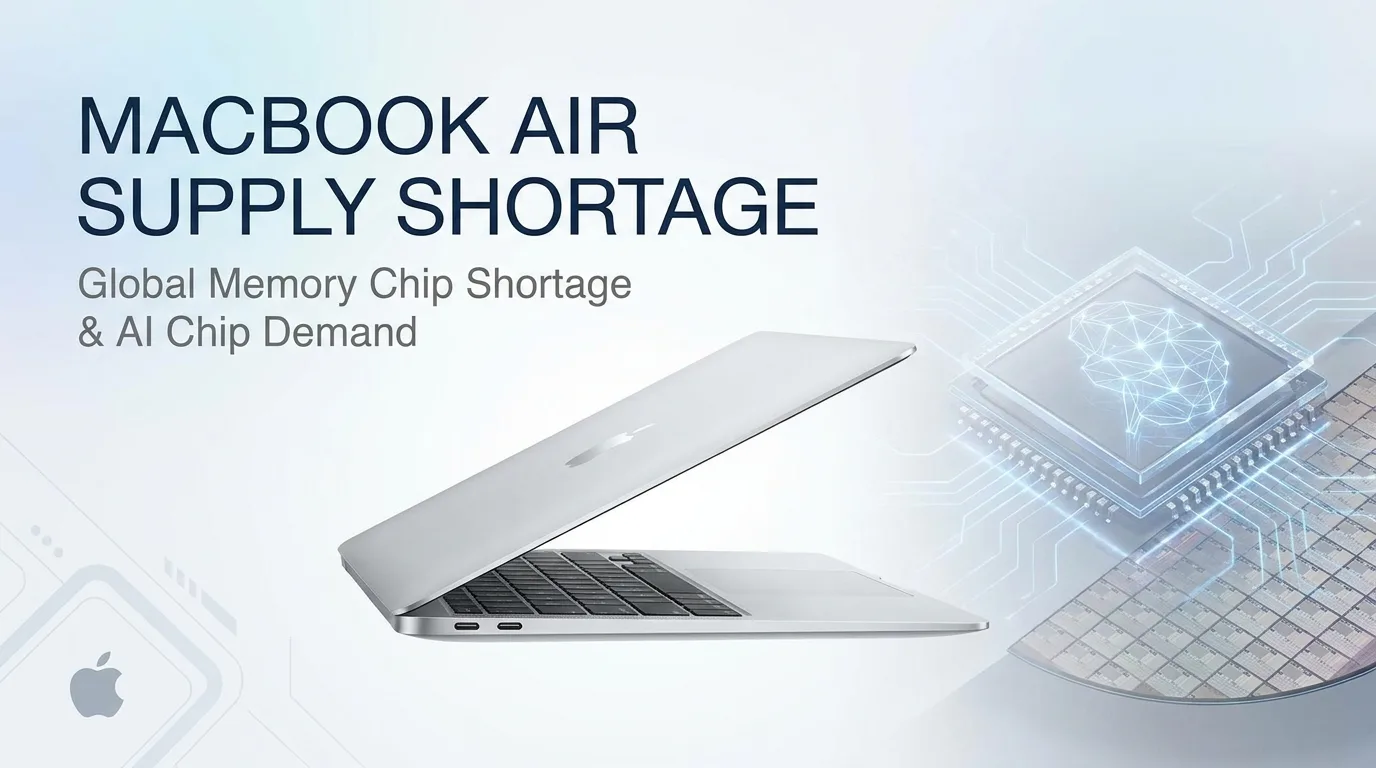
If you’ve tried to buy a MacBook Air this week and been told to wait until late August or even September, you’re not imagining things. Apple’s most popular laptop, a machine that’s usually sitting on store shelves and shipping within days, has quietly become one of the hardest computers to get your hands on. The culprit isn’t a design flaw or a components recall. It’s memory chips, and the shortage says a lot about where the entire tech industry is heading.
What’s Actually Happening
Order a MacBook Air from Apple’s online store right now and you’ll likely see delivery windows stretching two to six weeks out, with the longer waits attached to configurations that pack in extra RAM. Retail stores aren’t much better off. People with knowledge of Apple’s store inventory describe the current situation as tighter than anything they can remember for this particular laptop, and that’s saying something for a product that usually sits in steady, predictable supply.
This isn’t a case of Apple mismanaging one product line. The MacBook Air was refreshed with the M5 chip back in March, so it’s still very much a current-generation machine. Lengthy shortages this deep into a product’s life cycle just don’t happen under normal circumstances.
What makes this notable is that the shortage started somewhere else entirely. Earlier this year, it was the Mac mini and Mac Studio that saw stock disappear and delivery estimates balloon, since both machines can be configured with large amounts of unified memory that appeals to developers and AI hobbyists. Now the same pressure has spread to Apple’s highest-volume consumer product, which is a very different story.
Why Memory Chips Are the Real Culprit
The short version: the entire personal computing industry is fighting over the same pool of memory chips that data center operators now want for AI infrastructure.
Samsung, SK Hynix, and Micron run the fabrication plants that produce the bulk of the world’s DRAM. Over the past year or so, a growing share of their cleanroom capacity has shifted toward high-bandwidth memory, the specialized chips used in the accelerators powering AI training clusters. That memory commands far higher margins than the standard LPDDR and DDR5 chips that go into laptops, phones, and game consoles, so it’s an easy business decision for chipmakers to prioritize it.
The catch is that standard consumer memory doesn’t get made in a vacuum. Every wafer devoted to HBM is a wafer not going toward the RAM and storage chips that companies like Apple depend on. That’s the structural bottleneck now rippling through consumer electronics.
This Isn’t the 2020 Chip Shortage
It’s tempting to compare this to the supply chain chaos of 2020 and 2021, but the mechanics are different. That earlier shortage was mostly about logistics: shipping delays, factory shutdowns, and a scramble for automotive-grade chips. This one is structural. There’s no shipping container stuck at a port to blame. Consumer-grade memory is simply losing a bidding war to enterprise AI orders that pay more per wafer, and that dynamic isn’t going away quickly.
Apple isn’t the only company feeling it, either. Microsoft has already announced global price increases on Xbox consoles, adding $100 to $150 depending on storage tier, and pointed directly at the same memory and storage crunch. When a game console maker and a premium laptop maker are citing the identical root cause within weeks of each other, it’s a sign of an industry-wide squeeze rather than a company-specific problem.
Apple’s Price Hikes Tell Their Own Story
Apple has already adjusted pricing twice this year in ways that track closely with the memory crunch.
| Timing | Change | Notes |
|---|---|---|
| March 2026 | MacBook Air base price rose from $999 to $1,099 | Coincided with the M5 chip refresh |
| June 2026 | Base price rose again to $1,299 | Paired with a bump from 256GB to 512GB base storage |
| June 2026 | Broader price increases across roughly 14 products | Affected multiple Mac and iPad models |
Apple can point to the storage bump as partial justification for the second increase, and it’s a fair point. But a laptop that’s gone up several hundred dollars in a matter of months while still struggling to stay in stock tells you the price hikes weren’t enough to offset what’s happening on the component side.
How Apple Is Trying to Fix It
Apple’s response so far has come in a few different forms.
- It quietly delayed its usual back-to-school promotion, which normally runs in June.
- Marketing materials now include a notice that the MacBook Air is “subject to availability,” language Apple doesn’t typically attach to a laptop mid-cycle.
- Store staff and online merchandising have started nudging shoppers toward the entry-level 14-inch MacBook Pro instead, which may also help Apple preserve manufacturing capacity ahead of an expected chip refresh for that line later this fall.
- Apple has asked for permission to source memory from a Chinese supplier currently on a restricted list, specifically for units sold within China, in an effort to free up inventory from Samsung and Micron for markets elsewhere.
None of these are quick fixes. Diverting buyers toward a pricier laptop helps Apple’s margins in the short term, but it doesn’t solve the underlying memory shortage, and getting approval to work with a blacklisted supplier is not something that happens overnight.
Tim Cook has been fairly blunt about the scale of the problem too, telling investors on a recent earnings call that the supply chain pressure amounted to something like a “hundred-year flood.” That’s not the kind of language a CEO uses when he expects the issue to resolve itself in a quarter or two.
What This Means
If you’re shopping for a new MacBook Air right now, expect to wait, and expect to pay more than you would have a year ago. If you can be flexible on configuration, sticking with lower memory and storage tiers may get you a shorter delivery window, since the higher-spec builds appear to be facing the worst of the bottleneck.
The bigger picture matters more, though. This shortage isn’t really about Apple. It’s a preview of what happens when the AI boom starts competing directly with ordinary consumer electronics for the same raw materials. Laptops, game consoles, and eventually phones and tablets are all drawing from the same limited pool of memory chips that data centers now want more urgently and are willing to pay far more for. Switching brands won’t get you around this one, because the bottleneck sits upstream of any single manufacturer. Until memory production capacity catches up, or AI demand cools off, expect more of this: longer waits, higher prices, and companies quietly adjusting how they market products that used to be simple, in-stock purchases.