Apple is about to do something it has not done in nearly a decade: break its own iPhone launch calendar. The iPhone 18 series is not arriving as one neat autumn lineup. Instead, the expensive half shows up first, the affordable half waits until spring, and a foldable — possibly called iPhone Ultra — crashes the party as the most expensive iPhone ever made. With the launch event now believed to be weeks away, the leak pipeline has gone from a trickle to a flood: regulatory filings, a supplier ransomware breach, factory drop-test footage, and supply-chain chatter have filled in almost the entire picture. Here is everything credible we know so far.
The Biggest Change Is the Calendar, Not the Camera
Forget spec sheets for a second. The headline story of the iPhone 18 generation is that Apple is splitting the lineup in two. The iPhone 18 Pro, iPhone 18 Pro Max and the foldable iPhone are expected in September 2026, while the standard iPhone 18 and iPhone 18e slip all the way to spring 2027, with a second-generation iPhone Air possibly joining them.
The consequence is blunt: every new iPhone Apple introduces in September 2026 is likely to start at $999 or more. If you are the kind of buyer who has always picked the base model in the fall, there simply will not be one for you this year.
As for the date itself, Bloomberg’s Mark Gurman has pointed to September 8 as the most likely debut for the iPhone 18 Pro, iPhone 18 Pro Max and the foldable, with September 9 as the runner-up. Shipping is another matter. Nikkei reporting suggests the foldable’s manufacturing complexity and a global RAM shortage could push its actual on-sale date toward the end of the year.
iPhone 18 Pro and iPhone 18 Pro Max: Refinement Over Revolution
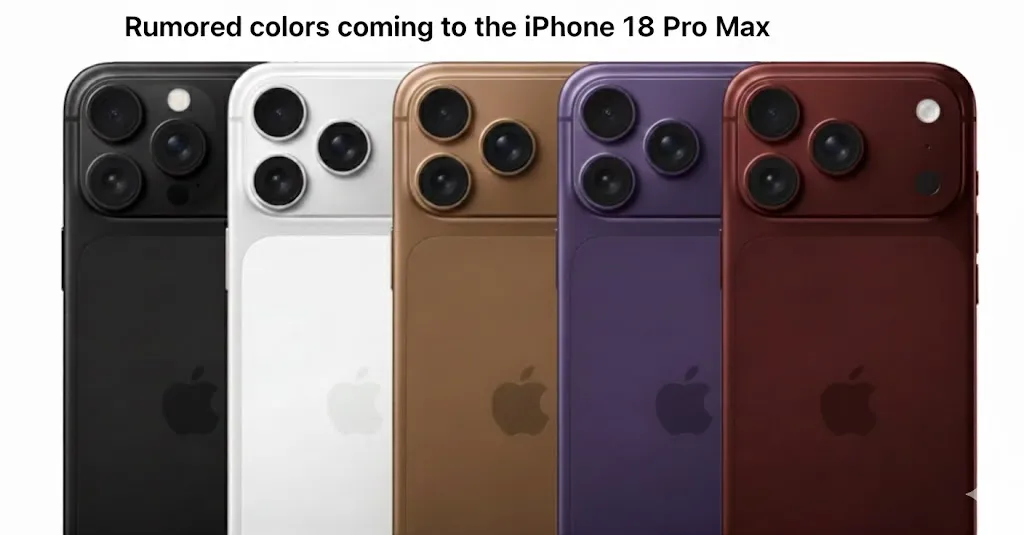
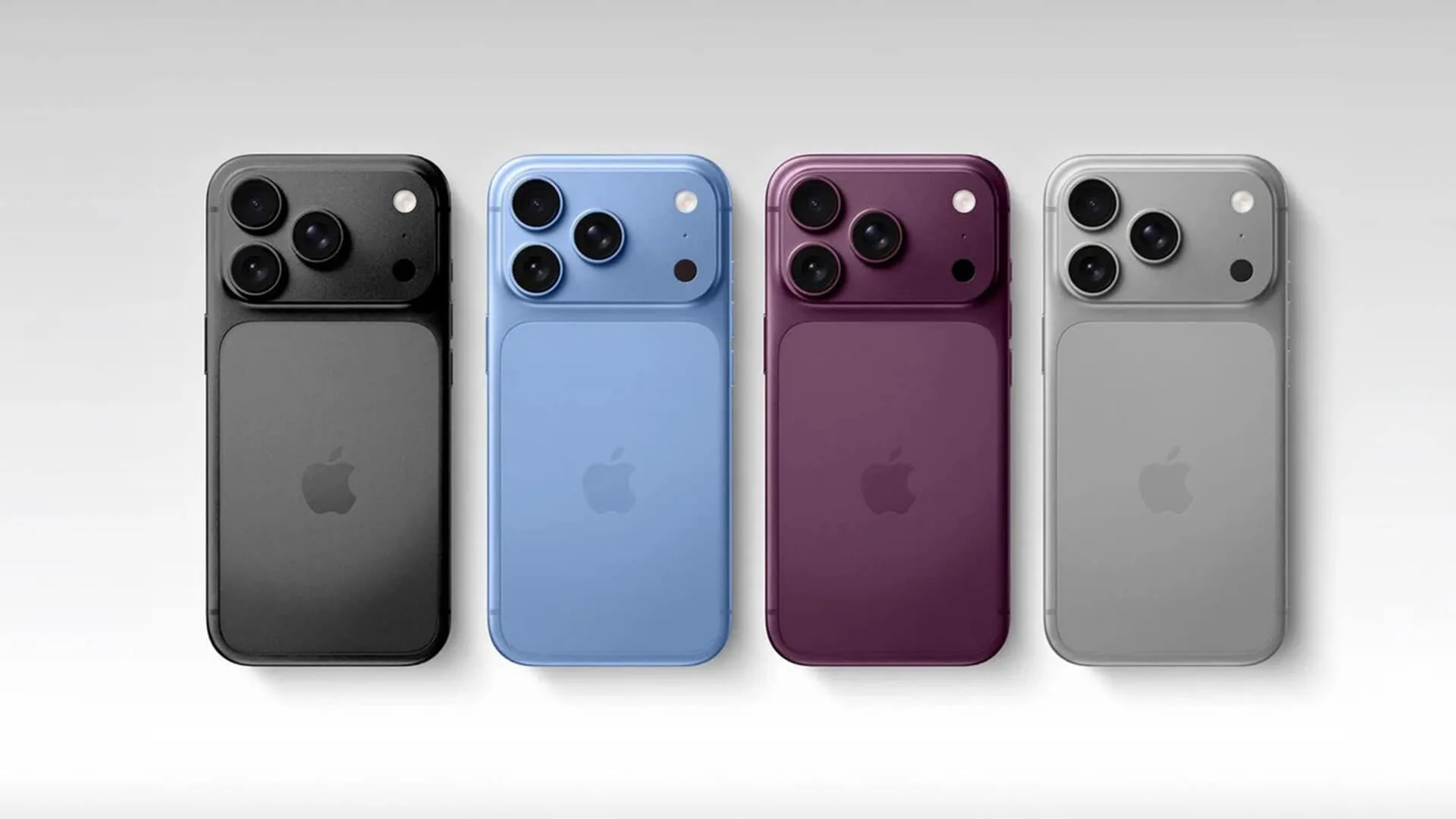
Externally, this is an iteration. The Pro models are expected to look much like the iPhone 17 Pro, with a cleaner rear design, a more unified transition between glass and aluminium, and new colours. The one recurring wildcard is a “slightly transparent” Ceramic Shield area for MagSafe charging, though nobody seems entirely sure what that means in practice.
Where things get interesting is the front. Face ID components are moving further beneath the display, shrinking the Dynamic Island — PhoneArena has claimed the cutout could shrink by almost half. An early report suggested the selfie camera would move to a corner punch-hole, but leaker Instant Digital said in January 2026 that this came from a mistranslation and only the infrared sensor moves under the glass — a claim corroborated by ShrimpApplePro and DSCC’s Ross Young. Expect a smaller centred pill, not a redesign.
Core Specs at a Glance
| Feature | iPhone 18 Pro | iPhone 18 Pro Max |
|---|---|---|
| Display | 6.3-inch LTPO OLED | 6.9-inch LTPO OLED |
| Chip | A20 Pro (2nm, TSMC) | A20 Pro (2nm, TSMC) |
| RAM | 12GB (WMCM packaging) | 12GB (WMCM packaging) |
| Battery (eSIM/US) | 4,288mAh | 5,567mAh |
| Battery (SIM tray/China) | 4,056mAh | 5,391mAh |
| Rear cameras | Triple, variable aperture main | Triple, variable aperture main |
| Front camera | 24MP | 24MP |
| Modem | Apple C2 (Qualcomm possible in US) | Apple C2 (Qualcomm possible in US) |
| Storage | 256GB – 2TB expected | 256GB – 2TB expected |
| Software | iOS 27 | iOS 27 |
| Expected price | ~$1,249–$1,399 | ~$1,349–$1,499 |
The Chip: Apple’s First 2nm Silicon
The A20 Pro is the generational flex. Rumours point to both a 2nm A20 and a higher-end A20 Pro, with the Pro variant reserved for the iPhone 18 Pro models — a long-awaited step down from the A19’s 3nm node. The packaging may matter more than the node. Apple’s A20 Pro reportedly uses new WMCM packaging that stacks 12GB of RAM directly onto the chip wafer, a structural change arguably bigger than the shrink itself.
Battery: The Pro Max Runs Away With It
Chinese regulatory filings have handed us the clearest numbers of the cycle. Filings in China’s C3 database, spotted by Digital Chat Station, rate the iPhone 18 Pro at 4,056mAh in China and 4,288mAh in the US, up modestly from the 17 Pro’s 3,988mAh and 4,252mAh. The Pro Max jumps far harder: 5,391mAh in China and 5,567mAh in the US, versus 4,823mAh and 5,088mAh last year.
That works out to roughly a 12 percent gain for the Pro Max — the largest battery ever fitted to an iPhone — while the standard Pro inches up by just 1 to 2 percent. The gap exists for a mundane reason: US iPhones have been eSIM-only since the iPhone 14, so removing the SIM tray frees internal volume for a slightly larger cell.
One caveat worth flagging. Apple is sticking with lithium-ion polymer chemistry rather than the silicon-carbon cells some Android rivals have adopted, and much of the extra capacity may be absorbed by the power draw of on-device AI rather than translating into dramatically longer screen-on time.
Camera: The Variable Aperture Era Begins
The marquee upgrade is a variable aperture main camera — a first for iPhone — giving real control over depth of field and low-light intake. Reports also point to a wider-aperture telephoto for better low-light zoom, a new stacked sensor design to cut noise and lift dynamic range, and a 24MP front camera. A pro-grade camera app with manual shutter, ISO and focus controls has also been floated.
Colours and Build
“Dark Cherry” is the name that keeps recurring, alongside Light Blue, Dark Gray and Silver. On dimensions, the reports conflict: some claim roughly 9mm thick and around 240g, while Macworld’s sourcing suggests body thickness stays close to the 17 Pro with only the camera plateau growing. Treat the “chunky iPhone” narrative with caution.
iPhone Ultra: Apple’s First Foldable
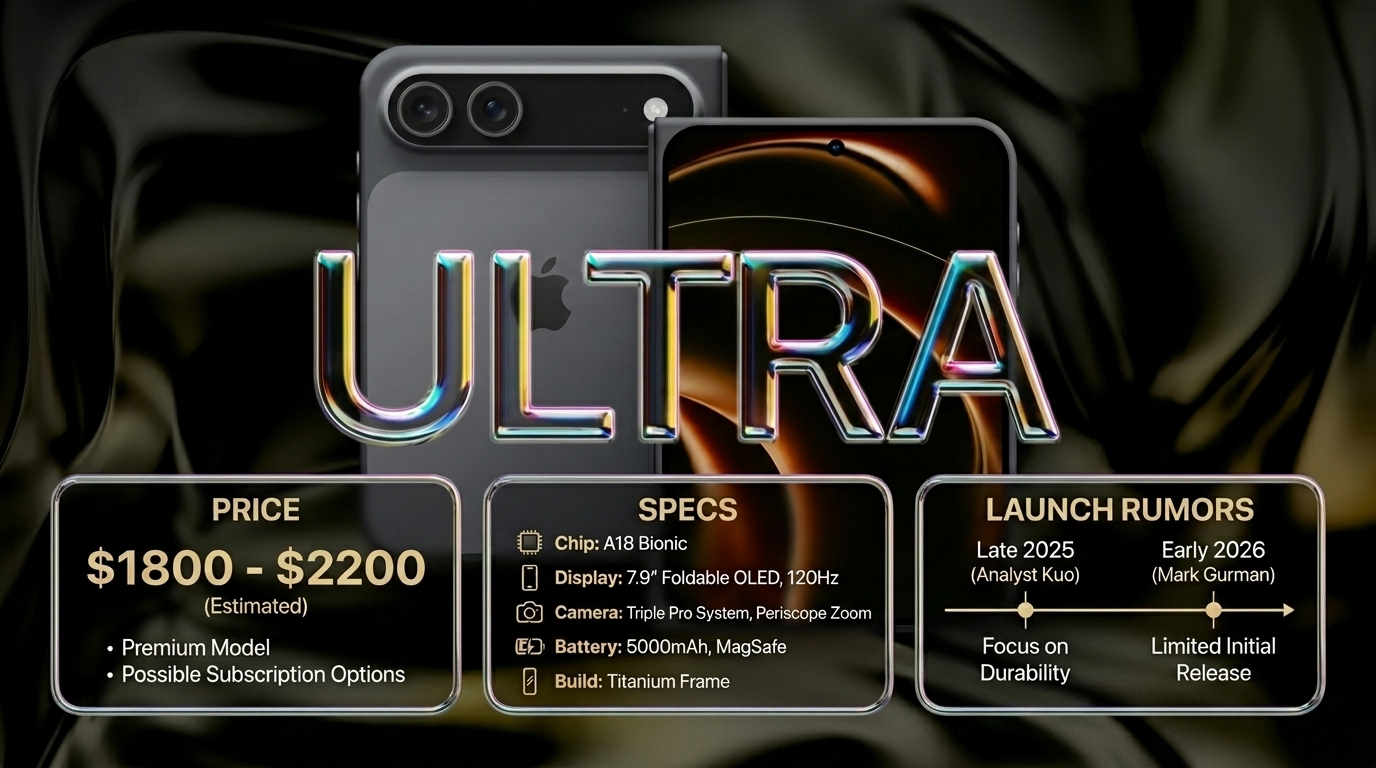
This is the device that will own the keynote. Ming-Chi Kuo describes a roughly 7.8-inch flexible inner display with a 5.5-inch cover screen, measuring 4.5–4.8mm unfolded — thinner than an iPhone Air — and around 9–9.5mm closed, with two rear cameras and a novel 3D-printed hinge.
| Spec | Expected |
|---|---|
| Inner display | ~7.76-inch, 2,713 x 1,920 |
| Outer display | ~5.49-inch, 2,088 x 1,422, 4:3 |
| Thickness | ~4.5mm open / ~9–9.5mm closed |
| Chip | A20 Pro, 12GB RAM |
| Cameras | Dual rear (wide + ultra-wide), dual 18MP front |
| Biometrics | Touch ID power button — no Face ID |
| Battery | ~5,400–5,800mAh (testing range) |
| Colours | White and indigo |
| Price | $2,000–$2,500+ |
The trade-offs are real. There is no telephoto lens and no TrueDepth system, meaning Touch ID replaces Face ID entirely. The engineering wins are equally real: a liquid metal hinge, vapor chamber cooling despite the 4.5mm thickness, and a near-creaseless panel. Apple reportedly pursued crease elimination “regardless of cost,” and the fold has been described as nearly invisible when open.
Pricing is the sting. Gurman expects it to cross $2,000; Kuo says not below $2,000 and possibly above $2,500, with higher storage tiers potentially breaching $3,000.
Why Everything Costs More: The Memory Crisis
The price story is not Apple being greedy — it is a genuine component shock. TechInsights estimates Apple paid around $39 for the 12GB of DRAM in the iPhone 17 Pro; that could climb to $145 in the iPhone 18 Pro. The 256GB NAND tier that cost roughly $13 could hit $51. Tim Cook called the situation a “hundred-year flood” in a June interview with The Wall Street Journal.
The Wall Street Journal’s own modelling suggests Apple would need roughly $1,371 to hold its margin, with $1,299 more likely given Apple’s love of round pricing — and $1,399 or higher if the pricier new camera system is factored in. MacRumors, benchmarking against Apple’s iPad price hikes, lands on $1,249–$1,299 for the Pro and $1,349–$1,399 for the Pro Max.
Software: iOS 27 and the Siri Reboot
The iPhone 18 Pro will ship with iOS 27, and the software story is Siri. Announced at WWDC on June 8, 2026, “Siri AI” is built on Apple Foundation Models in partnership with Google’s Gemini, lives inside the Dynamic Island, and finally behaves like a modern conversational assistant. It gets a dedicated app with pinnable, iCloud-synced conversations, onscreen awareness, a Siri mode inside the Camera app, and new expressive voices with adjustable pace.
Two catches. Voice customisation requires iPhone 17 Pro, iPhone Air or newer, and Siri AI will not be available in the EU on iPhone at launch, nor in China, pending regulatory work.
Final Verdict: Who Should Actually Wait?
The iPhone 18 Pro is a quietly excellent upgrade wearing last year’s suit. The A20 Pro, a variable aperture camera, a smaller Dynamic Island and a genuinely huge Pro Max battery add up to one of the more substantive Pro generations in years — even if none of it is visible from across a room.
But the value equation has moved. A likely $150–$300 price increase for an iterative design is a hard sell, and Apple knows it, which is why the foldable is doing the emotional heavy lifting this September. The iPhone Ultra is the more exciting product and the more compromised one: no telephoto, no Face ID, first-generation durability risk and a price that starts where most laptops finish.
Our read: if you own an iPhone 16 Pro or newer, sit this one out. If you are on an iPhone 14 or older and you shoot a lot of photos, the 18 Pro Max — with the biggest battery Apple has ever shipped — is the safe, sensible buy. And if you want the foldable, start saving now and expect to queue. Early supply is going to be tight, and Apple is not pretending otherwise.