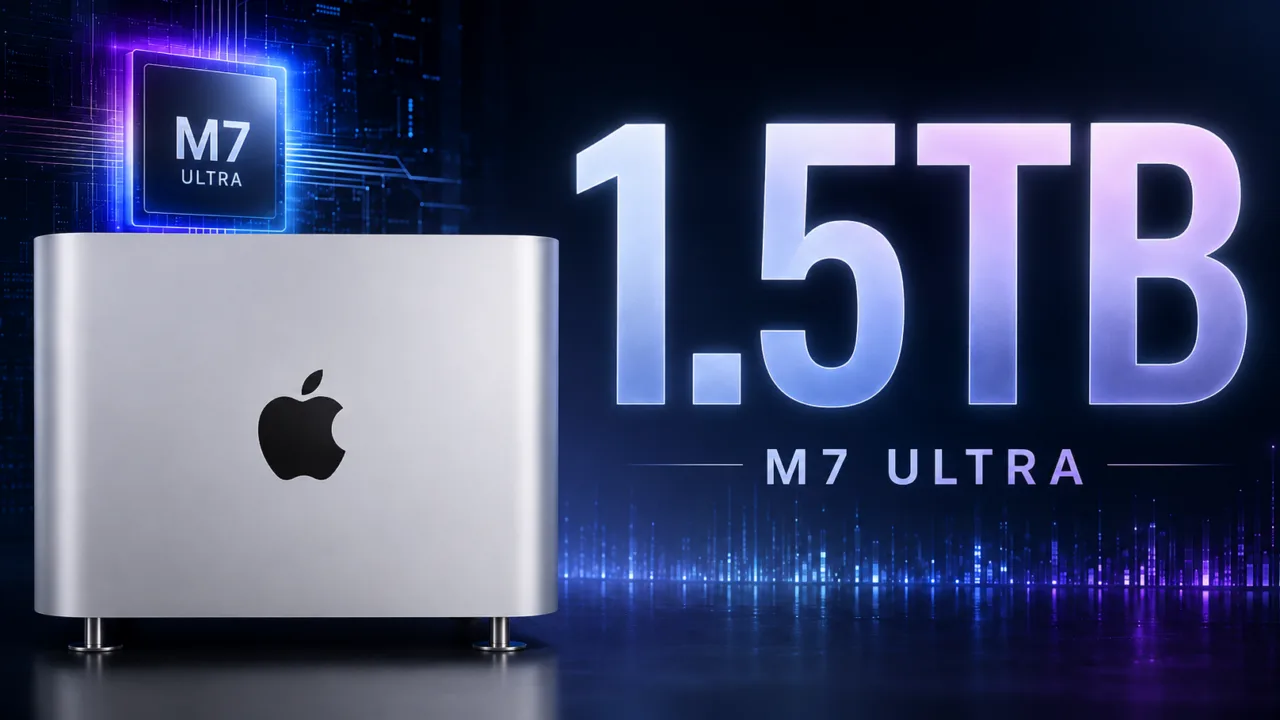
Remember when the 2019 Mac Pro’s 1.5TB memory ceiling felt like an absurd, almost theoretical spec? Seven years later, Apple is reportedly about to hit that number again — but this time on a single slab of silicon. According to Mark Gurman’s Bloomberg Power On newsletter, Apple is engineering the M7 Ultra chip to support up to 1.5TB of unified memory — roughly double the planned ceiling of the upcoming M5 Ultra, and a figure that would finally match the highest RAM configuration of the 2019 Intel Mac Pro. This isn’t just a spec bump for bragging rights. It’s the clearest signal yet that Apple is redesigning its entire silicon strategy around one thing: artificial intelligence.
The Headline Number: 1,536GB on a Single Package
Let’s put this in perspective—most flagship laptops in 2026 ship with 16GB or 32GB of RAM. Apple is designing a chip that can hold nearly 50 times that — 1,536GB of unified memory fused directly onto the chip package.
That last detail matters. Because Apple’s unified memory has to fit alongside the chip physically, there’s a hard ceiling on how much it can include, and no way to upgrade it later. That architectural reality is exactly why hitting 1.5TB is such a milestone — Apple has to engineer the packaging itself to accommodate that much memory physically. It’s not a spec bump; it’s a genuine engineering leap.
Here’s how the M7 Ultra’s reported ceiling stacks up against Apple’s recent high-end silicon:
| Chip | Max Unified Memory | Status |
|---|---|---|
| M3 Ultra (Mac Studio) | 96GB (currently) | Higher tiers discontinued |
| M4 Max | 128GB | Shipping |
| M5 Ultra | 768GB | Expected late 2026 |
| M7 Ultra | 1.5TB (1,536GB) | Expected 2028 |
Why Apple Is Chasing This Number: AI, AI, and More AI
The motivation isn’t mysterious. Large AI models are memory gluttons. The bigger the model, the more RAM it demands, and anyone hoping to run multi-billion-parameter models locally without leaning on the cloud needs a colossal pool of fast memory to do it.
According to Bloomberg’s reporting, Apple is developing the M7 Ultra with one clear goal: dramatically boosting AI performance, with the processor reportedly designed to handle workloads on a scale that brings it closer to dedicated AI accelerators like Nvidia’s Blackwell than traditional desktop processors.
That’s a bold target. Nvidia’s DGX-class hardware has owned the on-desk AI workstation conversation for years. A 1.5TB unified memory configuration — with the enormous bandwidth advantage that on-package memory provides — would give Apple its first genuinely credible answer for local large-model inference, long-context workloads, and heavy scientific computing.
The Server Play Nobody Saw Coming
The M7 Ultra isn’t just destined for a future Mac Studio. Apple also plans to use the chip as the backbone of its next-generation AI servers. While an M5 Ultra-based server platform is expected to arrive first, engineers are already developing a more powerful M7 Ultra-powered architecture targeted for deployment around 2029, helping power Apple Intelligence both on-device and in the cloud.
There’s even a fascinating origin story buried in the silicon. The M7 Ultra’s Neural Engine traces its lineage to Project Titan, Apple’s abandoned self-driving car project. The car chip design was never finished, but the IP survived, and Apple redirected that neural accelerator into consumer silicon.
A Strange, Compressed Roadmap: Where Did the M6 Ultra Go?
To get here, Apple is doing something it has never done before. According to Gurman, Apple is planning to release the standard M6 before moving directly to the M7 generation for its higher-end chips — meaning there may be no M6 Pro, M6 Max, or M6 Ultra processors at all. Apple has skipped individual Ultra chips before, including the M4 Ultra, but it has never abandoned all three higher-end versions in a single generation.
The reported timeline now looks like this:
- Late 2026: M5 Ultra Mac Studio arrives with up to 768GB of memory — a new Apple Silicon record on its own
- First half of 2027: The base M7 debuts, reportedly first in a redesigned entry-level MacBook Pro
- Late 2027: M7 Pro and M7 Max follow
- 2028: M7 Ultra lands, likely in a refreshed Mac Studio
- Around 2029: M7 Ultra-based AI server deployment
The compressed schedule is reportedly linked to larger Neural Engine upgrades planned for the M7, which Apple considered important enough to accelerate the entire generation. The M7 Ultra is expected to deliver the largest AI performance upgrade in the series.
The Two Big Asterisks: Supply and Price
Before anyone gets too excited, there are serious caveats — and Gurman himself flags them.
The Memory Shortage Problem
Widespread memory-chip shortages have made the component harder to find and more expensive, and the M7 Ultra might not launch with 1.5TB of RAM due to the ongoing crunch. Nonetheless, Apple is engineering the chip to support it.
The irony is thick. Earlier in 2026, Apple quietly pulled the highest-memory configurations from the current M3 Ultra Mac Studio — first the 512GB tier, then lower ones — and raised prices across its Mac and iPad lines, a move outgoing CEO Tim Cook reportedly described as responding to a “hundred-year flood,” blaming AI server demand for vacuuming up high-bandwidth memory. The same shortage squeezing today’s Macs is the very thing that could stop the 1.5TB M7 Ultra from ever shipping at full capacity. Apple is quite literally designing for abundance in a moment of scarcity.
The Eye-Watering Cost
Then there’s the price. Based on Apple’s current memory pricing of roughly $25 per gigabyte, upgrading from a 128GB base to the full 1.5TB would add more than $35,000 to the bill — before you’ve paid for the actual computer. This is firmly enterprise and workstation territory, not a purchase for the average creative professional.
The Poetic Full-Circle Moment
There’s a satisfying symmetry to all of this. The 2019 Mac Pro has remained the only Mac in Apple’s lineup ever to offer 1.5TB of RAM — a distinction that has stood since Apple transitioned to its own silicon. That Intel-based machine used traditional RAM slots rather than unified memory, allowing expansion in a way Apple Silicon has never replicated.
For years, raw memory capacity was one of the very few battles the old Intel “cheese grater” tower still won against Apple’s own chips. The M7 Ultra would finally close that last gap — while keeping the massive bandwidth advantage that unified memory brings.
Final Verdict
The M7 Ultra is still two years away, and rumors this early always deserve healthy skepticism — no bandwidth figures, core counts, or confirmed Mac Pro plans have surfaced yet. But the strategic direction is unmistakable and, frankly, more interesting than the headline number itself. Apple is no longer building chips that happen to be good at AI; it is building chips around AI, from the iPhone in your pocket to its own data centers. If the memory market cooperates and the 1.5TB configuration actually ships, the M7 Ultra could be the moment Apple Silicon graduates from “impressive workstation chip” to a legitimate rival for enterprise AI accelerators. Whether buyers are ready to spend $35,000 on RAM alone is another question entirely — but for the niche that needs it, there may soon be no other Apple option, and possibly no better one anywhere.