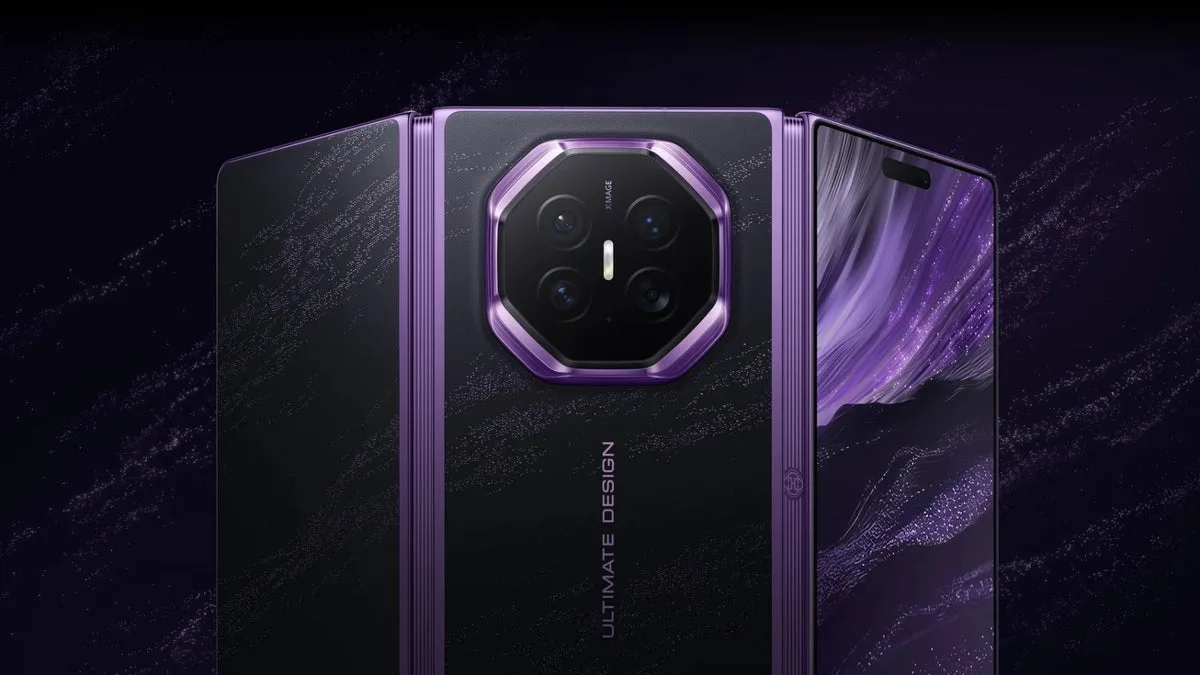
While the rest of the smartphone world is still arguing about whether a single fold is worth the money, Huawei just shipped a phone that folds twice. The Mate XT 2 is the company’s second-generation tri-fold, and it lands with a new in-house chip, a privacy screen that is genuinely novel, and a price that starts at roughly 2,980 dollars and climbs well past four thousand.
A phone that unfolds into a small tablet
The pitch is simple and a little absurd in the best way. Closed, the Mate XT 2 is a normal-ish phone with a 6.5-inch outer screen. Open it all the way and you get a 10.2-inch display, essentially a tablet you can fold into your pocket. Huawei has managed to keep it to about 3.5mm thick when fully opened and roughly 12.3mm folded, which for a device with two hinges is a real engineering flex.
The specs that matter
| Feature | Detail |
|---|---|
| Inner display | 10.2-inch, 3K resolution |
| Outer display | 6.5-inch, 6,500 nits peak brightness |
| Chip | Kirin 9050 Pro |
| Main camera | 50MP with variable F1.49-F4.0 aperture |
| Telephoto | 50MP periscope, 3.5x optical zoom |
| Ultra-wide | 40MP |
| Durability | IP58 and IP59, basalt glass |
| Software | HarmonyOS 7 |
| Starting price | About $2,980 (19,999 yuan) |
The Kirin 9050 Pro is the real story
Huawei says the new Kirin 9050 Pro delivers a 42 percent performance jump over the previous tri-fold, with single-core gains around 24 percent and multi-core closer to 52 percent. The graphics unit is claimed to be up to 142 percent faster, and the neural engine carries 30 billion parameters for on-device AI. Those are big numbers, and they matter for a reason that goes beyond benchmarks: they are Huawei’s own, designed and built despite years of sanctions meant to cut the company off from advanced chipmaking. Every generation that closes the gap is a geopolitical statement as much as a product update.
A privacy screen built into the hardware
The most interesting feature is not the fold at all. Huawei calls it Lingdun, and it is described as the first hardware-level privacy system built directly into a foldable display. Using dual-pixel technology, the screen can instantly narrow its viewing angle with a double-tap or a control key, so the person next to you on a train sees a dark panel instead of your messages. Software privacy filters have existed for years. Baking it into the display itself, and letting you toggle it on demand, is a smarter take on a problem every phone owner has quietly worried about.
Cameras and toughness
The camera array is flagship-grade, led by a 50MP main sensor with a wide variable aperture and an 18EV dynamic range, backed by a 50MP periscope telephoto and a 40MP ultra-wide. Huawei also claims a first for a tri-fold: IP58 and IP59 ratings for dust and water resistance, plus basalt glass it says is dramatically more drop-resistant than before. Foldables have historically been fragile things, you baby. Toughening one up is exactly the kind of unglamorous progress the category needs.
The catch
Two catches, really. The first is price. Even the base model costs as much as a very good laptop, and the top configuration with extra storage and a stylus set pushes toward 4,470 dollars. The second is availability. The Mate XT 2 goes on sale in China first, and Huawei’s complicated status outside its home market means most readers elsewhere will admire it from afar rather than buy one. This is a halo device, a flex of what the company can do, not a phone for everyone.
Final Verdict
The Mate XT 2 is not trying to be sensible, and that is the point. It is a statement that Huawei can out-engineer the field on form factor, silicon, and even a genuinely clever privacy feature, sanctions or not. Apple and Samsung are only now easing into single-fold phones with the caution of companies protecting a franchise. Huawei is two folds ahead and adding tricks nobody asked for, but many will covet. For most people, it will remain a fascinating thing to read about rather than own. For the industry, it is a marker of just how far ahead the tri-fold race has quietly gotten.