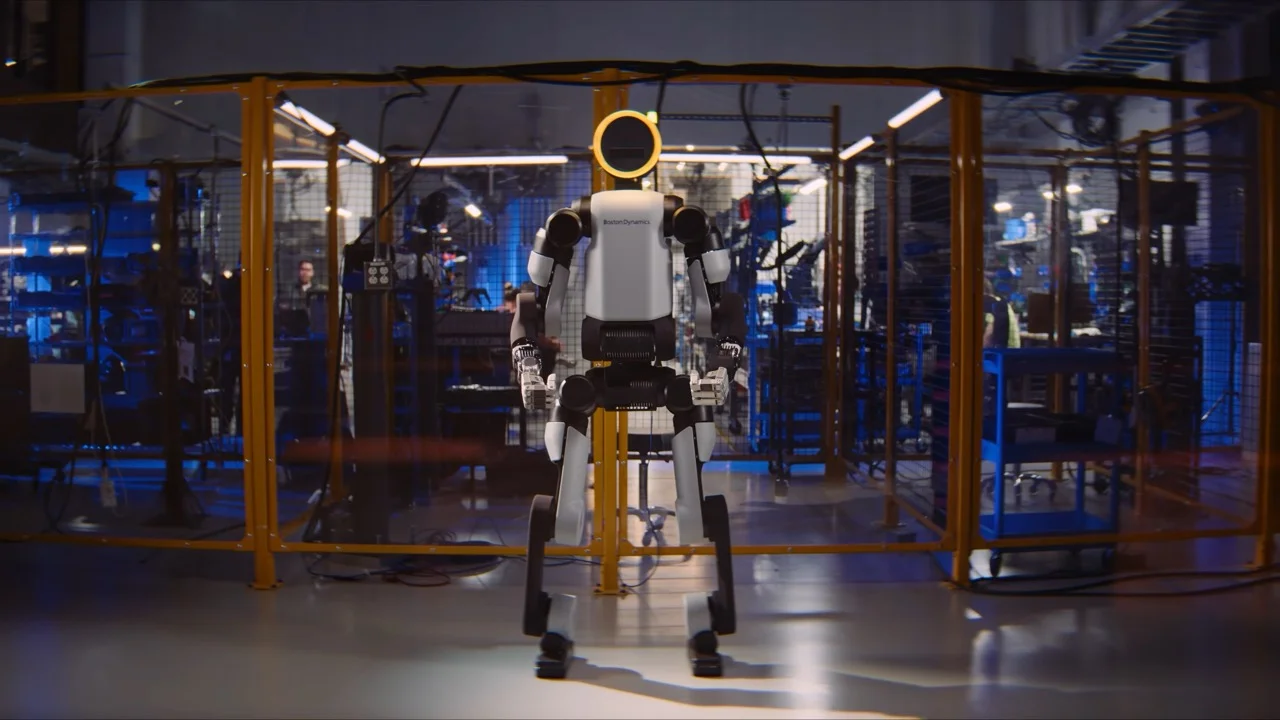
Boston Dynamics just gave its humanoid robot a new pair of hands, and the most interesting part isn’t what they added, it’s what they deliberately left off. Atlas’s new end effectors have four fingers instead of five, a choice the engineering team arrived at through a genuinely low-tech experiment: taping their own pinky fingers down for a day to see if they’d miss them. The answer shaped one of the more consequential design decisions in the robot’s recent history, and it says a lot about where humanoid robotics is actually headed.
Thirteen Degrees of Freedom, Zero Pinkies
The new hand packs 13 degrees of freedom across its four digits, with the thumb alone accounting for four of them and the remaining three fingers getting three apiece. That’s a serious jump in articulation for a robotic hand, enough to pull off dexterous pinch grasps, tripodal grips, and the kind of in-hand reorientation that lets the robot adjust its grip on an object without setting it down and starting over, something most robotic hands still struggle with.
Dense pressure-sensitive tactile sensors cover the fingertips and palm, giving Atlas a crude but functional sense of touch, enough to modulate grip force and detect when an object is slipping before it hits the floor. The actuation is direct and backdrivable, meaning the hand can respond to external force rather than fighting against it, and the whole mechanism is built without cables crossing exposed joints, a design choice that mirrors how Atlas’s body has been engineered to avoid the kind of exposed wiring that tends to fail first in field conditions.
The Pinky Experiment
According to Boston Dynamics mechanical engineer Dylan Thrush, the decision to drop the fifth finger wasn’t purely theoretical. Team members physically taped their pinky and ring fingers together for a full day to simulate what a four-fingered human hand could and couldn’t do. Their conclusion was blunt: the additional dexterity and task coverage a fifth finger would unlock wasn’t worth the added mechanical complexity, more actuators, more failure points, more weight, more cost. It’s the kind of trade-off that sounds obvious once you hear it explained, but getting there required actually testing the assumption instead of just defaulting to five fingers because that’s what human hands have.
From Grasping Variety to Actual Manipulation
Previous generations of robotic end effectors, including earlier Atlas hands, were largely judged on how many different grasp types they could execute, how many ways the robot could pick something up. This new hand represents a deliberate shift away from that metric and toward something harder to demonstrate but more useful in practice: sustained, dexterous manipulation of an object once it’s already in hand.
That shows up in the task list Boston Dynamics is showcasing for the new hand, and it’s notably industrial. The robot can wield drills, torque drivers, grinders, nail guns, and welding torches, tools that demand a stable, adjustable grip and the ability to apply controlled force over time, not just the ability to pick something up and set it down. It’s a strong signal about where Boston Dynamics sees Atlas actually going to work first, and it’s not folding laundry.
Built for Simulation First
One of the more technically significant aspects of the new hand is that it was explicitly engineered around sim-to-real reinforcement learning, the process of training a robot’s control policies almost entirely in high-fidelity simulation before deploying them on physical hardware. That requires a hand whose physical behavior, friction, compliance, sensor response, can be accurately modeled in software, so that skills learned virtually transfer cleanly to the real mechanism instead of falling apart the moment they hit an actual object. Designing hardware around the needs of a simulation pipeline, rather than the other way around, is a telling detail about how Boston Dynamics is trying to scale up the robot’s skill set without needing thousands of hours of real-world trial and error for every new task.
The Timing Isn’t Coincidental
This unveiling lands just a week after Boston Dynamics opened its Robotics Metaplant Application Center in Georgia, a facility focused on getting humanoid robots ready for actual industrial deployment rather than lab demonstrations. Pairing a hand built for heavy tool use with a freshly opened application center aimed at real manufacturing environments is a pretty clear signal that Boston Dynamics isn’t just iterating on Atlas as a research platform anymore. It’s building toward putting these hands to work on an actual factory floor, doing the kind of dirty, repetitive, tool-based labor that’s historically been hard to automate because it demands both strength and fine control at the same time.
What This Means
The humanoid robotics race has produced no shortage of flashy demo videos over the past few years, robots dancing, running, doing backflips, but comparatively few hands capable of doing sustained, useful work once the cameras stop rolling. Boston Dynamics choosing to simplify the hand’s finger count while increasing its functional dexterity suggests a company optimizing for deployability over spectacle, a hand that’s easier to manufacture, maintain, and simulate, built around tasks that actually show up on an industrial job site.
Whether Atlas ends up doing meaningful work on real factory floors any time soon is still an open question, and Boston Dynamics has a long history of impressive demos that take years to translate into commercial deployment. But the design philosophy behind this hand, test the assumption, cut what isn’t earning its complexity, build for the tasks you actually want to automate, is the kind of engineering discipline that tends to separate robots that eventually ship from robots that stay in the lab.