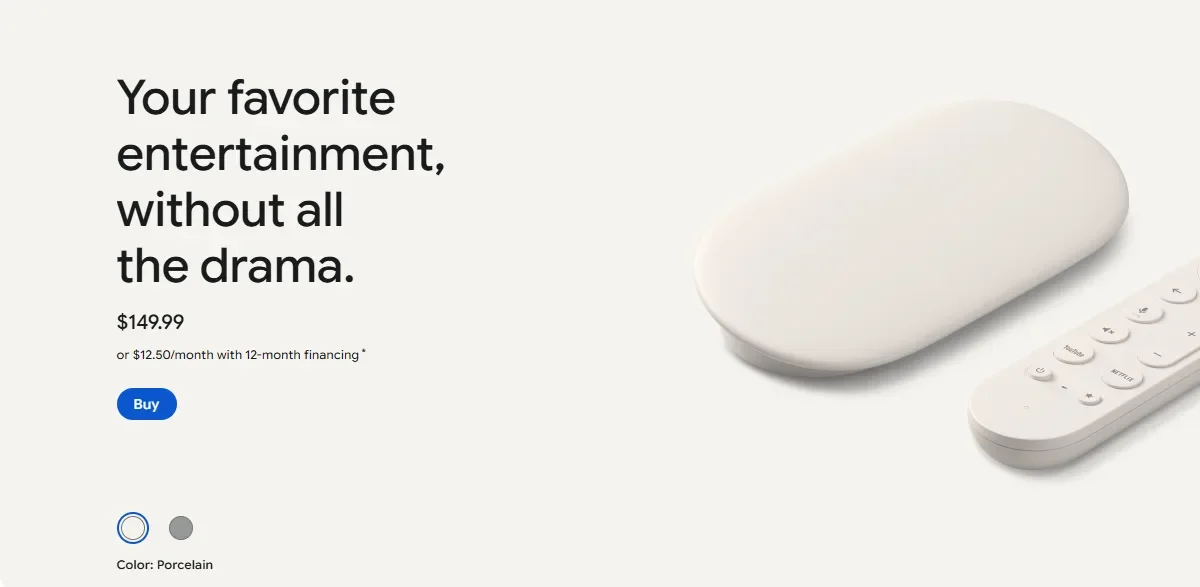
Google’s streaming box was the easy recommendation for two years running. A hundred bucks got you 4K HDR, Dolby Vision, an Ethernet port Apple charged extra for, and a Matter hub thrown in. That pitch just fell apart. As of August 31, the Google TV Streamer costs $149.99 in the US — fifty dollars more than it did over the weekend, for a device whose internals haven’t changed a bit since it shipped in September 2024.
No announcement. No press release. No new model. Just a fresh number on the Google Store listing, matched almost immediately by Best Buy.
What Actually Changed
Nothing about the hardware. The Streamer still runs on 4GB of RAM and 32GB of storage, still outputs 4K HDR at 60fps with Dolby Vision and HDR10+, still pushes Dolby Atmos, still acts as a Matter controller and Thread border router. Same remote, same chip, same firmware path. The only thing that moved is the sticker.
That works out to a 50% increase over the launch price — the steepest proportional jump any major streaming platform has taken this year, and that’s a competitive field.
The rollout has been uneven, which creates a short window for anyone who’s been circling this purchase:
- Google Store: $149.99, live now
- Best Buy: $149.99, updated to match
- Amazon and some third-party retailers: still showing $99.99 on remaining stock
That older inventory is not going to last. Once it clears, $149.99 becomes the floor.
Google’s Explanation
The company didn’t dress it up much. In a statement addressing the change, Google pointed to rising component costs and said it was adjusting US pricing on select Nest cameras, doorbells, and the Google TV Streamer 4K effective August 31, while promising continued feature updates for existing owners.
Translation: memory got expensive, and Google isn’t eating the difference anymore.
The RAM Squeeze Nobody Escapes
This is the part that explains 2026 hardware pricing generally. DRAM and NAND contract prices more than doubled in the early part of the year after already climbing through late 2025. The cause isn’t mysterious — chipmakers have redirected fab capacity toward high-bandwidth memory for AI servers, and data centers now absorb well over half of global DRAM and NAND output. Everything else in the supply chain fights over what’s left.
Streaming boxes are unusually exposed to this. A laptop maker can absorb a memory spike inside a $1,200 price tag. A $99 streamer built on razor-thin margins cannot. When the memory bill goes up, it shows up on the shelf almost dollar for dollar. New consumer-grade capacity isn’t expected in volume until late 2027 at the earliest.
Google has already applied the same logic elsewhere. The Pixel 11 series arrived $100 above the Pixel 10, and the Pixel Watch 5 followed the same pattern.
Google Wasn’t First — and That’s the Real Story
The Streamer is the last major player to fall in line, not the first. Look at the category over the past three months:
| Device | Old Price | New Price |
|---|---|---|
| Google TV Streamer 4K | $99.99 | $149.99 |
| Apple TV 4K (Wi-Fi, 64GB) | $129 | $199 |
| Apple TV 4K (Ethernet, 128GB) | $149 | $249 |
| Roku Ultra | $99.99 | $149.99 |
| Roku Streaming Stick 4K | $49.99 | $79.99 |
| Fire TV Stick 4K Max | $59.99 | $84.99 |
| Fire TV Stick HD | $34.99 | $39.99 |
Apple moved first in late June, tacking $70 onto the Wi-Fi model and $100 onto the Ethernet version without touching the hardware. Roku followed in July with increases as steep as 60% on its cheapest stick. Amazon went in August, quietly repricing Fire TV alongside Echo, Kindle, and eero, citing significant increases in memory and storage costs. Even Walmart’s Onn sticks — the reliable $20 impulse buy running Google TV — roughly doubled.
Here’s the uncomfortable bit for Google: for about six weeks, the Streamer’s unchanged $99.99 price was its single loudest selling point. Coverage of Amazon’s hike in August pointed to Google holding the line as the reason to buy a Streamer instead of a Fire Stick. That advantage lasted less than two weeks.
Nest Hardware Took a Hit Too
The same statement covered a broad markup across Google’s home security lineup, effective the same day. Every currently available Nest camera and doorbell went up, mostly by $20 to $30, with one model taking a much harder hit.
- Nest Cam (battery, indoor/outdoor): now $199.99, up from $179.99
- Nest Cam Outdoor (wired, 2nd gen): now $199.99, up from $149.99 — a 33% jump
- Nest Cam Indoor (wired, 3rd gen): now $129.99, up from $99.99
- Nest Doorbell (wired, 3rd gen): now $199.99, up from $179.99
- Nest Doorbell (battery): now $199.99, up from $179.99
A few things escaped. The Nest Cam with Floodlight bundle held at $279.99, which makes sense — a higher-margin bundle has room to absorb a component spike that a standalone camera doesn’t. The Google Home Speaker stayed at $99.99, presumably because it launched in June with these costs already baked in. Nest thermostats and the Nest Hub were untouched, at least for now.
Is the Streamer Still Worth It at $150?
Depends entirely on what you’re plugging it into.
If you own a Nest thermostat, a couple of Nest cameras, and a handful of Matter devices, the Streamer is doing more than playing video. It’s a Thread border router and a smart home hub with a proper Home panel on your TV. Apple charges $249 for the equivalent combination of Ethernet, Thread, and hub duties. On that comparison alone, $149.99 is still the cheaper path to the same job.
If you just want Netflix to load fast, the math is uglier. Gemini for TV replaced Assistant on the Streamer starting in November 2025 and has expanded steadily since, and it genuinely improves conversational search — but it’s regionally gated and it isn’t $50 of extra value. A Fire TV Stick 4K Max at $84.99 or a Roku stick at $79.99 does the streaming part fine for roughly half the money.
The awkward truth is that a device selling for $80 during earlier promotions this year now lists at nearly twice that, with an identical spec sheet and a two-year-old design.
What This Means
Two things, and they point in different directions.
Short term: if you want a Google TV Streamer, buy it from whichever retailer hasn’t updated its listing yet, and do it this week. That stock is finite, and a return to $99.99 isn’t coming. Holiday discounting, which knocked $20 off last year, is a much longer shot when the underlying component cost is the problem.
Longer term, this reprices an entire product category. Streaming boxes were the cheapest hardware in the living room, sold near cost by companies making money on ads, subscriptions, and content. That model assumed cheap memory. It no longer holds. A $150 streaming box now sits close enough to a budget smart TV or a discounted console that the calculus changes for a lot of buyers.
Google didn’t do anything unusual here. It did the same thing Apple, Roku, and Amazon already did, just later and more quietly. What stings is the loss of a genuinely good deal — and the reasonable suspicion that when memory prices eventually normalize, none of these prices will come back down.