Samsung’s flagship phones have looked the same from behind since 2023. Three floating lenses, no housing, no bump worth the name. It became a signature. Now a fresh batch of leaked images suggests the company is about to throw that signature out, and the early reaction from Samsung fans has been anything but warm.
The images landed over the weekend from Ice Universe, a leaker with an uncomfortably good track record on Galaxy hardware, and they were quickly backed up by a second well-known tipster. Together they sketch out a Galaxy S27 Ultra that looks less like its predecessor than any Ultra has in half a decade.
What the leaked images actually show
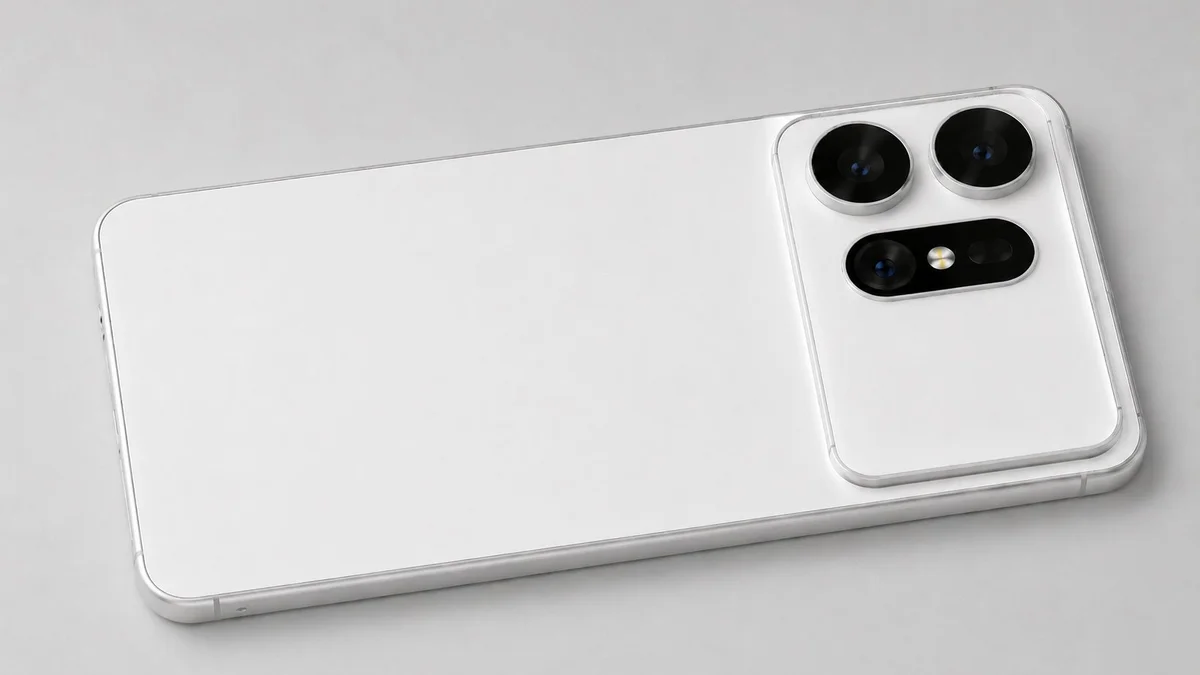
The headline change is a large rectangular camera plateau running across the top of the back panel. Gone are the individual metal rings that have defined the Galaxy S Ultra since the S23 era. In their place sits a raised, unified island housing the entire camera system.
The internal arrangement is unusual. The main and ultrawide sensors sit stacked vertically on one side, each still ringed. The telephoto shares a pill-shaped cutout with the LED flash and the laser autofocus module. It’s asymmetrical in a way Samsung’s recent designs have never been, and it’s the part of the leak drawing the most complaints.
There’s also a detail buried in the CAD-derived images that might matter more than the camera layout: a circular magnetic ring on the back panel. That’s a built-in Qi2 magnet array, and if it survives to production, it would mean Galaxy owners finally get magnetic accessory support without buying a special case. Samsung has flirted with this for two generations without committing. The S27 could be the year it stops stalling.
The iPhone comparison is unavoidable
Let’s not pretend otherwise: the plateau looks a lot like what Apple introduced on the iPhone 17 Pro. The lens arrangement inside it is different, and the proportions aren’t identical, but the silhouette reads the same from across a room. Samsung spent years mocking Apple’s design choices in ad campaigns. Shipping a phone that echoes one of them would hand critics an easy shot, and the company knows it.
The regular Galaxy S27 isn’t going anywhere
Here’s the part getting lost in the noise. A second leaked image, showing the standard Galaxy S27, is boring in the best possible way. It sticks with the clean vertical lens arrangement Samsung already uses. No plateau, no drama.
That points to a deliberate strategy rather than a company-wide redesign. Samsung appears to want the base model to stay instantly recognizable while giving the Ultra a distinct visual identity again. For a lineup where the Ultra has increasingly felt like a bigger version of the same phone, that’s a defensible call, even if the execution is divisive.
Hold on, two Ultras?
The second tipster went further. Working from two slightly different CAD models, he suggested Samsung may be preparing the Ultra in two sizes, which would be a first for the tier.
Treat that one carefully. There’s a competing explanation sitting right there: Samsung is already rumored to be adding a fourth model called the Galaxy S27 Pro, positioned as a smaller high-end option without S Pen support. A second, smaller CAD file could easily be that phone rather than a second Ultra. The lineup is expected to run four deep next year, with internal codenames NM1 through NM4 mapping to the S27, S27+, S27 Pro, and S27 Ultra.
This contradicts what leaked two weeks ago
Worth flagging, because it says something about how settled this design is: earlier in August, design filings spotted in the WIPO global database showed something else entirely. Those drawings depicted a wide horizontal camera bar with three sensors side by side, closer to a Google Pixel than an iPhone.
Two conflicting layouts within a fortnight usually means one thing. Samsung is still evaluating prototypes, and neither version is locked. Design filings capture what a company tested, not what it ships. Anyone treating these images as final in August 2026 is going to look silly in February 2027.
What’s rumored to be inside
The internals have been leaking steadily since summer and have held up better than the design chatter.
| Component | Galaxy S27 Ultra (rumored) |
|---|---|
| Display | 6.9-inch QHD+ with second-gen Privacy Display |
| Processor | Snapdragon 8 Elite Gen 6 Pro / Extreme tier |
| Memory | 12GB or 16GB RAM |
| Main camera | 200MP with OIS |
| Ultrawide | 50MP with autofocus |
| Telephoto | 50MP 5x with OIS |
| Front camera | 16MP with autofocus and OIS |
| Battery | Roughly 5,700mAh, silicon-carbon |
| Software | One UI 9.5 |
The battery number is the one to watch. Silicon-carbon chemistry lets manufacturers pack more capacity into the same volume, and Chinese brands have been shipping it for two years while Samsung sat out. A jump from 5,000mAh to something near 5,700mAh in a body that isn’t meaningfully thicker would be a real gain, not a spec-sheet flex.
Reports still disagree on whether a second telephoto lens survives into the final Ultra. Some supply chain claims describe a fourth rear camera; others describe a clean triple setup. That gap probably resolves in the next few months.
There may be a practical reason for all this
Aesthetics aside, a wider camera platform solves two nagging problems. It spreads the weight of the module across more of the back, which cuts down the wobble you get when the phone sits on a desk. More importantly, consolidating the lenses into one block frees up real estate lower on the panel, which is exactly where you’d put a Qi2 magnet ring.
If Samsung has decided magnets are non-negotiable for the S27 generation, the camera layout had to change to make room. That reframes the redesign as an engineering consequence rather than a styling whim, which is a more charitable read than most of the internet is currently offering.
What This Means
Samsung is roughly six months out from a launch expected in early 2027, and by its own admission it has been tightening internal controls to slow the leak pipeline. It clearly hasn’t worked. What we’re seeing now is a company mid-argument with itself, and the fact that two credible tipsters produced two different camera layouts inside a month tells you the argument isn’t over.
For buyers, the sensible posture is patience. The specs look genuinely strong, particularly the battery and the chip. The design is a coin flip. If Samsung ships the plateau, expect a rough first week of reviews and then, as always, a quiet acceptance once people actually hold the thing. If it reverts to something closer to the horizontal bar, nobody will remember this leak happened.
The Qi2 magnets, though? That’s the detail worth actually hoping for.