Eight days before Apple unveils the most ambitious iPhone it has ever attempted, a small detail slipped out that says more about the device than any leaked render has. Apple didn’t just consider stylus support for its first foldable iPhone. It built the stylus. Engineers designed it, prototyped it, tested it against the folding screen — and then, by every indication, decided it wasn’t worth shipping.
That’s a remarkable thing for a company that spent a decade insisting phones don’t need pens. It’s also a window into the compromises baked into a device that has to be thinner than any iPhone Apple has ever made while surviving thousands of folds.
What Apple Actually Built
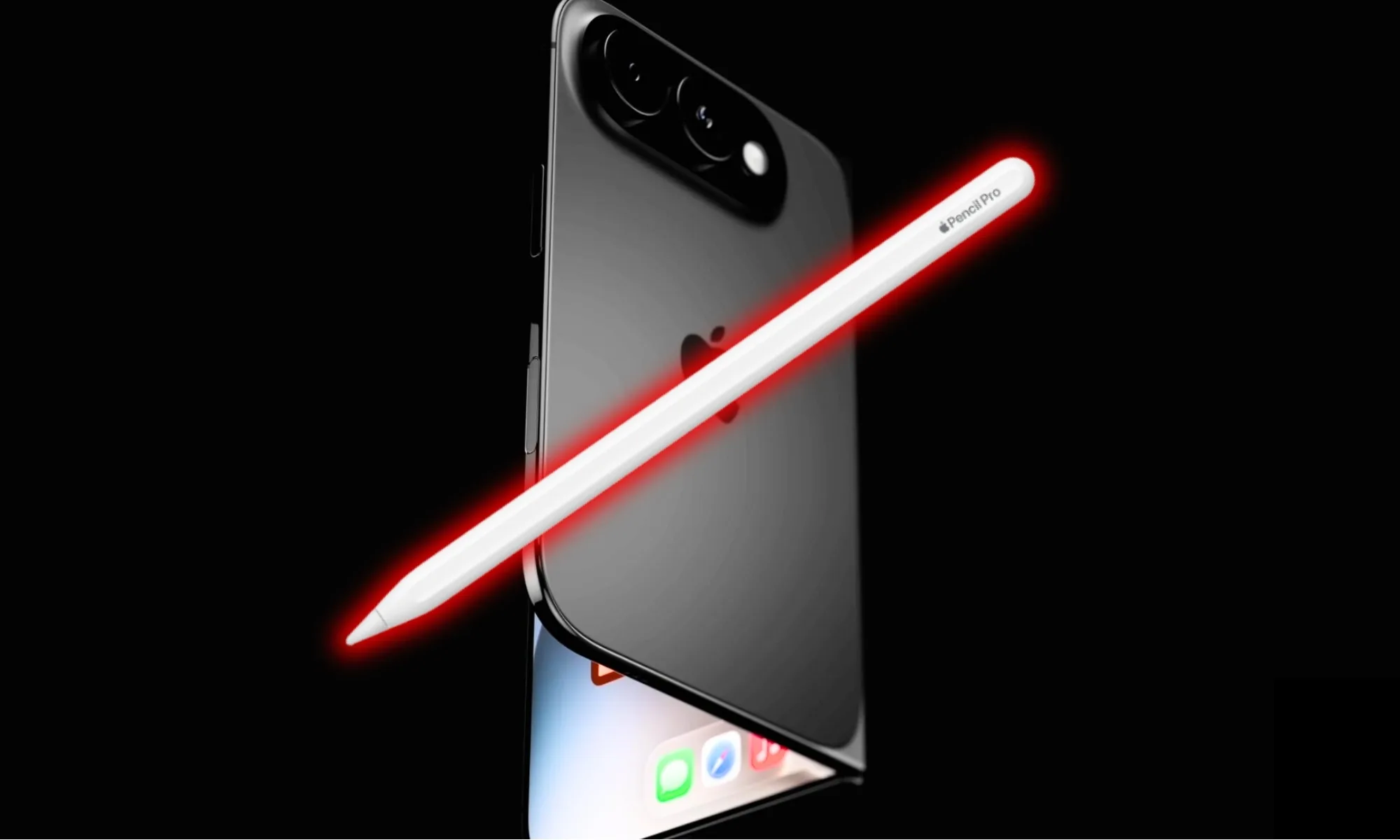
The accessory wasn’t a rebranded iPad Pencil. It was designed from scratch for a phone that opens into something the size of an iPad mini.
The prototype was noticeably shorter and stubbier than the Pencils sold for iPad, sized to line up with the foldable’s height when the device is closed. Carrying a full-length iPad stylus alongside a phone would have been absurd, and Apple clearly knew it. The pen also magnetically snapped to the side of the chassis for storage and wireless charging, the same trick that has made the second-generation Pencil and Pencil Pro so easy to live with on iPad.
So the concept was sound. The execution kept running into the same wall.
The screen couldn’t take it
Foldable displays are not glass in the way a normal phone screen is glass. They’re layered plastic and ultra-thin glass over a hinge, engineered to bend rather than resist. That flexibility is exactly what makes them vulnerable to a hard tip pressing into a single point.
Apple’s testing reportedly found that a stylus could leave visible marks on the inner display — the kind of blemish that shows up after a few weeks of aggressive note-taking and never goes away. On a $2,000 phone, that’s not a quirk. That’s a warranty problem, a review headline, and a reputational hit rolled into one.
Samsung dealt with the same physics for years. Its Fold-compatible S Pens shipped with retractable nibs specifically so users couldn’t jam the tip through the panel. Apple, a company that has never once shipped an accessory with a “please don’t press too hard” caveat, would have had to do something similar or accept the damage risk.
The pen got in the way of the phone
The second problem is almost comically mundane, and it’s the kind of thing you only discover once you’re holding hardware.
Because the shortened Pencil aligned with the tall closed edge of the phone, it sat exactly where your fingers go to open the device. Every time you wanted to unfold the iPhone, you’d be prying it apart around a magnetically attached cylinder. Nobody wants that. And unlike an iPad, where the Pencil parks on an edge you rarely touch, a book-style foldable has no spare real estate.
The Thinness Problem Nobody Wants to Talk About
Here’s the part that probably killed it for good, even if the screen-marking issue hadn’t.
Active stylus input requires a digitizer — a dedicated sensing layer beneath the display that tracks the pen’s position, pressure, and tilt. It’s less than a millimeter thick, which sounds like nothing until you remember what Apple is trying to pull off.
The foldable iPhone is rumored to measure around 4.5mm when open. For context, the current thinnest Apple product is the iPad Pro at 5.1mm. Apple has to fit two battery cells, a hinge assembly, a vapor chamber, dual cameras, and a 2nm chip into a body thinner than a stack of four credit cards. A digitizer layer isn’t a rounding error in that budget. It’s a real sacrifice.
Something has to lose. Stylus support lost.
Samsung Already Ran This Experiment
If this sounds familiar, it’s because the Android side of the industry settled this argument a year ago.
Samsung added S Pen support to its book-style foldables with the Galaxy Z Fold 3 in 2021 and kept it going for several generations. Then the Z Fold 7 arrived at 8.9mm folded and roughly 4.2mm open, and the S Pen was gone. Samsung was blunt about why: it pulled the digitizer to hit that thickness, and the extra room let it use thicker protective glass for durability.
The company also admitted something that matters here. Stylus usage on Fold devices was, in its own words, extremely low. The pen was a separate purchase, worked only on the inner screen, and needed a dedicated case to carry. Very few people bothered.
Samsung says it’s now researching a digitizer-free stylus that could bring pen input back without the thickness penalty. Apple, sitting on years of Pencil engineering, is presumably watching that same research closely.
What’s Actually Coming on September 9
Apple’s event runs at Apple Park under the tagline “Surprise and shine,” and it will be the first keynote led by John Ternus, who took over as CEO from Tim Cook on September 1. Ternus ran hardware engineering when this foldable was designed, which makes the timing unusually neat.
Here’s what the current reporting points to, all of it unconfirmed until Apple says otherwise:
| Spec | What’s rumored |
|---|---|
| Inner display | ~7.8 inches, book-style, crease-free |
| Outer display | ~5.5 inches, 4:3 aspect ratio |
| Thickness | ~4.5mm open, ~9–9.5mm folded |
| Chip | A20-series on TSMC 2nm, 12GB RAM |
| Authentication | Side-button Touch ID, no Face ID |
| Rear cameras | Dual 48MP, no telephoto |
| Battery | Dual-cell, roughly 4,900mAh combined |
| Frame | Titanium with a liquid metal hinge |
| Starting price | Around $1,999, with higher configs rumored past $2,400 |
| Stylus support | Not expected |
What This Means
The instinct is to read the shelved Pencil as a failure. I’d argue the opposite.
A 7.8-inch canvas in your pocket practically begs for a pen, and Apple has the best stylus in consumer tech sitting on a shelf. Building one for this phone was the obvious move. Apple built it, tested it honestly, and concluded the first-generation hardware couldn’t support the experience at the standard the Pencil brand implies. Shipping a stylus that scars a $2,000 display would have been far worse than shipping none.
The real signal is that the project existed at all. Nineteen years after Steve Jobs told a Macworld audience that nobody wants a stylus, Apple’s engineers were quietly building one for an iPhone. That tells you where this product line is headed — just not this year.
Expect the foldable iPhone to arrive as a pure touch device. Expect Apple to keep working on the digitizer problem in the background. And if the second-generation model shows up in 2027 or 2028 with a stubby little Pencil clinging to its spine, remember that the idea was never the hard part.