Take a metal that’s been written off as nonmagnetic, shave it down to just two nanometers, then stretch its crystal lattice. Suddenly, ruthenium dioxide starts behaving like a magnet after all. That’s the core surprise in a new study that shows how mechanical strain can switch on hidden magnetic order in RuO₂—an oxide long trapped in a scientific identity crisis.
Ruthenium dioxide’s strange double life
Ruthenium dioxide (RuO₂) is not some exotic lab curiosity. It already has a day job as an industrial catalyst and is prized for its excellent electrical conductivity. But in recent years, it’s also become one of the most controversial materials in condensed-matter physics.
Depending on the experiment, RuO₂ has looked either magnetic or stubbornly nonmagnetic. Some teams saw hints of magnetic order and unusual transport effects. Others, especially those working with bulk crystals or relaxed thin films, reported no sign of magnetism at all, even when they pushed their measurements down to films just 5 nanometers thick.
That debate matters because RuO₂ has been a leading candidate for a newly proposed class of materials called altermagnets. These are not your standard bar magnets. In an altermagnet, electrons are magnetically ordered, but the overall magnetization cancels out across the crystal. You don’t get a big external magnetic field, but you do get strong, spin-dependent effects inside the material that could be a powerful resource for spintronics and low-power electronics.
The problem: the experimental evidence for RuO₂ as an altermagnet has been maddeningly inconsistent. Theoretical work predicted strong altermagnetic spin splitting, yet key measurements kept disagreeing. That left open a glaring question: was the theory wrong, or were experiments missing something crucial about how the material was prepared?
How a 2-nanometer stretch changed the story
The new work suggests the missing ingredient wasn’t in the chemistry at all—it was in the mechanical state of the crystal lattice.
Instead of working with bulk RuO₂ or relatively thick films allowed to relax into their preferred structure, the researchers grew ultrathin RuO₂ layers just two nanometers thick on carefully chosen titanium dioxide-based substrates. At that thickness, the film can’t simply relax. It’s forced to stretch to match the substrate’s atomic spacing, a condition known as epitaxial strain.
If you’ve ever tried to lay a fine mesh screen over a frame that’s just a bit too big, you know the effect: the mesh stretches uniformly, and every tiny junction moves. In a crystalline material, those microscopic shifts change how electrons move and how their spins interact. The team’s goal was to see whether those subtle distortions were enough to unlock magnetism that stays hidden in relaxed RuO₂.
Keeping the film atomically smooth and fully strained at only two nanometers thick is not trivial. It demands exquisite control over growth conditions and substrate choice. But that extreme level of control is exactly what let the researchers probe a regime that previous studies had largely skipped: ultrathin, fully strained RuO₂ where the spin structure in the “ultrathin limit” had remained largely unexplored.
Spin-ARPES: watching electrons one by one
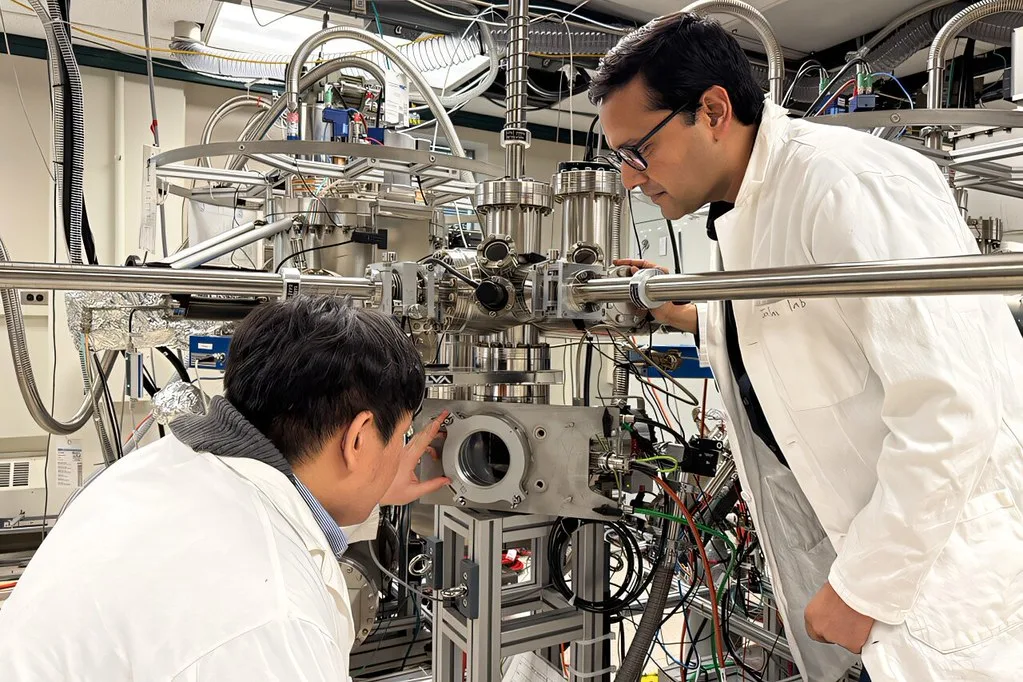
To find out what the stretched film was really doing, the researchers turned to one of the most detailed electron-mapping tools available: spin-resolved angle-resolved photoemission spectroscopy, or spin-ARPES.
The idea is deceptively simple. You shine light on the sample, which knocks electrons out of the material. By measuring each electron’s energy, momentum, and spin direction as it leaves, you can reconstruct a three-dimensional map of the material’s electronic structure and its spin texture.
For this study, spin-ARPES was crucial because the scientific question wasn’t just “are electrons present?” but “are they spin-polarized in a way that proves magnetic order?”
The team didn’t just take one pass, either. They repeated the spin-ARPES measurements in two different experimental geometries to separate genuine magnetic signals from potential artifacts introduced by the measurement technique. That kind of cross-check is essential when you’re chasing subtle spin-dependent effects in a material that many still consider nonmagnetic.
Additional X-ray and optical experiments confirmed that the films were indeed fully strained and provided detailed information on the crystal symmetry of the RuO₂ layers. With the structural side locked down, any spin polarization they saw in the electronic structure would have a much stronger claim to being real magnetism rather than a quirk of the setup.
Magnetic order appears where none was expected
In those ultrathin, stretched films, the magnetic story of ruthenium dioxide flipped.
Where relaxed samples and thicker films had failed to show consistent signs of magnetism, the fully strained 2-nanometer RuO₂ films produced clear evidence of magnetic order. Spin-ARPES measurements revealed the kind of spin-dependent electronic structure that theorists had been expecting if RuO₂ could access an altermagnetic state.
That doesn’t mean the material suddenly turns into a classic bar magnet with a north and south pole you could feel with a compass. The overall magnetization can still be vanishingly small. But inside the material, the electrons aren’t behaving symmetrically anymore. Their spins are ordered in a way that changes how charge and spin move through the crystal.
The key takeaway is that in RuO₂, magnetism isn’t a simple on/off trait baked into the chemistry. It’s a property that can emerge or disappear depending on how the lattice is stretched at the atomic level. By tuning epitaxial strain, the researchers essentially discovered a “mechanical knob” for turning magnetic order on in a material that had long been classified as nonmagnetic in its bulk form.
Why altermagnets matter for electronics
This result doesn’t just settle an argument about one oxide. It feeds directly into a broader push to rethink how we use magnetism in electronics.
Traditional spintronic devices rely heavily on ferromagnets—materials with a strong net magnetization. They’re powerful but come with trade-offs: stray magnetic fields, issues with device scaling, and, often, relatively high power demands.
Altermagnets, by contrast, are predicted to offer large spin splitting and strong spin-dependent transport without a big external magnetic field. That makes them attractive for building components like magnetic memory, logic devices, or spin filters that could be faster, more compact, and more energy-efficient.
RuO₂ has been especially intriguing in this context because it’s a good electrical conductor already used in industry. If its altermagnetic behavior can be reliably switched on and controlled via strain engineering, it becomes a much more practical platform for spintronics than something that only works under extreme lab conditions.
The new study doesn’t instantly turn RuO₂ into a commercial device material. But it does something arguably more important: it shows that magnetism in this oxide is tunable and that the ultrathin, fully strained regime is where the action really starts.
Strain engineering as a design tool
There’s a bigger conceptual shift buried in this result. For decades, materials science has relied primarily on chemistry—change the elements, change the composition, get a new behavior. Strain engineering adds another powerful axis: keep the chemistry the same, but warp the lattice just enough to fundamentally change how the electrons behave.
In RuO₂, that means stretching a two-nanometer film so that its atoms sit in slightly different positions than they would in a relaxed crystal. The fact that this can unlock hidden magnetism suggests a broader playbook: other oxides and metals that appear nonmagnetic in bulk might reveal ordered spin structures when pushed into similarly extreme, ultrathin, strained states.
As fabrication techniques improve, the idea of routinely growing atomically smooth, fully strained films only a few atomic layers thick is starting to look less like a science experiment and more like a practical engineering tool. The RuO₂ result is an early but compelling example of how that tool can be used not just to tweak properties but to activate entirely new phases of matter.
What This Means
By showing that ruthenium dioxide can host clear magnetic order when grown as a two-nanometer, fully strained film, this work effectively rewrites the magnetic profile of a metal many had filed under “nonmagnetic.” It strengthens the case for RuO₂ as a viable altermagnet and highlights epitaxial strain as a powerful way to control spin structure in ultrathin materials.
For scientists, the message is direct: if you’re still studying bulk crystals or relaxed films, you may be missing some of the most interesting quantum behavior. For technologists chasing faster, lower-power electronics, it’s a reminder that the future of spintronics may depend as much on mechanical control—how we stretch and shape materials at the atomic scale—as it does on inventing entirely new compounds.
Hidden magnetism, it turns out, might not be so rare. We’ve just been looking at relaxed crystals instead of asking what happens when you pull them slightly out of their comfort zone.
Photo: nebulousness / PDM via Openverse