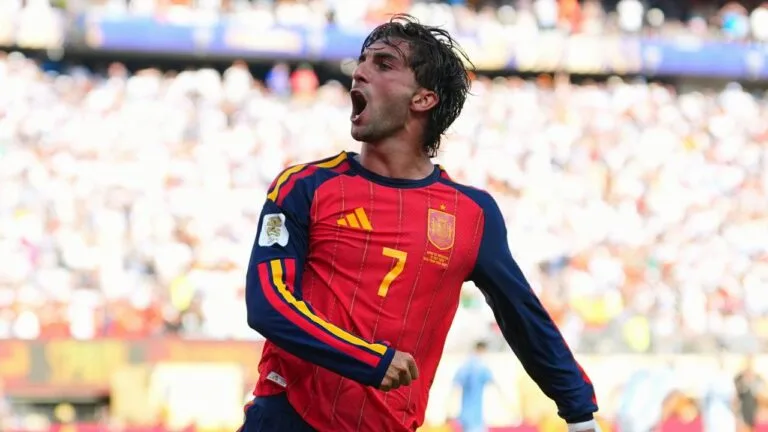
Spain are world champions again, and they did it the way they’ve done everything at this tournament — by squeezing the life out of the opposition until something finally gave. Ferran Torres’ 106th-minute finish settled a tense, attritional final 1-0 against Argentina at MetLife Stadium in East Rutherford on Sunday, handing La Roja their second men’s World Cup and denying Lionel Messi a fairytale ending that half the planet seemed to be rooting for. Sixteen years after Andrés Iniesta’s extra-time winner in Johannesburg, Spain closed out another World Cup with the exact same scoreline, the same method, and the same ruthless patience.
How the Match Unfolded
The pattern was set almost immediately. Spain took the ball, kept the ball, and pinned Argentina into their own half for long, airless stretches. Lionel Scaloni’s side, so streetwise and opportunistic throughout their knockout run, chose survival over adventure — and for 90 minutes, it nearly worked.
The numbers from the first half were genuinely startling. Argentina didn’t register a single shot before the break. They didn’t manage a single touch inside the Spanish penalty area either. Messi, playing in his record sixth World Cup at 39, was limited to just 15 touches in the opening 45 minutes, while 19-year-old Lamine Yamal — the heir apparent playing his first final — had 26 on his own.
Argentina’s best moment arrived early and disappeared just as fast. In the fifth minute, Julián Álvarez slipped a through ball behind Spain’s back line with only Unai Simón to beat. Messi sprinted after it, but the Spanish goalkeeper read the danger and cleared before the Argentine captain could get there. It would prove to be as close as Argentina came all afternoon.
From there, the match became a duel between Spain’s relentless possession and one man in a green shirt.
Emiliano Martínez’s One-Man Resistance
If Argentina made it to extra time at all, it was because of Emiliano Martínez. The goalkeeper who broke French hearts in the 2022 shootout produced the defining individual performance of this final, setting a men’s World Cup final record for saves along the way. His 10th stop — a full-stretch, fingertip denial of a vicious Yamal free kick deep in stoppage time — was the save of the tournament and sent the match into extra time with the score still goalless.
Spain threw everything at him. Mikel Oyarzabal, Dani Olmo, and Álex Baena all tested him. Rodri, who set a new record for completed passes in World Cup history during this tournament, kept recycling possession and probing for gaps. Spain even had a goal chalked off for a foul in the buildup. Martínez simply refused to be beaten — until the game around him fell apart.
The Red Card That Changed Everything
The turning point came in the third minute of second-half stoppage time. In a chaotic end-to-end sequence, Enzo Fernández flew into a challenge that sent Spain’s teenage center-back Pau Cubarsí airborne. It was the midfielder’s second yellow card of the match, and referee Slavko Vinčić didn’t hesitate. Fernández became just the sixth player ever sent off in a men’s World Cup final, and Argentina — already clinging on with eleven men — faced 30 minutes of extra time with ten.
Against this Spain side, that was a death sentence. Luis de la Fuente’s team had conceded exactly one goal in the entire tournament coming into the final. Give them a man advantage and half an hour, and the outcome starts to feel inevitable.
The Goal: Williams to Torres, 106th Minute
The breakthrough finally arrived in the first minute of the second extra period. Nico Williams, on as a substitute and stretching Argentina’s exhausted defense down the left, picked out Ferran Torres, who swept home a first-time finish past Martínez. One touch, one goal, and 16 years of waiting over.
Argentina, to their enormous credit, chased the game to the very end. Messi whipped in corners, Giuliano Simeone volleyed over from the edge of the box, and the ten men generated more urgency in the final 15 minutes than they had in the previous 100. But Spain’s defense — the meanest this tournament has ever seen — held firm. When Vinčić blew the final whistle, Spain had finished the World Cup unbeaten, with a single goal conceded across eight matches.
The Key Numbers
| Stat | Spain | Argentina |
|---|---|---|
| Final score (AET) | 1 | 0 |
| Goal | Ferran Torres 106′ | — |
| Shots on target | Double digits forced from Martínez | 0 |
| Red cards | 0 | 1 (Fernández, 90+3′) |
| Goals conceded all tournament | 1 | — |
A Passing of the Torch
The subplot everyone came for — Messi versus Yamal, the greatest ever against the kid built to replace him — delivered a quieter verdict than the hype suggested. Yamal, the first teenager to start both a World Cup final and a European Championship final, didn’t score, but he was Spain’s most dangerous creator and forced the save of the match. Messi, starved of service and space, barely got a kick.
Whether this was Messi’s last act in an Argentina shirt remains unanswered. He walked off without a winner’s medal for the first time in a final since 2016, his hopes of back-to-back World Cups — a feat no nation has managed since Brazil in 1958 and 1962 — extinguished by the most complete team of the modern era. Kylian Mbappé, meanwhile, finished as the tournament’s top scorer with 10 goals after his brace in France’s wild 6-4 third-place defeat to England.
Even the occasion itself was supersized. A Tom Cruise monologue opened the pregame ceremony, and an 11-minute halftime show packed in Shakira, BTS, Justin Bieber, and Coldplay’s Chris Martin performing alongside a Staten Island school choir — FIFA leaning fully into the Super Bowl treatment for its American showpiece.
What This Means
Spain leave this World Cup with a legitimate claim to being the best international side ever assembled. World champions, European champions, unbeaten across the tournament, one goal conceded in eight games, and a squad whose best player is 19. The 2010 generation won with beauty; this one wins with beauty and brutality. The scary part for everyone else: the core of this team could plausibly contest the next three World Cups.
For Argentina, the golden era closes with silver. They fought, they defended, and Martínez delivered a final for the ages in a losing cause. But football moved on Sunday afternoon in New Jersey — from Rosario to Rocafonda, from Messi to Yamal, from one dynasty to the beginning of another.