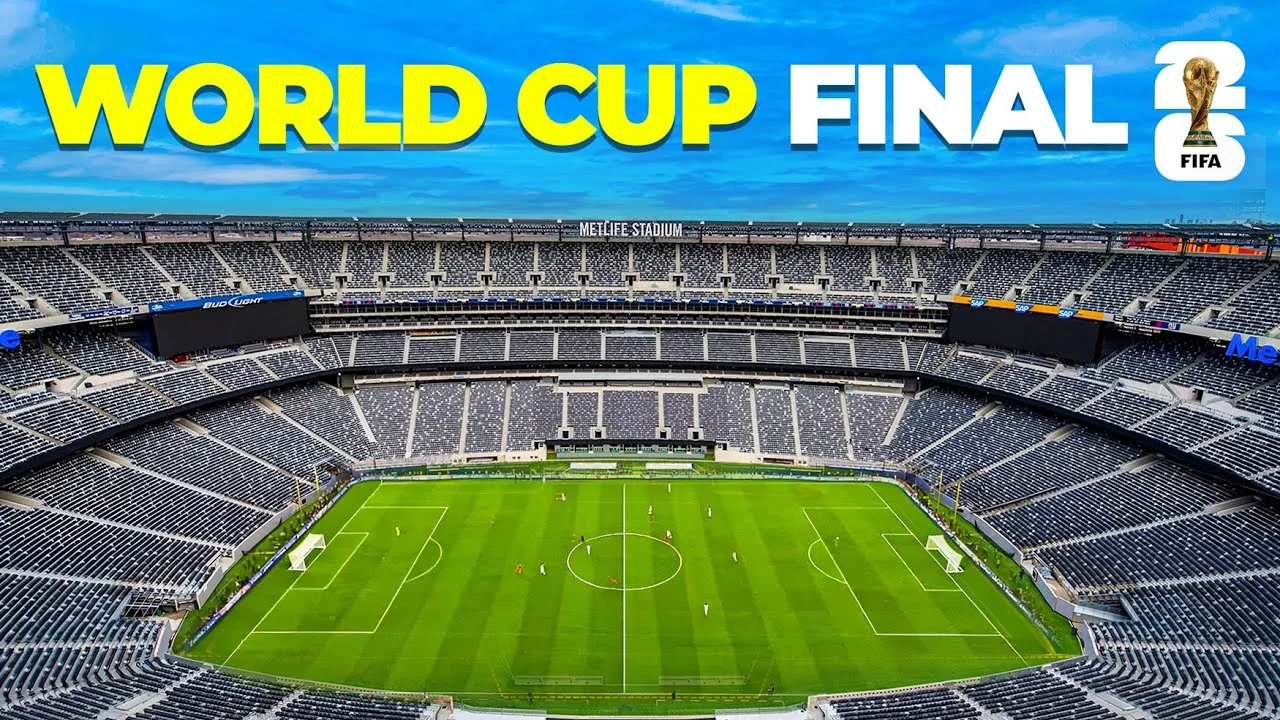
Soccer’s biggest match of the decade kicks off in East Rutherford, New Jersey, this afternoon, and for the past 18 months a sizable chunk of the football world has been asking the same question: why here? Spain against Argentina. Lamine Yamal against Lionel Messi. A first-ever halftime show curated by Chris Martin. All of it staged inside a grey concrete bowl beside a highway interchange that even its own NFL tenants’ fans struggle to defend. The final will be magnificent. The venue debate isn’t going away.
A Stadium That Won FIFA’s Bid but Never Won the Room
FIFA confirmed MetLife Stadium as the site of the 2026 final in February 2024, after a delay caused by planning complications. During the tournament, it has been rebranded as New York New Jersey Stadium, with MetLife’s own signage covered or stripped out to comply with sponsorship rules. FIFA lists the capacity for the final at 80,663.
The logic was never mysterious. The venue sits close to Manhattan, the largest media market on the continent, and it has a genuine track record with enormous events — Super Bowl XLVIII, Copa América matches, CONCACAF Gold Cups, and last summer’s Club World Cup final between Chelsea and Paris Saint-Germain, which drew 81,118 people without incident.
The complaint has never really been about competence. It’s about character, and about everything that happens outside the turnstiles.
Architecturally, the place is a compromise by design. Because it houses both the Giants and the Jets, it was built deliberately neutral — no signature exterior, no bold structural gesture, no roof. Set against SoFi Stadium in Inglewood, AT&T Stadium in Arlington, or Mercedes-Benz Stadium in Atlanta, it looks like what it is: an extremely capable, extremely anonymous box.
There’s a competitive irony buried in that comparison. Both semifinals were played indoors, under the retractable roofs at AT&T Stadium and Mercedes-Benz Stadium. The final, the one match FIFA most wants to look flawless on camera, is the one fully exposed to a July afternoon in New Jersey.
The Pitch Problem That Refuses to Die
The most substantive criticism has come from the players themselves.
FIFA regulations require natural grass, so a temporary surface was laid over the stadium’s artificial turf — the same approach used at the Club World Cup, where it drew complaints from the very first match. Palmeiras and Porto both grumbled about a slow, under-watered field in a goalless draw.
This summer produced the same chorus, only louder. Brazil’s Vinícius Júnior said after the 1-1 draw with Morocco that heat dried the grass out fast enough to slow the ball and kill any rhythm, forcing teams to adapt rather than play. France’s Adrien Rabiot was blunter, questioning whether the surface deserved to be called grass at all. Norway manager Ståle Solbakken added his own criticism.
Agronomists have offered a more measured read. Shallow sand-based systems dry out quickly under afternoon sun without aggressive irrigation, and a hard base beneath the root zone reduces shock absorption — meaning more wear on players’ legs over 90 minutes. One turfgrass researcher at Cornell has argued that objective firmness readings at MetLife fall within FIFA’s normal tolerance and broadly match those at other host venues.
The numbers give the defense some cover. MetLife has averaged 3.14 goals per match this tournament, eighth among the 16 venues and above the tournament average of 2.91. Whatever players felt underfoot, the football hasn’t been strangled by it.
But the damage to perception is real, and it’s compounded by history. MetLife’s artificial surface has been a running grievance among NFL players for years, most infamously when Aaron Rodgers ruptured his Achilles four snaps into his Jets debut in September 2023.
Getting There Is the Other Half of the Argument
Here is where the criticism gets hardest to wave away.
There’s no general parking at the stadium for World Cup matches, and no tailgating — the single most American matchday ritual, banned outright. Fans have been funneled toward public transit, shuttles, and park-and-ride options instead.
| Option | Cost | Notes |
|---|---|---|
| NJ Transit rail from Penn Station | $98 round trip | Normal fare is roughly $12.90 |
| Official NYNJ shuttle bus | ~$20 round trip | Cheapest route, poorly publicized |
| American Dream parking | $225 | Pre-booked, match ticket required |
| Rideshare | Variable | Brutal after the final whistle |
NJ Transit’s $98 matchday fare landed only after earlier proposals near $150 triggered public backlash and political pressure. Organizers projected roughly 40,000 rail riders per match; the Meadowlands spur has historically maxed out around 35,000, and the plan closed that gap with shuttle buses rather than actual infrastructure.
The stadium is about five miles from Manhattan as the crow flies. On matchday it can take an hour by car — and walking isn’t an option, because the complex is ringed by highways. Spanish journalist Sid Lowe, who covered multiple Club World Cup fixtures at the ground, described the experience in unambiguously negative terms and said he hoped, without expecting, that lessons had been learned.
MetLife’s first World Cup match this June proved that hope optimistic. Transit strained visibly and empty seats were conspicuous on television — an unwelcome image for a venue meant to showcase American hosting at its peak.
The Money Problem Nobody Wants to Own
Venue criticism has become inseparable from FIFA’s ticketing model. Dynamic pricing pushed final tickets to record territory: Category 1 seats that opened around $6,370 last October had climbed past $10,990 by April, four to six times what equivalent seats cost in Qatar in 2022.
Fan groups Football Supporters Europe and Euroconsumers filed a formal complaint with the European Commission, accusing FIFA of exploiting a monopoly on ticket sales. Officials in New York, New Jersey, California, and Texas opened their own investigations into whether the pricing and seat-assignment practices break state consumer protection law.
The market has since spoken. Resale get-in prices peaked above $12,000 in late June and slid roughly 21-28% in the closing fortnight. Hundreds of seats were still listed on FIFA’s own portal on the morning of the match, priced between about $10,990 and $24,995. By average purchase price, this is still on track to become the most expensive sporting event ever staged on American soil, ahead of any Super Bowl or NBA Finals game.
Today, at Least, the Weather Is Cooperating
One long-standing worry has quietly resolved itself. FIFPRO, the global players’ union, previously flagged East Rutherford as a high heat-injury risk for afternoon matches, and the 3 p.m. ET kickoff — chosen to land in European prime time — sits squarely in the hottest window of the day. The 30-year average for July 19 in East Rutherford is 83°F, with a RealFeel of around 89°F.
Sunday’s forecast came in gentler: mostly sunny, low 80s, humidity around 55%, improving air quality, and a low risk of weather disruption. Hydration breaks remain in the protocol regardless.
What This Means
MetLife Stadium was always going to host a technically successful World Cup final. It has the seats, the security apparatus, the broadcast infrastructure, and the institutional experience. Nothing catastrophic is likely to happen this afternoon, and by Monday morning the conversation will belong to whoever lifts the trophy.
But the criticism has landed for a reason, and it isn’t snobbery about New Jersey. It’s that FIFA optimized for market size and broadcast windows and treated everything else — the surface players compete on, the roads and rails fans arrive by, the price of getting through the door — as solvable later. Some of it got solved. A lot of it got patched.
The lesson for 2030 is uncomfortable but simple: a final venue isn’t just a stadium with enough seats. It’s the whole apparatus around it. Get that wrong, and you spend the entire buildup to the biggest match in sport defending your choice instead of celebrating it.