There are more Ferraris parked in a single Beverly Hills driveway than there are working IMAX film cameras on Earth. Roughly 26 were ever built. Fewer than a dozen are realistically usable on a feature set. Each one weighs as much as a large dog, eats a thousand feet of film in under three minutes, and makes a noise that cinematographer Hoyte van Hoytema once compared to an unhinged lawn mower.
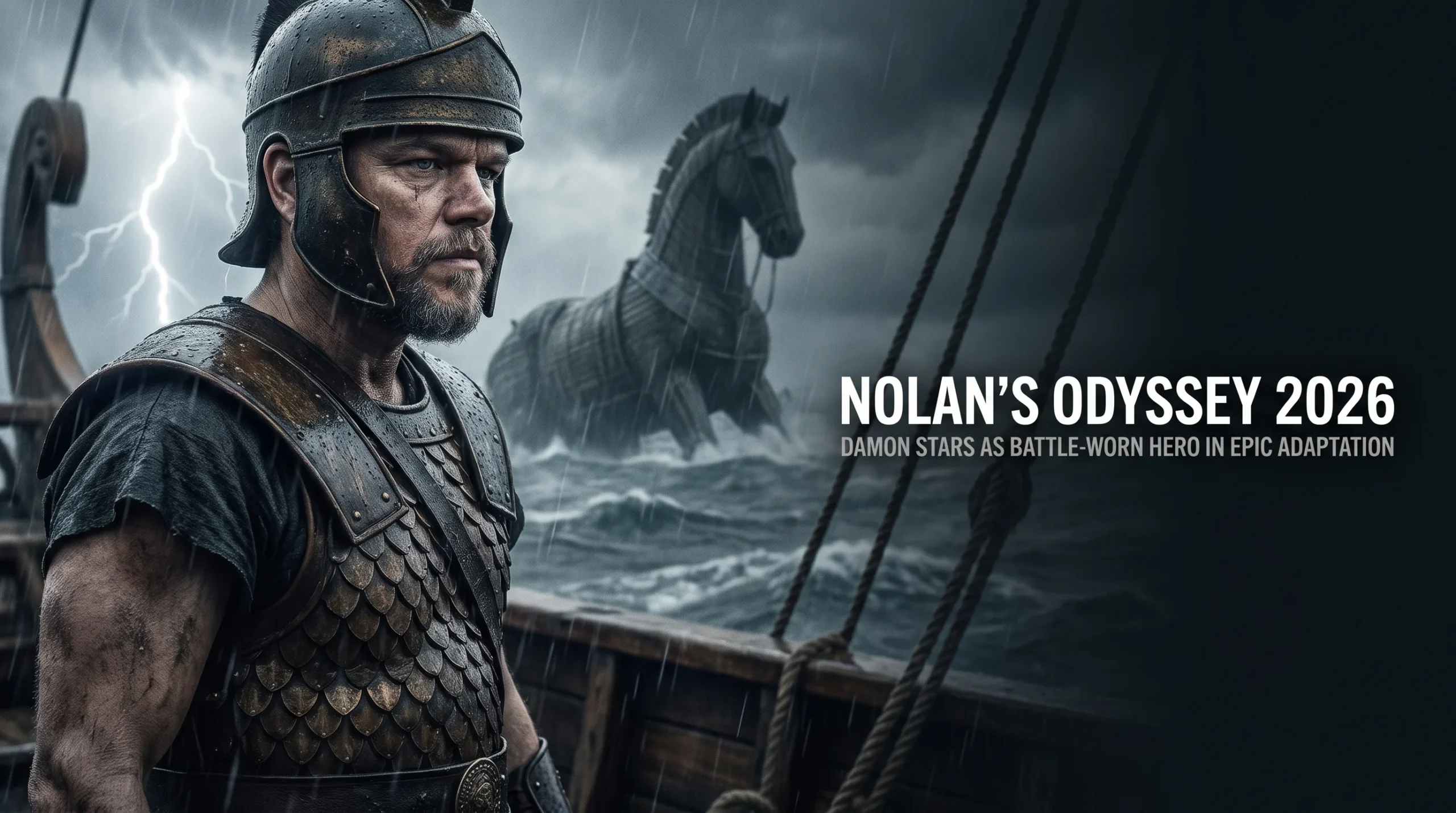
And yet Christopher Nolan just spent a reported $250 million — the biggest budget of his career — building an entire Homeric epic around them. The Odyssey opened on July 17, 2026 as the first narrative feature in history shot entirely on IMAX film cameras, and it detonated at the box office. So what exactly is an IMAX camera, why is it such a nightmare to use, and why do the world’s most powerful directors keep coming back to it anyway?
What an IMAX Camera Actually Is
Start with the film itself. A standard Hollywood movie is shot on 35mm negative, with each frame occupying four perforations in vertically running stock. An IMAX film camera runs 65mm negative horizontally through the gate, with each frame spanning 15 perforations. That’s where the shorthand “15/70” comes from — 15 perfs, printed to 70mm release stock, with the extra 5mm carrying the soundtrack.
The result is a negative frame roughly 2.74 inches by 1.91 inches. That is about ten times the surface area of a 35mm frame and roughly three times that of a standard 65mm frame. A more negative area means more silver-halide crystals resolving detail, which is why scanning facilities have historically pulled 8K x 6K files from IMAX negative and why IMAX itself has long claimed the format outresolves any digital sensor on the market.
| Format | Frame size (approx.) | Native aspect ratio | Typical scan resolution |
|---|---|---|---|
| 35mm (4-perf) | 0.87″ x 0.63″ | 1.85:1 / 2.39:1 | 4K |
| 65mm (5-perf) | 2.07″ x 0.91″ | 2.20:1 | 6K–8K |
| IMAX 15/70 | 2.74″ x 1.91″ | 1.43:1 | 8K x 6K and beyond |
That 1.43:1 ratio is the format’s real signature. It is nearly square, tall enough to fill your peripheral vision on a purpose-built screen, and it delivers what Nolan describes as the screen disappearing — a sense of three dimensions without any glasses involved.
The Cameras Themselves: Rare, Heavy, and Deafening

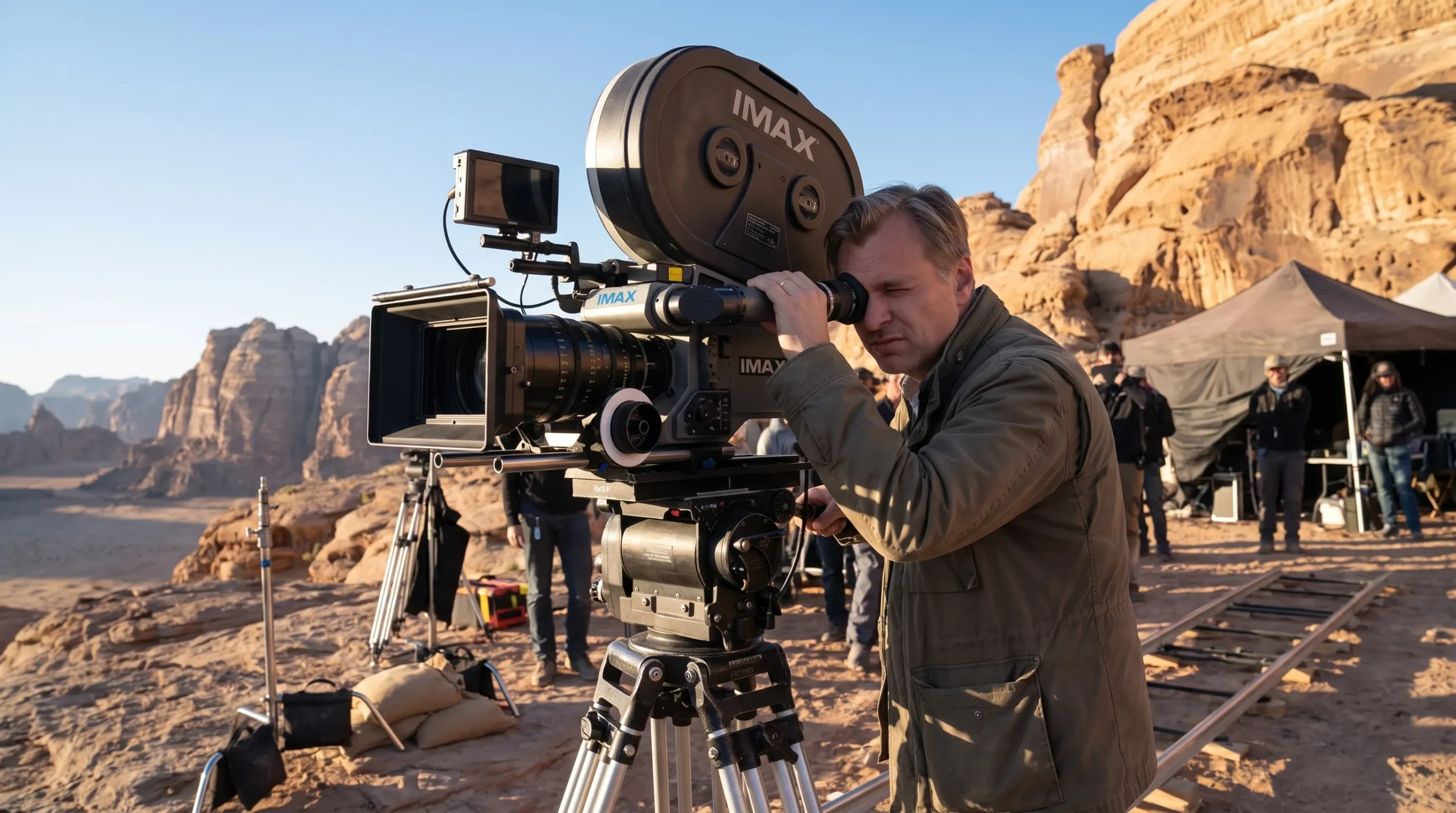
The workhorse body is the IMAX MSM 9802, a general-purpose camera with a 1,000-foot magazine, and the body alone weighs around 35kg. Alongside it sit the MKII, MKIII and MKIV reflex bodies, including a “lightweight” 500-foot variant that is only lightweight by IMAX standards. Fully accessorised and loaded, these rigs land around 25kg in the operator’s hands — which has never stopped van Hoytema from shooting handheld.
The constraints are brutal and well documented:
- Run time. IMAX stock moves at roughly 334 feet per minute at 24fps. A full magazine gives you about 2.5 to 3 minutes before you need to reload.
- Noise. The mechanical movement required to yank a frame that large into place 24 times a second is loud enough to bury dialogue on set. This is the single reason no one had shot a talky feature on IMAX before.
- Monitoring. Legacy bodies shipped with low-resolution video taps that suggested framing rather than showed it. On Oppenheimer, van Hoytema often refused Steadicam and remote-head cranes outright, because the optical eyepiece was the only trustworthy view.
- Cost and scarcity. Stock, processing, scanning, and a finite global pool of bodies make IMAX film the most expensive way to expose an image in the industry.
Why Nolan Kept Pushing
Nolan’s IMAX obsession dates back to childhood visits to Chicago’s Museum of Science and Industry. Professionally, it starts in 2008, when The Dark Knight became the first Hollywood feature to use IMAX film cameras for select sequences. Every film since has pushed the ratio further: Interstellar, Dunkirk, Tenet, and Oppenheimer — the last of which was the first production to shoot IMAX 65mm black-and-white stock, manufactured to order by Kodak.
But he was always fenced in. IMAX was the action camera, the spectacle camera, the “wait for the big moment” camera. Intimate dialogue belonged to quieter equipment. Nolan wanted the whole movie.
The Bowie Test
The breakthrough was disarmingly simple. Van Hoytema shot IMAX test footage of a child reading the lyrics to David Bowie’s “Sound and Vision” off a piece of paper, then projected it. Nolan called the result electrifying — that scale of face, that intimacy, on the largest format in existence. It proved the creative case. The engineering case still had to be built from scratch.
The Keighley: IMAX Builds a New Camera
Nolan personally challenged IMAX CEO Rich Gelfond to solve the format’s practical problems. What came back is the IMAX Keighley, named for longtime chief quality officer David Keighley and his wife Patricia. David, who oversaw post-production on more than 500 IMAX films across five decades, died on August 28, 2025 — days after signing off on dailies for The Odyssey. The film is dedicated to him.
The Keighley is still a fully analog film camera. Everything around the film is new:
- Carbon-fibre honeycomb and titanium construction — the same materials family used in Formula 1 chassis and fighter airframes — redistributing weight rather than merely reducing it.
- Quieter operation. IMAX’s marketing figure is 30% quieter; van Hoytema has characterised the real-world improvement as 15–20%, or the difference between a lawn mower and a well-oiled sewing machine.
- A 4K UHD video tap feeding a real SDI signal, with selectable 1.43:1, 1.90:1 and 2.40:1 framing overlays — finally making Steadicam and remote heads viable.
- An LCD status display showing film remaining, frame rate, shutter angle, voltage and internal temperature (held near 20°C to protect the ESTAR-based emulsion).
- Metadata capture, pushing IMAX film acquisition closer to a modern digital editorial workflow.
The Blimp, and the Mirrors
Even a quieter camera wasn’t silent enough for whispered dialogue. Nolan’s team and IMAX built a heavily insulated acoustic housing nicknamed the blimp — a mass-loaded enclosure roughly the size of a floor safe, reported at around 240 pounds on its own and closer to 400 pounds once the full system is rigged. Dollies had to be reinforced with steel plating. It reportedly took six people to move.
That solved the audio and created a geometry problem: the blimped rig was too bulky to place near an actor’s eyeline. The answer was a mirror system. Matt Damon has described standing beside the camera, performing to a mirror that bounced his eyeline back into the lens. It worked, take after take, until the crew realised mid-production that they were actually going to finish the entire film this way.
Not Every “IMAX Movie” Uses an IMAX Camera
This is the distinction most audiences miss. Since 2020, IMAX has run the Filmed in IMAX certification program in partnership with ARRI, Panavision, RED and Sony. Certified digital bodies include the ARRI Alexa LF, Mini LF and Alexa 65 IMAX, the Panavision Millennium DXL2, the RED Ranger Monstro and Sony’s Venice line.
| Approach | Cameras | Ratio delivered | Examples |
|---|---|---|---|
| Shot on IMAX film | MSM 9802, MKIII/MKIV, Keighley | 1.43:1 | Oppenheimer, Sinners, The Odyssey |
| Filmed in IMAX (digital) | Alexa LF/65, Venice, DXL2, Ranger Monstro | 1.90:1 (sometimes expanded) | Dune, Dune: Part Two, Top Gun: Maverick |
| IMAX DMR conversion | Any | Reformatted in post | Most Marvel and studio tentpoles |
Denis Villeneuve’s Dune films and Joseph Kosinski’s Top Gun: Maverick were framed for IMAX from preproduction on certified digital rigs. Ryan Coogler’s Sinners went back to actual IMAX film stock. All three are legitimately “IMAX movies.” Only one category involves a 15-perf negative physically running through a camera.
Does It Actually Pay Off?
Commercially, spectacularly. The Odyssey opened to a projected $120.5 million domestic three-day weekend — Nolan’s third-biggest opening ever and his largest global launch at roughly $257 million worldwide, with an A CinemaScore and a 95% Rotten Tomatoes rating. IMAX 70mm screenings in major cities sold out a full year in advance, generating around $1.5 million in ticket sales within an hour of going live across just 26 venues.
The scarcity economics are striking. On opening Friday, IMAX 70mm accounted for about 5% of the gross from only around 34 such screens worldwide, with roughly 25 in the United States. IMAX accounted for about 25% of domestic business overall, with premium large formats accounting for well over half. Hollywood’s TCL Chinese Theatre, freshly fitted with a 70mm IMAX screen, became the top-grossing single location in the country.
Final Verdict
The IMAX camera is, by every rational metric, a bad tool. It is heavier, louder, rarer, more expensive, and vastly more restrictive than any digital cinema camera you could rent tomorrow. Its magazines run dry before most scenes finish. Its bodies are museum pieces kept alive by a handful of technicians.
It is also the only camera that produces an image of that size, and no amount of sensor engineering has yet made that irrelevant. What the Keighley changes is not the picture — it is the boundary of where that picture can be captured. Quieter operation, real monitoring, usable metadata and a manageable body turn IMAX from a spectacle-only instrument into something a director can actually build a performance-driven drama around.
Nolan’s gamble was that audiences would still pay a premium, plan travel and set alarms for 2 a.m. showtimes to see an image no home screen can reproduce. Opening weekend suggests he read the room correctly. The more consequential outcome may be what happens next: IMAX is betting the Keighley unlocks the format for a generation of filmmakers who previously wrote it off as impractical. If it does, The Odyssey won’t be remembered as the last word in large-format filmmaking — it’ll be remembered as the proof of concept.