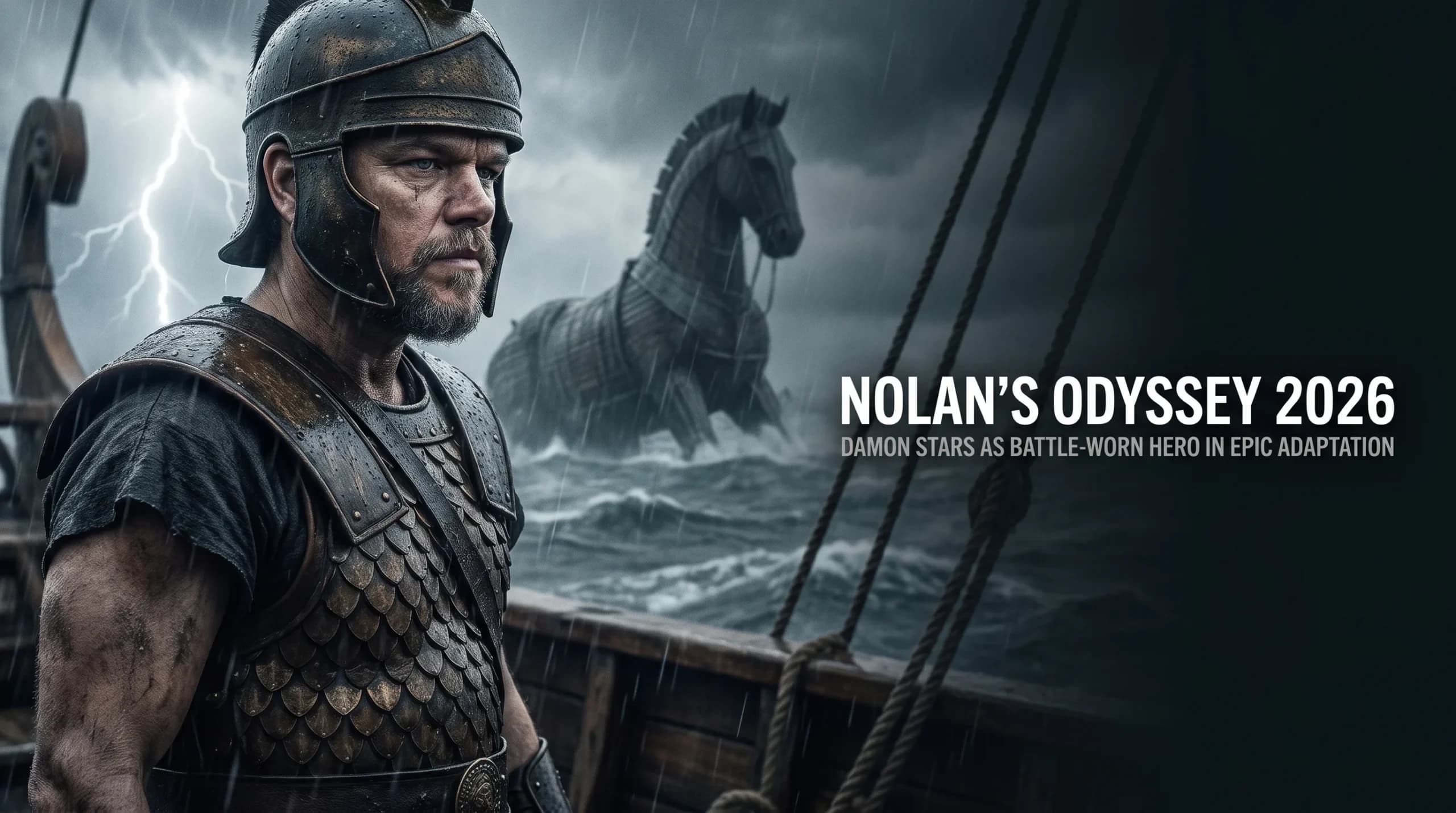
Christopher Nolan spent two years telling everyone that The Odyssey had to be seen on the biggest screen possible. Judging by the first 48 hours, audiences took the instruction as a personal challenge. Universal’s adaptation of Homer’s poem pulled $17.6 million from Thursday night previews — the biggest preview haul of 2026 — and is now tracking toward an opening weekend that would be the largest of Nolan’s career outside his Batman films. More surprising than the money is the reception. Both critics and paying moviegoers have handed the film the highest scores of Nolan’s 28-year career, and they’ve done it for a nearly three-hour, R-rated Greek epic with no franchise scaffolding underneath it.
That combination shouldn’t work in 2026. It’s working anyway.
The numbers: a preview night that broke the year’s record
The Thursday figure is the headline. $17.6 million from roughly 3,900 North American screens edged past Toy Story 5‘s $17.5 million to become the best preview night of the year, and it landed well ahead of Oppenheimer‘s $10.5 million — a film that had the entire Barbenheimer cultural phenomenon pushing it.
By Friday morning, projections had climbed sharply. Early tracking put the film in the mid-$80 million to $100 million range. After previews, that estimate jumped to $117 million in three-day domestic opening, off an anticipated $50 million Friday, with some rival studios modeling closer to $120 million. Globally, the weekend outlook sits north of $200 million.
Here’s how the opening stacks up against Nolan’s own history:
| Film | Thursday Previews | Domestic Opening |
|---|---|---|
| The Dark Knight Rises (2012) | $30.6M | $160.8M |
| The Dark Knight (2008) | $18.5M | $158.4M |
| The Odyssey (2026) | $17.6M | ~$117M (projected) |
| Oppenheimer (2023) | $10.5M | $82.4M |
If it holds, The Odyssey becomes the biggest R-rated opening of the year, Universal’s biggest R-rated opening ever, and the best live-action debut of 2026. It would also join a very short list — roughly five titles in history — of R-rated films that have cleared $100 million domestically in three days.
The premium format story is the real story
Strip out the raw dollars and the format breakdown is what should worry every studio executive still debating whether theatrical exclusivity is worth defending. Of Thursday’s gross, about 25% came from IMAX digital screens. Another 25% came from exhibitor-owned premium large formats — Dolby Cinema, Screen-X, and the like. IMAX 70mm contributed 5% despite there being only a few dozen such screens on the planet, and standard 70mm added 3%.
Add it up: 58% of the opening night gross came from premium formats. That is an extraordinary skew, and it’s the direct consequence of The Odyssey being the first feature shot entirely on IMAX cameras. Fandango named it the platform’s number-one presale title of 2026, with advance sales totaling around $40 million heading into the weekend. When AMC opened IMAX 70mm presales last year — a full twelve months ahead of release — the ticketing system buckled, and seats started appearing on resale sites at absurd markups.
Internationally, the pattern repeats. Mexico posted Nolan’s biggest opening day ever in the market at $1.5 million, 70% above Oppenheimer. Germany opened at $1.5 million with a 54% share of the entire market’s box office. Brazil came in 85% ahead of Oppenheimer for Nolan’s biggest opening day there. The offshore IMAX footprint runs to roughly 440 screens.
The reviews: Nolan’s best-received film, by the numbers
The Odyssey currently sits at 96% on the Tomatometer from close to 300 reviews — the highest critical score of Nolan’s career, ahead of The Dark Knight and Memento at 94% and Oppenheimer at 93%.
The number of audience members is arguably more striking. The Popcornmeter opened at 96% and climbed to 97% once verified ratings surpassed the 1,000 mark, with an average rating of around 4.8 out of 5. That tops every film Nolan has made, including The Dark Knight. Notably, no Nolan film has ever gone rotten with audiences — but none has ever hit this ceiling either.
What critics actually liked
The praise clusters around a few consistent points, and they’re not the ones you’d expect from a Nolan release.
- Matt Damon’s performance. Reviewers repeatedly singled out his Odysseus as terse, weathered, and regretful rather than heroic — some calling it among the best work of his career.
- The restraint on spectacle. Nolan reportedly tamps down the supernatural. Circe’s transformation of the crew reads as tactile and low-key rather than magical. The Cyclops sequence strips out dialogue entirely and plays as straight monster-movie tension.
- Emotional directness. The final act apparently abandons Nolan’s signature structural puzzle-boxing for something plain and classical, with Damon, Anne Hathaway, and Tom Holland selling a fractured family reassembling itself.
- The imagery. Shots of the fleet at sea have been described as genuinely overwhelming in the format.
And the dissent
It isn’t unanimous, and the minority reports are worth reading. A recurring complaint is that a filmmaker known for dense conceptual architecture has made something comparatively hollow — that in flattening the myth into realism, Nolan drained the mythic charge that made the source material endure. Others found it uneven, or felt the film’s back half tips into something closer to a rough night out than a Greek tragedy. Some critics who admired it stopped short of calling it moving, framing its power as the by-product of a director stubbornly refusing to compromise rather than genuine emotional resonance.
The cast Universal assembled
The ensemble is absurd, and it clearly did work at the box office. Damon leads as Odysseus, with Hathaway as Penelope and Holland as Telemachus. Robert Pattinson plays Antinous, the most predatory of the suitors circling Ithaca. Zendaya appears as Athena — effectively the only god given meaningful screen time. Samantha Morton plays Circe, and the supporting bench includes Charlize Theron, Lupita Nyong’o, Jon Bernthal, Elliot Page, Mia Goth, John Leguizamo, Himesh Patel, Benny Safdie, and Corey Hawkins.
The reported budget is around $250 million, which makes premium-format demand less of a flex and more of a necessity.
What This Means
The one figure still missing is CinemaScore, which won’t register until full-weekend surveys are compiled. That’s the number to watch, because it measures general moviegoers rather than the self-selecting first-night crowd. Nolan’s films have historically shown unusual legs in weeks two and three, particularly overseas — Oppenheimer rode that curve to $975 million worldwide. If The Odyssey posts a strong CinemaScore and holds through the second frame, a billion-dollar run stops being speculation.
The broader signal matters more than any single record. An original-format, three-hour, R-rated adaptation of a 2,800-year-old poem just delivered the biggest opening night of the year and the best audience score of its director’s career, in a summer where it had to share attention with a World Cup final. The industry has spent a decade insisting audiences won’t turn out for anything that isn’t a franchise. The Odyssey is the loudest counterargument since Oppenheimer — and unlike that film, it doesn’t have a pink-clad co-conspirator to share credit with.
Nolan’s real competition arrives soon enough in the form of Spider-Man: Brand New Day. Until then, he owns the multiplex.