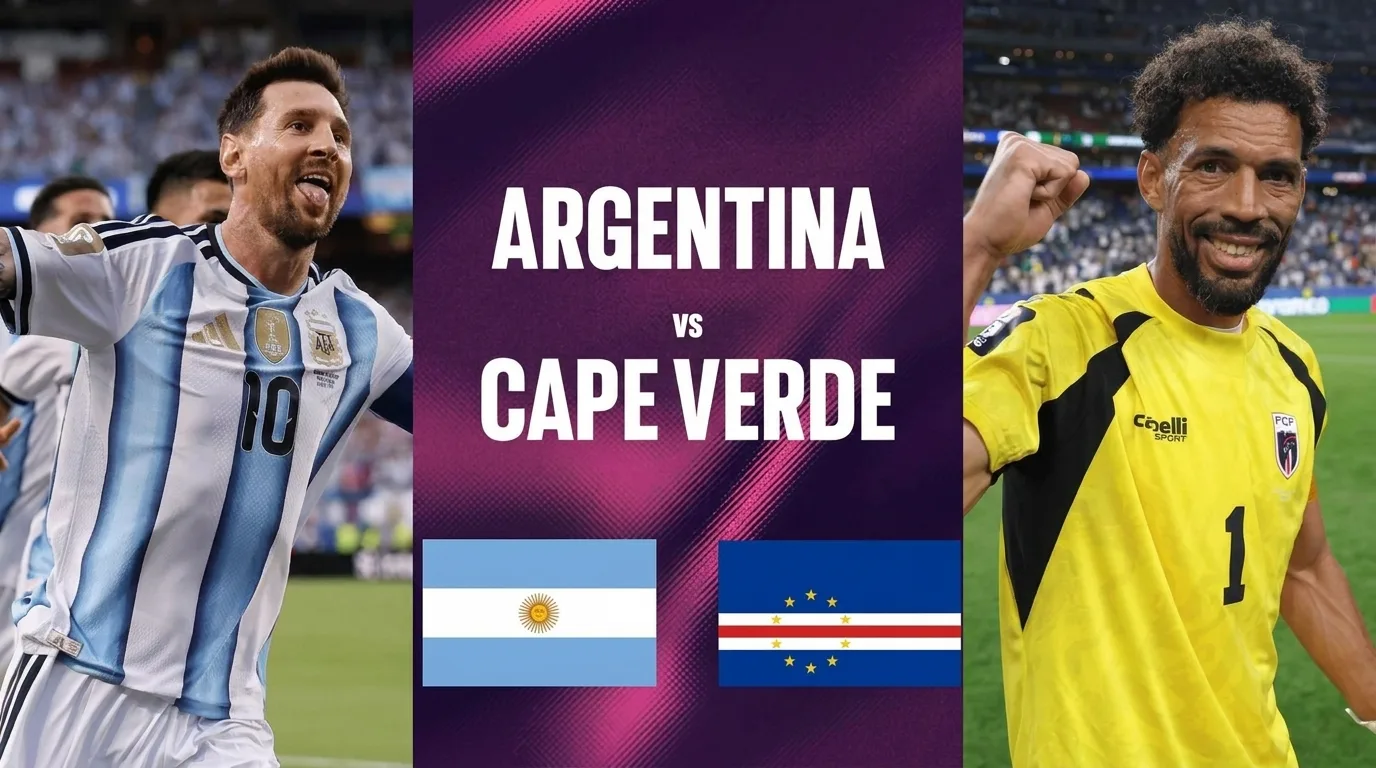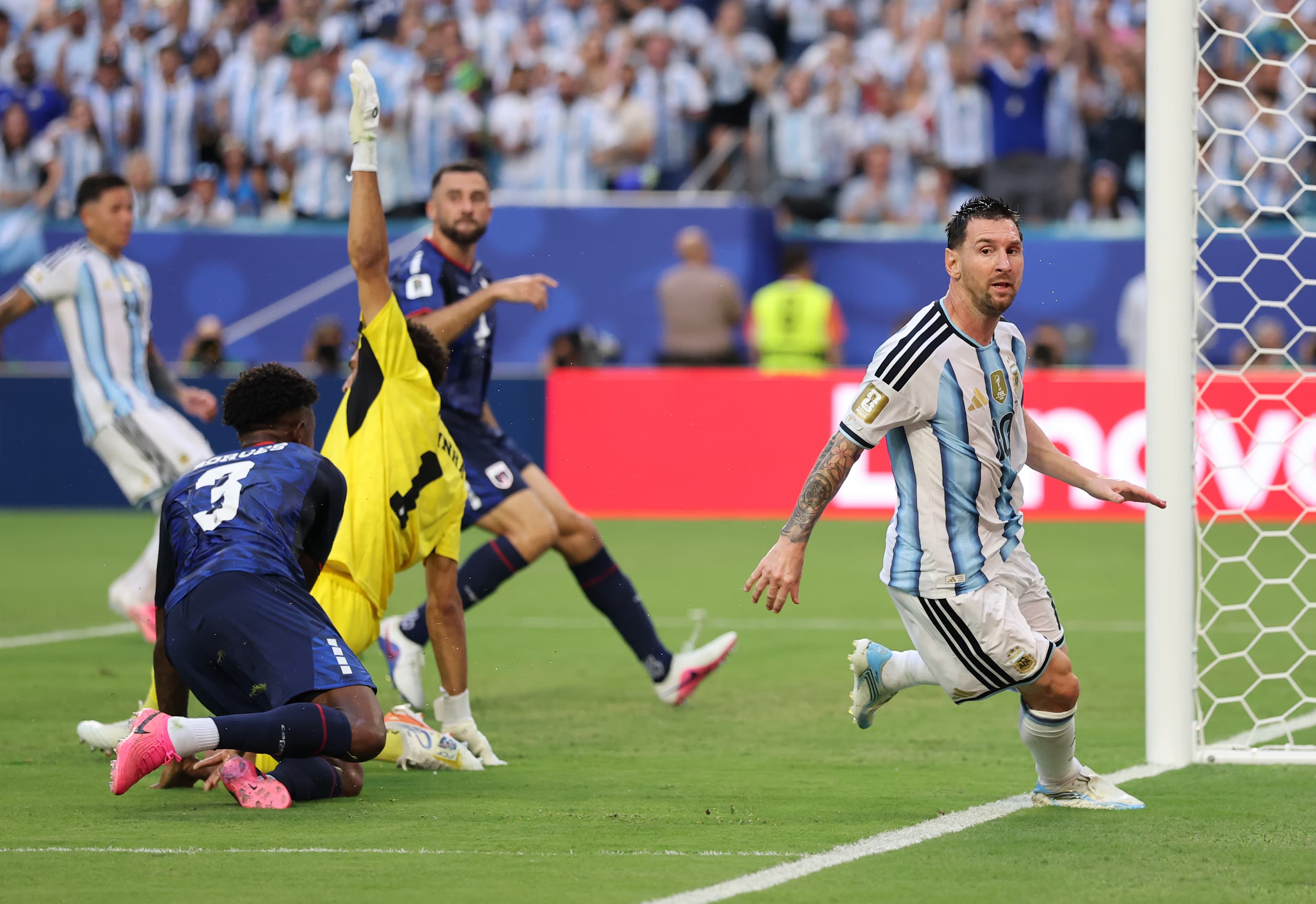
Argentina needed 120 brutal minutes and an extra-time winner to finally shake off a magnificent Cape Verde side, winning 3-2 in a Round of 32 epic that will be etched into World Cup folklore. Messi scored the opening goal and created the second, but the champions nearly threw it all away as the Blue Sharks staged a second-half fightback that stunned the world. When the final whistle blew, Argentine players collapsed in exhaustion. Cape Verdean players sank to their knees in tears. Everyone inside the stadium knew they had witnessed something extraordinary.
How the Night Unfolded: Messi Draws First Blood

The match began beneath a sky heavy with humidity and tension. Argentina, wearing their iconic light blue and white stripes, controlled the ball from the opening seconds. Cape Verde set up in a compact 5-4-1 block, every player behind the ball, every passing lane squeezed shut. For the first quarter of an hour, the Blue Sharks held firm. They tackled, they blocked, they cleared their lines desperately. But the pressure was relentless, and the man they feared most was inevitably at the heart of it.
The breakthrough arrived in the 16th minute through a moment of pure Messi magic. The captain collected a pass on the right edge of the penalty area, shifted the ball onto his legendary left foot with a touch so quick it barely registered, and then unleashed a curling shot that bent around the goalkeeper’s outstretched hand and nestled into the far corner of the net. The strike was vintage Messi. Precision, power, and placement. The goalkeeper had no chance. The Argentine supporters behind the goal erupted in a shower of blue and white confetti. Their captain had delivered on the biggest stage once again.
Messi Turns Provider as Argentina Doubles the Lead
Cape Verde barely had time to regroup before Argentina struck again. In the 28th minute, Messi drifted into a pocket of space 30 yards from goal, the kind of position that sends a shiver through every defender who has ever faced him. Enzo Fernández found him with a crisp pass. Messi took one touch to control, another to assess his options, and then delivered a perfectly weighted through ball that sliced the Cape Verdean defense in half. Julián Álvarez, darting in behind the back line, latched onto the pass and slotted a clinical finish past the onrushing goalkeeper.
Two-nil. The stadium was a carnival. Argentine supporters danced in the aisles. Cape Verde’s players looked at each other, shoulders slumped. Messi had a goal and an assist inside half an hour. The match seemed over. Everyone inside the ground, from the journalists in the press box to the vendors selling empanadas in the concourses, began mentally preparing for a routine Argentina victory. Nobody was prepared for what came next.
The Cape Verdean Fightback That Shook the World
Cape Verde emerged from the halftime tunnel with a different energy. Their manager had clearly delivered the team talk of his life. The Blue Sharks pressed higher, tackled harder, and began to believe. In the 52nd minute, a long ball over the top from the Cape Verdean center-back caught Argentina’s high defensive line completely flat-footed. The striker, Ryan Mendes, used his body brilliantly to shield off Cristian Romero, took the ball in stride, and lashed a shot toward goal. Emiliano Martínez, diving to his left, got a hand to it but could only push it into the side netting. The Cape Verdean supporters, a tiny pocket of blue in a sea of Argentine shirts, erupted with a noise that seemed impossibly loud.
The goal transformed the match. Cape Verde’s players suddenly had energy they did not possess in the first half. Their midfielders began snapping into tackles. Their wingers started running at defenders with intent. Argentina, so composed before the break, looked rattled. Passes that had been crisp became sloppy. Movements that had been synchronized became disjointed. The champions were wobbling badly.
The Equalizer That Defied Belief

In the 71st minute, Cape Verde won a free kick near the left touchline, about 40 yards from goal. The delivery was whipped into the box with pace and curve, a ball that asked to be attacked. It flicked off the head of a Cape Verdean midfielder, took a deflection off Lisandro Martínez’s shoulder, and looped high into the air. The Argentine goalkeeper scrambled backward, his eyes tracking the ball’s bizarre trajectory, but he was helpless. It dropped beneath the crossbar and into the net.
Two-two. Cape Verde had done the unthinkable. The equalizer was scrappy, fortunate, and utterly magnificent. The Blue Sharks’ players sprinted toward their bench, a tangle of limbs and screams and disbelieving laughter. In the stands, Cape Verdean fans wept openly. On the pitch, Messi stood with his hands on his hips, staring at the ground. His face was unreadable, but the message was clear. This was now a fight for survival.
Argentina Throws Everything Forward as Regulation Time Slips Away
The final 20 minutes of regulation time were a siege. Argentina poured forward in waves. Messi dropped deeper and deeper, collecting the ball from his center-backs and trying to orchestrate a breakthrough. Di María fired a shot inches wide. Álvarez headed over from six yards. Enzo Fernández saw a dipping volley clawed away by the Cape Verdean goalkeeper, who was playing the game of his life.
Cape Verde defended with the desperation of a team that knew it was living through the most important night in its nation’s sporting history. Bodies were thrown in front of shots. Clearances were hacked away to anywhere. Every tackle was celebrated like a goal. The referee signaled four minutes of added time. Argentina won a corner. Martínez came up from the back. The ball was swung in, a scramble ensued, and somehow Cape Verde cleared it off the line. The whistle blew for full time. The match was going to extra time. Cape Verde had dragged the world champions 30 more excruciating minutes.
Extra Time: The Decisive Moment Arrives
Extra time is where legends are forged and where exhausted bodies find reserves they did not know they possessed. Argentina, stung by the collapse of their two-goal lead, came out for the first period of extra time with fire in their eyes. Messi, who had already given everything with a goal and an assist, continued to pull the strings, demanding the ball and trying to unlock a Cape Verdean defense that simply refused to break.
In the 105th minute, just before the extra-time halftime whistle, the decisive moment arrived. A period of sustained Argentine pressure around the Cape Verdean penalty area finally created a crack in the Blue Sharks’ defensive wall. Messi received a pass on the right edge of the box and drew three defenders toward him, sucking in the entire Cape Verdean defense with his magnetic presence. Instead of shooting, he cut the ball back to a teammate arriving late at the edge of the area. The shot was struck low and hard, fizzing through a forest of legs and past the goalkeeper’s outstretched hand. The net rippled. The stadium detonated.
The Argentine bench emptied. Players sprinted down the touchline to join the celebration. It was not Messi’s goal, but it was Messi’s creation. His vision, his patience, and his selflessness had unlocked a defense that seemed impenetrable. The goal belonged to the team, but the moment belonged to the captain who had carried his nation to the brink of survival once again.
Cape Verde’s Final Stand and Argentina’s Desperate Defense
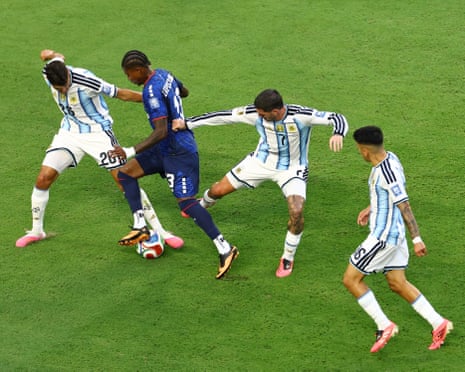
The goal did not kill Cape Verde’s spirit. The Blue Sharks, exhausted beyond measure, threw everything forward in the second period of extra time. They won corners. They launched long throws into the box. Every Argentine clearance was greeted with a fresh wave of Cape Verdean pressure. Martínez was forced into a stunning save in the 112th minute, diving full stretch to tip a goal-bound header over the bar. The Cape Verdean striker held his head in his hands. That was the moment. That was the chance to equalize and force penalties.
Argentina defended the final eight minutes with every ounce of experience and desperation they possessed. Romero headed away everything that moved. De Paul ran until his legs nearly gave out. Messi tracked back to make tackles, the 39-year-old captain defending as if his life depended on it. When the referee finally blew the final whistle, the Argentine players did not celebrate. They collapsed. They lay on the grass, chests heaving, staring at the sky. Cape Verde’s players sank to their knees, some openly weeping, others simply staring into the distance, unable to process the cruelty of coming so close to immortality.
Messi’s Goal and Assist: A Captain’s Complete Performance
Messi’s statistical contribution to this victory was immense. His opening goal in the 16th minute was his 13th World Cup goal, moving him further up the all-time scoring charts and setting the tone for what should have been a comfortable night. His assist for Álvarez’s goal showcased his vision and execution, the kind of pass that only a handful of players in history can deliver. And his role in the extra-time winner, drawing defenders toward him like a gravitational force before releasing the decisive pass, demonstrated his football intelligence and selflessness.
This was not a vintage Messi performance in terms of dominating every minute. Cape Verde’s midfield did an excellent job of limiting his touches in dangerous areas during the second half. But great players find moments. Messi found three of them. A goal, an assist, and the creation of the winner. That is what captains do. That is why Argentina is still alive.
Cape Verde’s Heroic Exit: A Nation’s Pride Remains Intact
Cape Verde leaves the 2026 World Cup with its reputation immeasurably enhanced. The Blue Sharks came within a deflection and a wonder-save of eliminating the reigning world champions. They scored two goals against a defense that was supposed to be impenetrable. They forced Argentina to dig deeper than anyone expected. The players will return home as heroes. Their story will be told for generations.
The Cape Verdean manager embraced each of his players on the pitch after the final whistle. There were tears, but there were also smiles. Pride overwhelmed disappointment. The squad gathered in front of their traveling supporters, who sang and waved flags long after the match ended. This was a defeat that felt like a victory in every way that mattered.
What This Result Means for Argentina’s World Cup Campaign
Argentina advances to the Round of 16, but the questions surrounding this team have multiplied. The defensive lapses that allowed Cape Verde back into the match were not isolated incidents. The high line was exposed repeatedly. The midfield lost control of the game for a 30-minute stretch. The attack, so lethal early on, became predictable and frustrated against a well-organized defensive block.
Scaloni will have days to fix the problems before the Round of 16. The manager acknowledged in his post-match comments that the team must improve. The wake-up call has been delivered. Whether Argentina responds to it will define the rest of their tournament. Champions find a way. Argentina found a way tonight. But the road ahead only gets steeper, and the margins for error are now razor thin.
Cape Verde’s Legacy at the 2026 World Cup
Years from now, when the 2026 World Cup is remembered, Cape Verde’s name will be spoken with reverence. The Blue Sharks did not simply participate. They competed. They scared the champions. They scored goals. They created moments of pure, unfiltered joy that reminded the world why this tournament matters so deeply. The final score reads Argentina 3, Cape Verde 2 after extra time. But the numbers do not capture the story. The story is about a tiny island nation that looked a giant in the eye and refused to blink. That is the beauty of the World Cup. That is why we watch.