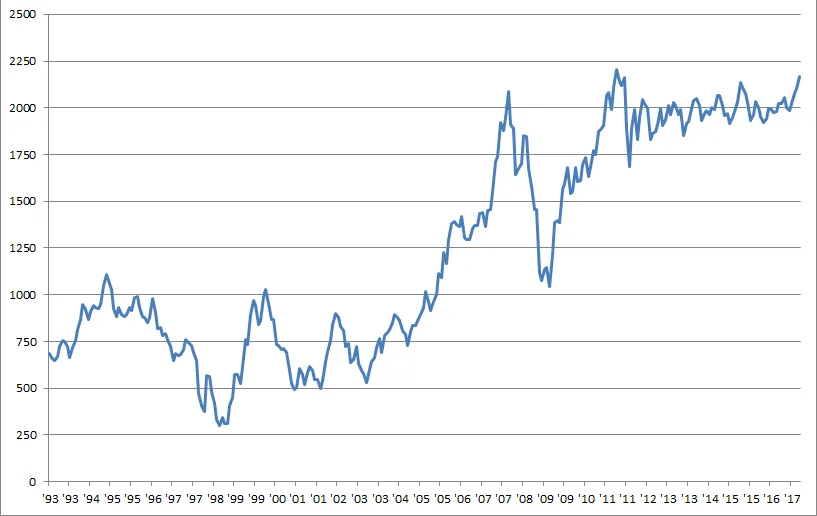
AMD closed in on a $1 trillion market cap this week, and it didn’t tiptoe there. The stock jumped 8.67% in a single session to $607.97, pushing the company’s valuation to roughly $992.4 billion and putting it within arm’s reach of a club that, until recently, only a handful of American companies had ever entered. It’s up more than 17% in the last week alone and nearly 183% year to date, which is the kind of chart that makes long-term shareholders check their portfolio twice to make sure they’re reading it right.
The Chip Prices Went Up, and Wall Street Cheered
Here’s the part that would normally spook investors: AMD just raised prices by 10% across three of its most important product lines — AI accelerators, consumer GPUs, and chipsets. In most industries, a price hike signals a company trying to protect margins against softening demand. AMD’s management framed it as the opposite. The message to investors was essentially that demand is outrunning supply so badly that the company can charge more and still sell every unit it can produce.
That’s not spin dressed up to sound good. AMD’s actual numbers back it up. In its most recent quarter, revenue hit $11.54 billion, up 50.1% year over year, with the data center segment alone pulling in $6.718 billion — a 107% jump that now accounts for 58% of AMD’s entire business. Non-GAAP earnings came in at $1.66 per share against a Street consensus of $1.61, and gross margin expanded more than 200 basis points to 56%. Guidance for the current quarter points to roughly $13 billion in revenue, implying 41% year-over-year growth is expected to continue rather than taper off.
Who’s Actually Buying All This Silicon
The customer list explains a lot of the confidence behind those numbers. OpenAI has committed to deploying 6 gigawatts of AMD GPUs. Meta is in for up to 6 gigawatts of AMD’s Instinct line. Anthropic locked in 2 gigawatts of the newer MI450 series chips. Microsoft Azure expanded its existing Helios partnership with AMD on top of all that. CEO Lisa Su has described the opportunity in blunt financial terms, estimating “double digit billions” in revenue potential per gigawatt of deployed capacity — and when you multiply that out across the commitments AMD has already locked in, it starts to explain why a 10% price increase barely registered as a risk to investors this week.
Nvidia Isn’t the Only Game in Town Anymore
For years, the AI chip conversation has essentially been a one-company story, with everyone else treated as a rounding error next to Nvidia’s dominance in AI training and inference hardware. AMD’s run this year is the clearest signal yet that the market no longer believes that framing holds. Analysts covering the stock are overwhelmingly bullish — four rate it Strong Buy, 39 rate it Buy, 11 sit at Hold, and not a single covered analyst currently rates it a Sell. The average price target sits at $616.51, just above where the stock closed after this week’s surge, suggesting Wall Street sees the current run as roughly fairly valued rather than a bubble waiting to pop.
That said, “fairly valued” is doing some heavy lifting in a stock trading at a trailing price-to-earnings ratio north of 211. That’s an extraordinarily high multiple even by AI-era standards, and it leaves essentially no room for AMD to stumble on execution without a serious correction following close behind.
The Parts of the Business That Aren’t Booming
It’s worth being honest about where the cracks are, because they exist even inside a quarter this strong. AMD’s gaming segment fell 31% year over year, a reminder that the console and PC gaming GPU cycle is running on a completely different clock than the AI infrastructure boom. Server CPU supply is also described as tight through the back half of 2026, which could cap how much of that surging demand AMD can actually convert into shipped, revenue-generating product in the near term. And looming over all of it are U.S. export controls, which have already reshaped how every American chipmaker sells into China and could tighten further with little warning.
Only 14 Companies Have Ever Done This
Crossing the trillion-dollar market cap threshold puts AMD into genuinely rare company — by most counts, only 14 companies globally have ever reached that level, and the vast majority of them are the household names you’d expect: the biggest names in tech, energy, and finance. AMD getting there on the back of AI infrastructure demand specifically, rather than consumer products, says something about where investors currently believe the next decade of enterprise spending is headed.
What Happens If the AI Buildout Slows Down
The obvious risk sitting underneath all of this optimism is the same one hanging over every company riding the AI infrastructure wave right now: what happens if the hyperscalers pull back on capital spending. OpenAI, Meta, Anthropic, and Microsoft have all made real, multi-gigawatt commitments to AMD, which is more concrete than vague industry enthusiasm. But those commitments were made in an environment of aggressive, sometimes eyebrow-raising capital expenditure across the entire AI sector. If any of those companies hit a wall on funding or decide to slow deployment timelines, AMD’s growth trajectory gets a lot less certain very quickly, and a stock trading at a 211 P/E has very little cushion for that kind of disappointment.
What This Means
AMD’s trillion-dollar moment is real, backed by actual revenue growth and actual signed commitments from the biggest names in AI, not just momentum trading. The 10% price hike landing as good news rather than bad news tells you how tight AI chip supply currently is across the entire industry, not just at Nvidia. But the valuation now assumes near-flawless execution for years to come, at a moment when the broader AI capital spending cycle is still an open question nobody — not AMD, not its customers, not the analysts setting those price targets — can fully answer yet. For now, though, AMD has done something that felt unlikely even twelve months ago: turned itself from Nvidia’s distant second into a company Wall Street treats as an essential, must-own piece of the AI buildout in its own right.