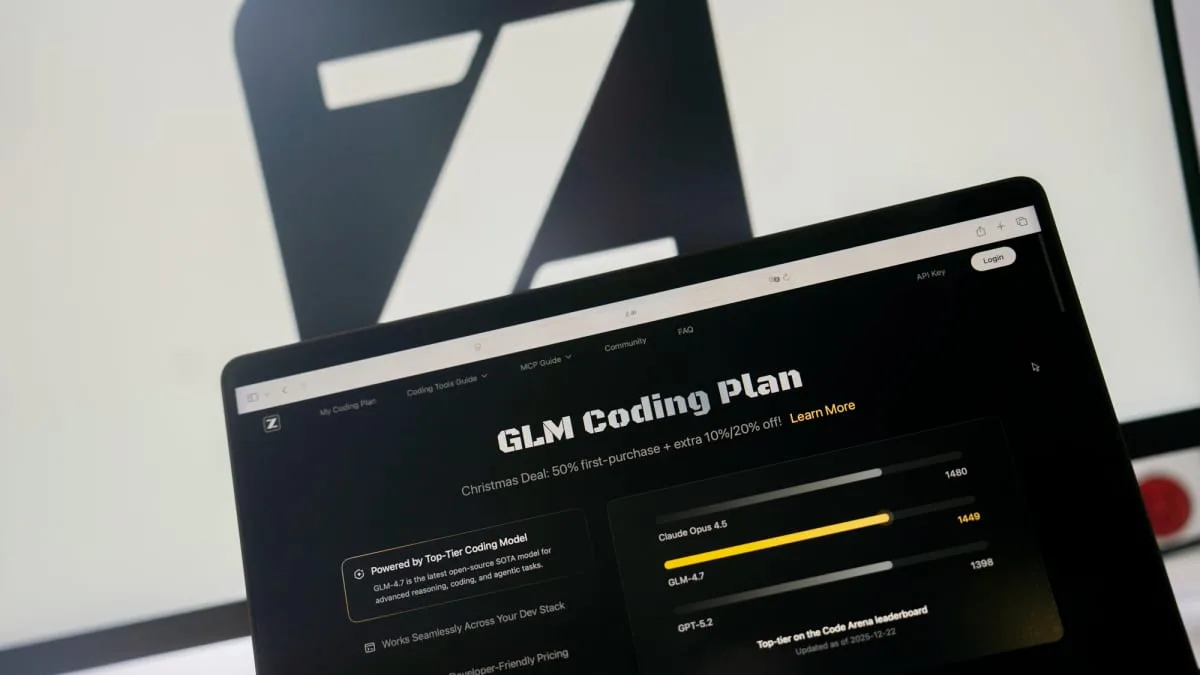
Z.ai raised about $5 billion this weekend to fund its next generation of GLM models, and the market’s response was to sell the stock hard. Shares in the Hong Kong-listed Chinese AI developer fell more than 10%, which is an unusual reaction to a company successfully securing the single most contested resource in its industry.
The reaction makes more sense once you look at the terms and the timing. This is the second enormous raise in roughly two months, and the first one was $4 billion.
The Structure of the Raise
The $5 billion arrived in two pieces:
- Roughly $2 billion from a Hong Kong share placement, priced at HK$714 per share. That is a 10% discount to the previous close of HK$793.
- Roughly $3 billion from zero-coupon convertible bonds maturing in September 2027.
A discounted placement is dilution that shareholders can price immediately, which explains a good chunk of the drop. The convertible structure is the more interesting half. Zero-coupon means Z.ai pays no interest; the bondholders are compensated entirely by the option to convert into equity at a premium. It is cheap money if the share price holds up and expensive dilution if it does not.
A 2027 maturity on a zero-coupon convertible is also a short runway. It implies the company expects either a materially higher share price within roughly a year, or another financing event to roll it.
Where the Money Goes
Z.ai’s stated uses are specific enough to be informative, and they read like a list of exactly where frontier labs are currently bottlenecked:
- Developing next-generation GLM foundation models
- Building a fully self-training system
- Scaling training and inference infrastructure
- Automated generation and filtering of training data
- Task environments for agentic training
- Long-range reasoning capability
- Adaptation for domestic chips
- Inference cost optimization
Two of those deserve attention. Automated training-data generation and filtering is the industry’s current answer to running out of high-quality human text, and it is technically fraught. Task environments are what you need to train agents that take multi-step actions rather than just producing text, and building them well is arguably harder than the model training itself.
The Domestic Chip Line
Adaptation for domestic chips is the quiet strategic item. Export controls mean Chinese labs cannot count on continued access to the highest-end Western accelerators, and every serious Chinese AI company is now running a parallel engineering effort to make its training and inference stacks work on domestically produced silicon. That work is expensive, duplicative and non-optional.
The Numbers That Should Have Helped
Z.ai’s operating results are not the problem. First-half revenue rose roughly 400% to 953.9 million yuan, and annualized recurring revenue reached approximately $1.6 billion by August. Growth at that rate, off a base that size, is genuinely rare.
The problem is what sits underneath it. Macquarie projects the company will remain loss-making into 2030. Jefferies, while raising its revenue forecasts, cut its price target and flagged a familiar cluster of concerns: customer concentration, uneven growth in computing supply, low switching costs and competitive pressure.
Low switching costs is the one that should worry Z.ai most. In a market where several Chinese labs are shipping competitive open-weight models and cutting prices aggressively, there is very little keeping an enterprise customer on any particular stack. Revenue that grows 400% can shrink quickly if the model underneath it stops being the cheapest good option.
The Pattern Across Chinese AI
Z.ai is not alone in this cycle. Chinese AI developers have been raising at a pace that suggests everyone has concluded the compute race will be settled in the next two or three years, and nobody wants to be capital-constrained when it is.
The result is a sector where fundraising velocity has decoupled from profitability entirely. Companies are being valued on model capability and revenue trajectory, and funded on the assumption that whoever is still standing with a frontier-class model at the end of the decade will be able to charge accordingly. That is a coherent thesis. It is also the exact thesis that produces a violent repricing the moment the market decides the timeline has slipped.
Why a 10% Drop Is Rational
Raising money is only good news if the market believes the return on that capital exceeds the cost of the dilution. Two raises totaling roughly $9 billion in about two months, with the second priced at a discount, sends a different signal: that capital needs are running ahead of plan, and that the company would rather secure funding at an unattractive price than risk not having it.
For a company burning heavily on compute, that is arguably the correct decision. Shareholders are entitled to notice that it cost them 10% anyway.
What This Means
Z.ai now has a very large war chest and a very specific list of things to spend it on. If the next GLM generation lands well and the inference optimization work meaningfully lowers serving costs, this raise will look like good timing at an ugly price.
If it does not, the company faces a zero-coupon convertible maturing in September 2027 against a share price that has just demonstrated how quickly it moves on bad news. The window between now and then is not long, and the thing that has to happen in it is the hardest thing in the industry: ship a model good enough that customers with low switching costs choose not to switch.