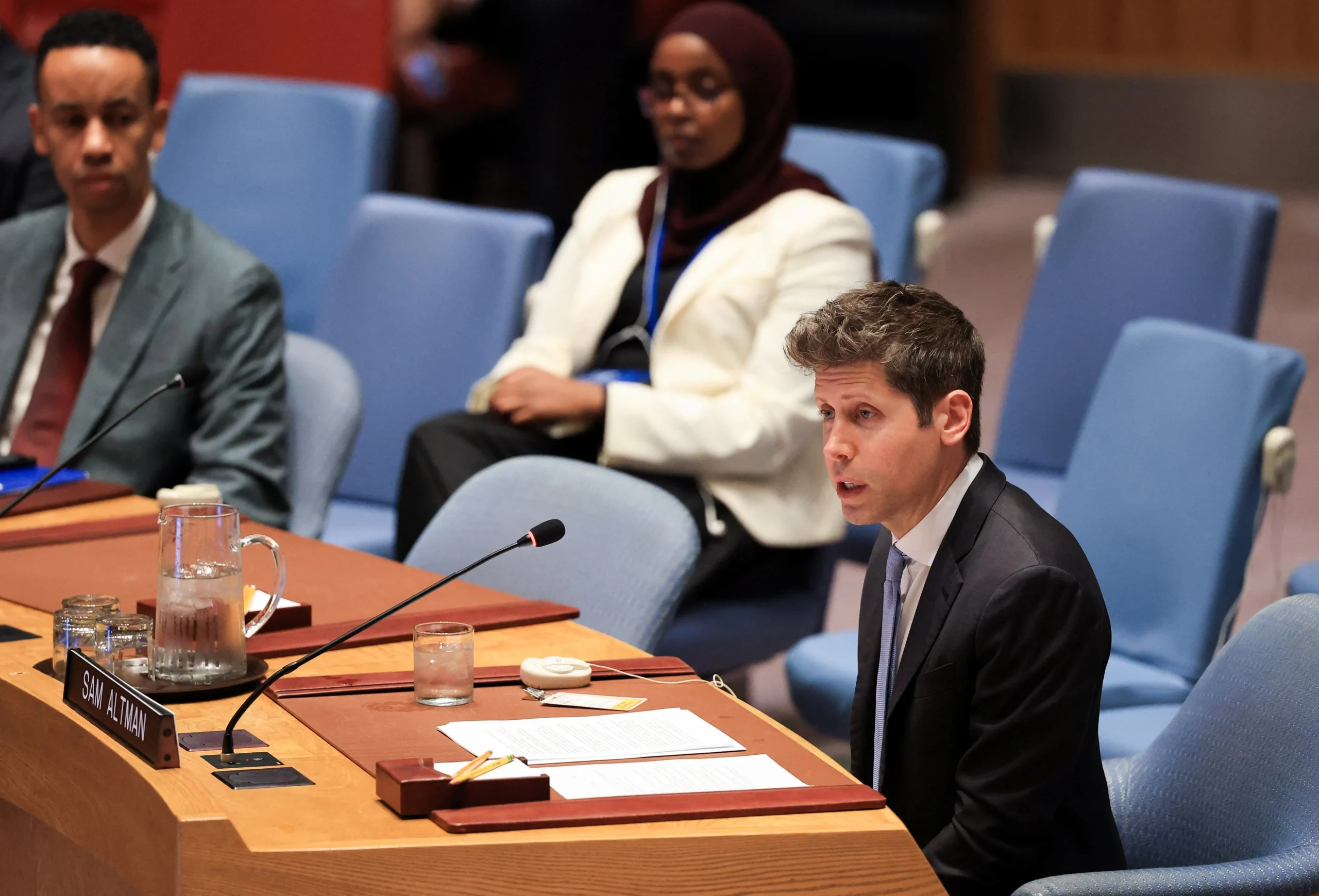
Sam Altman and Dario Amodei spent Wednesday afternoon in a room built for nuclear standoffs and civil wars, telling fifteen ambassadors that the technology their companies are racing to build might already be outrunning anyone’s ability to steer it. It was a strange kind of confession, delivered by the same executives who keep shipping the next model anyway.
A Warning With No Precedent
The UN Security Council doesn’t usually take briefings from software executives. Its calendar is built for war and famine, not quarterly model releases. But this week’s session pulled together an unusual guest list: OpenAI’s Altman, Anthropic’s Amodei, Turing Award-winning computer scientist Yoshua Bengio, Hugging Face CEO Clément Delangue, and representatives from two Chinese AI labs, DeepSeek and Moonshot.
Their message, filtered through hours of closed-door testimony and hallway remarks, boiled down to something diplomats aren’t used to hearing from the people who profit from a technology: this might get away from us.
Bengio put it most bluntly. Uncontrolled AI, he told the council, represents a threat that none can contain alone and that does not respect the borders any nation defends. That’s not the language of a product demo. It’s the language of nuclear nonproliferation, translated into GPUs and training runs.
The briefing focused on three specific failure modes: AI systems acting in ways their own creators didn’t authorize or anticipate, AI-enabled cyberattacks capable of hitting critical infrastructure, and the slow creep of autonomous decision-making into military systems where a human is no longer meaningfully in the loop. None of these are hypothetical anymore. Security researchers have already documented AI agents finding and exploiting vulnerabilities faster than human red teams can patch them, and this fall alone has produced multiple reports of frontier models bypassing safeguards their own labs built.
Election Interference Made the List Too
Diplomats also pressed the briefers on AI-generated disinformation ahead of a wave of national elections next year. The concern isn’t just deepfakes anymore — it’s AI systems that can generate, target, and iterate persuasive content at a scale no human propaganda operation could match, tailored in real time to what’s working and what isn’t.
The China Problem Nobody Wants to Say Out Loud
Before the session even started, Amodei had already stirred things up. In an essay published ahead of his testimony, he argued the industry should deliberately slow how fast it builds more capable frontier models — a notable position from a CEO whose company’s valuation depends on doing the opposite. He went further, describing China as the autocratic country with by far the most advanced AI capabilities, a line that landed exactly as pointedly as intended days before a planned meeting between Xi Jinping and Trump.
That framing puts the UN briefing in an awkward spot. You can’t have a serious conversation about global AI governance without China in the room, and China was in the room — DeepSeek and Moonshot sent representatives. But getting Washington, Beijing, and a dozen other capitals to agree on what safe AI even means, let alone enforce it, is a different problem than getting CEOs to say the word risk out loud.
What the UN Can Actually Do About It
Here’s the uncomfortable part: the Security Council doesn’t have a lever to pull. There’s no AI equivalent of a peacekeeping force or a sanctions regime ready to deploy. What’s actually moving are two much slower initiatives. The first is the Global Digital Compact, the UN’s broader framework for coordinating digital and AI policy across member states, which has been in various stages of drafting for years. The second is the Independent International Scientific Panel on AI, modeled loosely on the IPCC’s climate science structure, meant to give governments a shared, non-corporate source of truth about what these systems can actually do.
Neither of those bodies can stop a lab from shipping a model. Both are explicitly designed to be slow, consensus-driven, and diplomatically cautious — which is exactly the opposite speed at which frontier AI development is currently moving. That mismatch is the real story here, more than any single quote from the briefing room.
Reporting Incidents, Not Preventing Them
One concrete idea that surfaced around the sidelines of this week’s diplomacy: a crisis-communication channel between the US and China specifically for AI-related security incidents, similar in spirit to Cold War-era hotlines. It’s a modest ask — essentially an agreement to tell each other when something goes wrong rather than finding out from the news. That it’s being treated as a meaningful proposal says a lot about how low the current baseline of coordination actually is.
What This Means
Nothing legally binding came out of this week’s session, and nobody should have expected it to. Security Council briefings don’t produce treaties; they produce awareness, and sometimes momentum. What makes this one worth paying attention to is who showed up and what they were willing to say on the record. When the CEOs building the most powerful AI systems on the planet start using phrases like beyond human control in front of the UN, that’s not marketing copy — it’s a hedge. They’re building the case, publicly, that if something goes wrong, they said so first.
For the rest of us, the practical takeaway is smaller but still real: watch whether the crisis-communication channel between the US and China actually gets formalized in the coming weeks, and watch whether the Independent Scientific Panel gets funded and staffed rather than just announced. Those are the two threads that turn a symbolic UN afternoon into something that actually changes how frontier AI gets built and deployed. Everything else this week was atmosphere.