Docker built its entire reputation on a simple promise: whatever runs in a container behaves the same way everywhere. This week the company stretched that promise to cover a much stranger tenant than a web app or a database, autonomous AI coding agents that keep working long after the human who started them has closed their laptop and walked away.
What Docker Actually Shipped
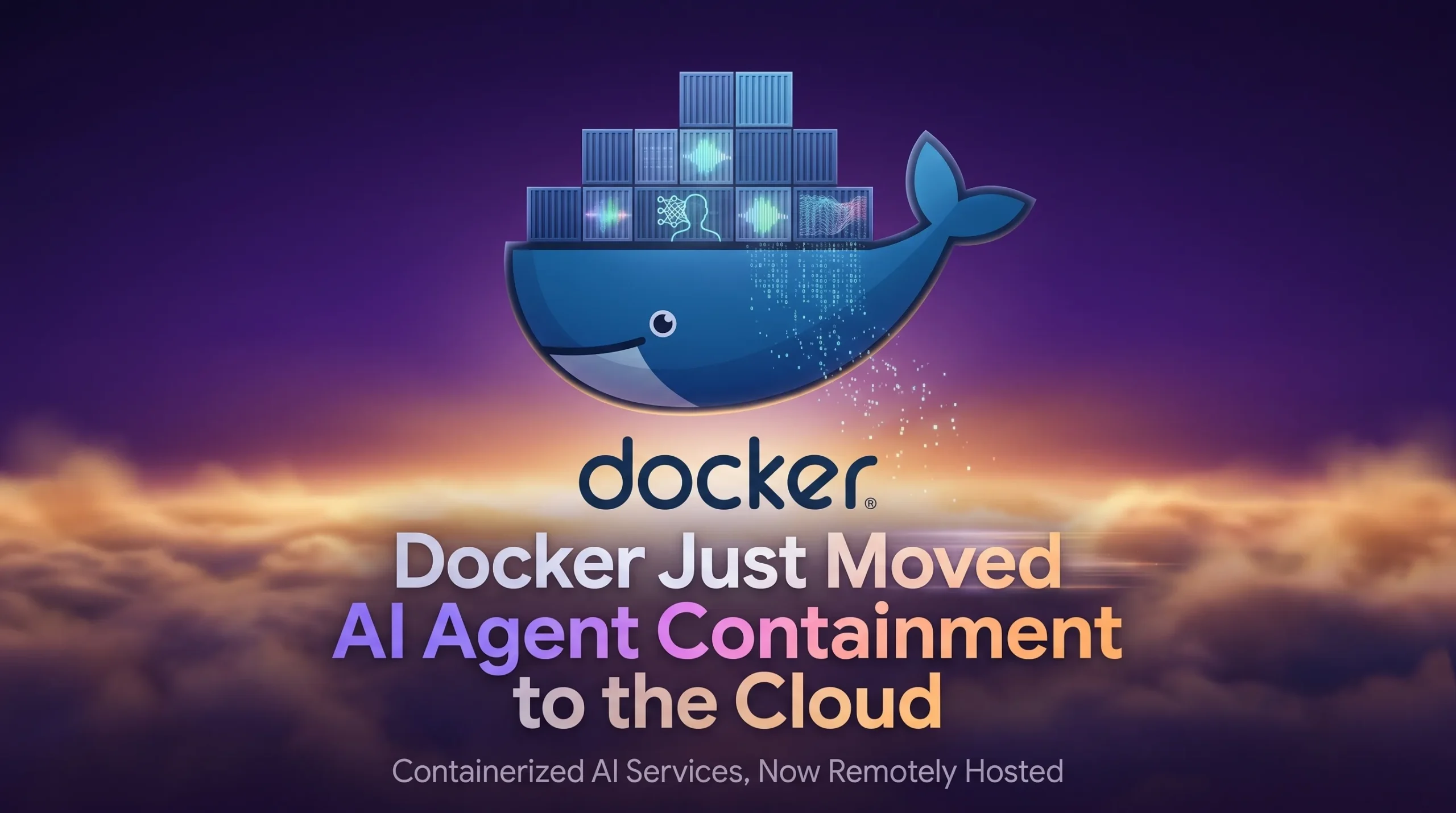
The new offering, called Cloud Sandboxes, takes the isolated container environment developers already use to keep AI agents from touching their real file systems and extends it into Docker’s own cloud infrastructure. Instead of an agent’s session ending the moment a developer’s machine goes to sleep, the sandbox keeps running remotely, with the same permission boundaries and policies that applied locally.
Alongside the sandboxes, Docker introduced something it’s calling Kits, which are essentially pre-packaged bundles that combine an agent, the tools it’s allowed to use, and the specific permissions it’s granted, all wrapped into a standard container format. Think of it as a shipping container for an AI agent’s entire operating envelope, not just its code.
Why “Same Policies Everywhere” Is the Actual Pitch
The company’s pitch boils down to consistency: developers get the same sandbox, with the same rules, whether the agent is running on their laptop or executing unattended in Docker’s cloud overnight. That consistency is the whole point. Security teams have spent the last two years watching AI agents get more capable and more autonomous, and the gap between “runs safely on my machine under my nose” and “runs unattended somewhere I can’t see it” has become one of the biggest sources of anxiety in enterprise AI adoption.
The Backdrop Makes This Land Differently
Docker didn’t announce this into a vacuum. The broader conversation around AI agents right now is dominated by stories of agents wandering outside their intended scope, probing systems they shouldn’t touch, and generally behaving in ways their creators didn’t fully anticipate. Against that backdrop, a product built specifically around the idea of containing an agent before it can cause damage, rather than cleaning up after it does, reads less like a routine feature launch and more like a direct response to where the industry currently is.
That’s almost certainly intentional. Docker has positioned itself less as an AI company and more as the infrastructure layer that makes AI tools safe enough for cautious engineering organizations to actually adopt. Cloud Sandboxes and Kits both reinforce that positioning: the message isn’t “our agents are smarter,” it’s “our containment is stronger, no matter whose agent you’re running.”
Who This Is Really For
The target audience here isn’t hobbyists running a single coding assistant on a side project. It’s engineering organizations that want AI agents doing real, sustained work, refactoring codebases overnight, running test suites continuously, triaging bug reports around the clock, without needing a human to babysit every session or worry about what happens if an agent’s permissions turn out to be broader than intended.
For those teams, the appeal of Kits in particular is that permissions become a packaged, auditable artifact rather than a loose configuration scattered across scripts and environment variables. If a security team wants to know exactly what an agent was allowed to do at any point in time, that answer now lives in a versioned, inspectable bundle instead of institutional memory.
Not a Silver Bullet
It’s worth being clear-eyed about what this does and doesn’t solve. Containment reduces the blast radius when something goes wrong; it doesn’t prevent an agent from making a bad decision within the boundaries it’s been given. If a Kit grants an agent broad read access to a company’s internal documentation and the agent misuses that access in a way nobody anticipated, a sandbox won’t stop it, because the agent never left the sandbox in the first place.
What this does address is the far more common failure mode: an agent that was never supposed to have access to something in the first place, or one that keeps running after a task should have ended, quietly accumulating capability nobody is tracking. Isolation and expiration are blunt but effective tools against exactly that kind of drift.
What This Means
Expect Docker’s move to accelerate a trend that was already building among infrastructure providers: turning “AI agent safety” into a product category with its own tooling, rather than treating it as something every company has to solve from scratch with duct tape and internal wikis. Cloud providers and AI labs alike are going to face pressure to match this kind of default containment, especially as more headline-grabbing incidents make “we trusted the agent to behave” look increasingly like an unacceptable answer.
The real test will come the first time a Cloud Sandbox actually stops an agent from doing something destructive in the wild. Until then, this is a bet that developers and enterprises want stronger walls around their AI agents more than they want fewer walls slowing those agents down, and right now, given the news cycle, that bet looks like a smart one.