The 2008 meltdown began with mortgages. The next one, some on Wall Street quietly fear, could begin with a tube of toothpaste paid for in four installments. A fast-growing credit system — built almost under the radar over the past decade — now connects everyday Buy Now, Pay Later (BNPL) purchases to some of the world’s largest asset managers through the $1.8 trillion private credit market. It has never been tested in a real recession, and that is exactly what has analysts, rating agencies, and former regulators paying very close attention in 2026.
A New Credit Machine, Built in Plain Sight
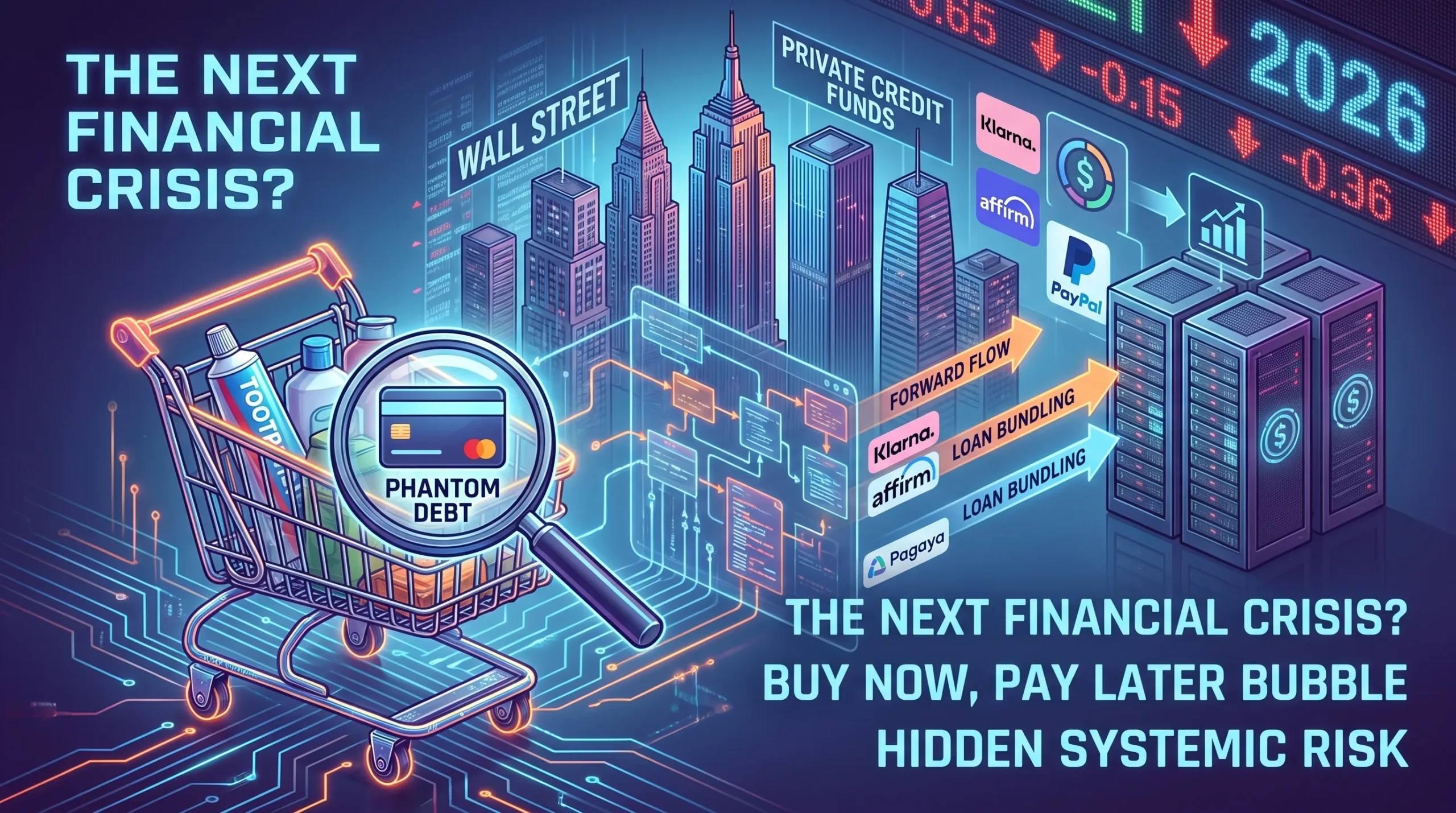
The mechanics are deceptively simple. Instead of a bank issuing a loan and holding it until repayment, fintech companies extend credit to consumers at checkout, and investment funds purchase those loans almost immediately afterward. The capital flows back to the fintech firm, which recycles it into new loans. Behind the scenes, many of those funds are themselves financed by institutional investors and, in some cases, banks.
The result is a credit chain that links a shopper splitting a grocery bill into installments directly to pension funds, insurers, and Wall Street giants.
Private credit — also called direct lending — was a niche corner of finance until the 2008 crisis, when post-crash regulation limited banks’ ability to extend certain kinds of credit. Private funds filled the gap and grew into a $1.8 trillion industry. For years, these funds focused on corporate lending, leveraged buyouts, and real estate. But recently they have redirected a growing share of capital into consumer credit, particularly BNPL, one of the fastest-growing payment methods in online commerce.
How “Forward Flow” Agreements Power the Boom

At the heart of this system sits a deal structure most consumers have never heard of: the forward flow agreement.
An investment fund commits in advance to buy loans a fintech company will originate in the future. The moment a consumer takes out a BNPL loan, it is sold to the fund at pre-agreed terms, and the fintech recycles the capital into fresh lending. The lender never has to wait for repayment to keep growing — the faster the conveyor belt moves, the greater the lending volume.
The scale of these arrangements is staggering:
- Klarna and Elliott: Klarna expanded its forward flow agreement with Elliott Investment Management to $2 billion in March, an arrangement expected to support up to $17 billion in U.S. lending under its “Fair Financing” product.
- PayPal, Blue Owl, and KKR: Blue Owl and KKR signed similar agreements with PayPal last year, and KKR has extended and upsized its European deal with PayPal to purchase up to €65 billion of BNPL loans.
- Affirm and PGIM: Affirm secured a $3 billion arrangement with PGIM Credit and expanded its cooperation with the Canada Pension Plan Investment Board.
- Pagaya: The Israeli fintech has signedforward-flow agreements with Blue Owl and Castlelakes covering consumer, personal, and auto loans totaling up to $4.4 billion.
Industry analysis suggests publicly disclosed facilities already give private credit the capacity to fund well over $100 billion of BNPL payment volume over the next few years.
Echoes of 2008 — With Important Differences
If “originate loans, sell them fast, repeat” sounds familiar, it should. The model echoes the “originate-to-distribute” approach that dominated U.S. mortgage lending before the subprime crisis, when lenders issued loans intending to offload them quickly — potentially weakening the incentive to vet borrowers rigorously.
Critics argue the same dynamic could push fintech firms to scale lending faster than underwriting discipline allows, since much of the credit risk transfers to the investors buying the loans.
The Safeguards This Time Around
Defenders of the model point out that the comparison is incomplete. Many forward-flow agreements include “skin in the game” provisions that require fintechs to retain a portion of the loans. Investors can suspend purchases if defaults exceed preset thresholds, and loans are often acquired at a discount, which helps buffer against losses. Some agreements even mandate minimum credit-quality metrics, such as a FICO score.
There are structural differences on the risk side too. Consumer credit portfolios are diversified across hundreds of thousands or millions of small loans, and underwriting now relies on large-scale datasets and machine learning models that didn’t exist two decades ago.
The hard numbers, so far, look manageable. According to CFPB data analyzed by the Richmond Fed, the BNPL charge-off rate fell from 2.63% in 2022 to 1.83% in 2023 — comfortably below the 4.19% charge-off rate on U.S. bank credit cards in the same period.
The Warning Signs Piling Up in 2026
Look past the headline default rates, though, and the consumer picture is getting uncomfortable.
- Nearly half of all BNPL users — 47% — reported making late payments in the past year, up from 41% in 2025 and 34% in 2024.
- A LendingTree survey found 54% of BNPL users now rely on the service out of financial necessity rather than convenience.
- BNPL is increasingly used not for electronics or fashion, but for everyday essentials like hygiene products and household goods.
- BNPL-financed purchases hit $28.5 billion in the first four months of this year per Adobe Analytics data, accounting for 7.8% of all U.S. online commerce.
- Market Data Forecast estimates the U.S. BNPL market reached $189 billion in 2025, is projected to hit $220 billion in 2026, and could grow to $746 billion by 2034 — a compound annual growth rate of roughly 16.5%.
One borrower’s story captures the shift. Verdell Wright told Bloomberg he turned to BNPL after losing his job, using it to finance $168 worth of essentials. “You can earn over $100,000 a year and still not have enough,” he said. Interestingly, PYMNTS Intelligence research backs this up at scale: by March 2026, 20% of consumers earning $150,000 or more reported using BNPL, double the 10% rate among those making under $50,000.
The “Phantom Debt” Problem

Regulators have another worry: debt they can’t see. Many BNPL loans are not consistently reported to credit bureaus, meaning a consumer’s total indebtedness can be significantly underestimated when they apply for a mortgage or other credit — a phenomenon regulators have taken to calling phantom debt. Without standardized credit bureau reporting, neither BNPL originators nor private credit buyers have a complete picture of borrowers’ leverage.
Private credit funds face their own transparency criticism: unlike banks, they operate largely outside public markets with lighter disclosure requirements — an increasingly awkward fit as their role in consumer finance expands.
The Question Nobody Can Answer Yet
Every safeguard, every diversification argument, every machine-learning underwriting model shares one weakness: none of it has faced a genuine downturn.
“As long as the market is stable, everything functions smoothly,” Mike Taiano, senior analyst at Moody’s, told Bloomberg. “The question is how investors will respond if credit quality starts to deteriorate. We have not yet seen this market operate under real stress.”
The contagion path is easy to sketch. In a downturn, rising defaults could force funds to tighten purchasing terms or slow transactions, driving up financing costs for fintechs and choking off consumer credit right when households need it most. And the linkage runs both ways: “If there is a significant disruption in private credit, then we may see a scaling back of the backing private credit has for BNPL loans,” Juniper Research’s Nick Maynard told Bloomberg.
For now, the official read is calm. The Richmond Fed concluded in February that, given BNPL’s current scale, outstanding debt, and observed default rates, its impact on financial stability “appears limited at present,” with no clear evidence of elevated stress spilling over into other consumer credit markets. Regulation is tightening elsewhere, though — the UK’s FCA brings BNPL under formal oversight starting July 2026, with stricter creditworthiness assessments and disclosure requirements, while the U.S. approach remains more fluid.
Final Verdict
This is not a subprime replay — at least not yet. BNPL debt is a fraction of the mortgage market’s size in 2008, portfolios are radically more diversified, and the forward-flow deals of 2026 carry structural protections that the mortgage machine never had. But the uncomfortable parallels are real: loans originated at speed and sold immediately, risk migrating into opaque corners of finance, debt regulators can’t fully measure, and a consumer base increasingly using installment credit for groceries rather than gadgets. The system works beautifully in good times — that’s precisely the problem, because good times are the only conditions it has ever known. Whether your shopping cart becomes the epicenter of the next crisis depends entirely on what happens the first time the cycle genuinely turns. Watch the late-payment numbers. They’re the canary in this particular coal mine.