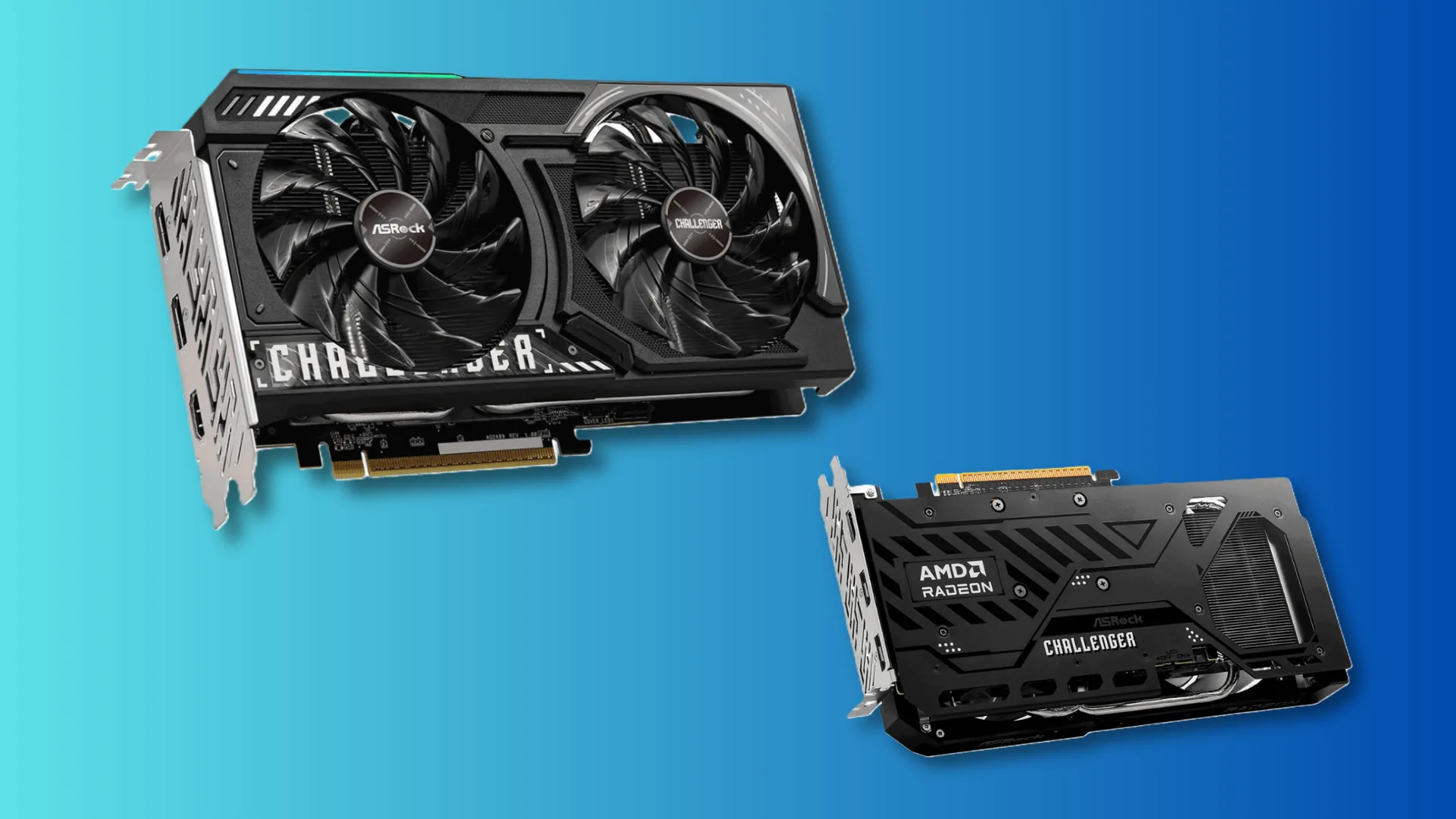
The 4GB graphics card was supposed to be dead. The last time anyone shipped a new one, it was 2022, and the reaction was bad enough that both AMD and Nvidia seemed to quietly agree never to do it again. Four years later, AMD just changed its mind. The new Radeon RX 9050 arrives in two flavors, and while the 8GB version is a perfectly reasonable budget card, its 4GB twin is a throwback nobody was asking for, wearing the exact same name.
Here’s the twist that has PC builders raising eyebrows: these two cards share a badge but not a spine. One is a competent little 1080p performer. The other is a memory-starved compromise built for a market where every gigabyte of GDDR6 now costs real money. AMD is betting you won’t notice the difference. You should.
What the RX 9050 actually is
Strip away the naming drama and the RX 9050 is AMD’s lowest-rung RDNA 4 desktop card, sitting a full tier below the Radeon RX 9060 series. It’s powered by a cut-down version of the same Navi 44 chip found in the RX 9060 XT, but with the wick turned way down. You get 1,024 stream processors spread across 16 compute units, exactly half the compute resources of the 9060 XT’s 32-CU configuration.
Both versions of the card carry identical silicon. Same 16 compute units, same 1,024 stream processors, same boost clock topping out around 2.6 GHz. On paper the GPU pushes roughly 5.3 TFLOPS of FP32 compute, which is fine for what this card is meant to do. It’s an entry-level part aimed squarely at 1080p esports and lighter mainstream gaming, and it doesn’t pretend otherwise.
Crucially, this is still a full RDNA 4 chip, which means it inherits the whole modern feature stack. FSR 4 upscaling, third-generation ray tracing accelerators, second-gen AI accelerators, PCIe 5.0, AV1 encode and decode, FreeSync, and Anti-Lag 2 are all here. That matters, because FSR 4 is genuinely good, and it’s the main reason a card this modest can punch above its raw horsepower at 1080p.
The 8GB model: a sensible budget play
The retail version, the one AMD actually wants you to buy, ships with 8GB of GDDR6 running at 18 Gbps across a proper 128-bit bus. That works out to 288 GB/s of memory bandwidth, which is enough to keep the GPU fed at the resolution it targets. AMD rates this model at a 92W total board power, low enough that partner cards like the ASRock Challenger get by on a single 8-pin connector and a 450W power supply recommendation.
AMD’s own first-party numbers, measured at 1080p Medium, paint the picture of a capable esports machine. The company claims 227 FPS in Counter-Strike 2, 206 FPS in Rainbow Six Siege, and a frankly silly 593 FPS in Valorant on high. Heavier titles look reasonable too: 131 FPS in Forza Horizon 6, 116 FPS in Call of Duty: Black Ops 7, 96 FPS in Cyberpunk 2077, and 60 FPS in 007: First Light. Those are vendor figures, so treat them as best-case, but they line up with what an 8GB RDNA 4 card should manage at these settings.
The 4GB model: 2022 called
Then there’s the other one. The 4GB RX 9050 keeps the same GPU but slices the memory in half and, worse, narrows the bus to just 64 bits. That drops bandwidth to 144 GB/s, exactly half of the 8GB card’s throughput. It’s the same wound the poorly received Radeon RX 6500 XT suffered back in 2022, reopened in 2026.
Memory bandwidth isn’t an abstract spec. It dictates how fast the GPU can stream texture data in and out of VRAM, and at 144 GB/s this card is crawling compared to its sibling. Pair that with a 4GB capacity ceiling and you’ve got a real problem, because most modern VRAM guidance now treats 8GB as the practical floor for 1080p AAA gaming at higher texture settings. Unreal Engine 5 titles leaning on Nanite geometry streaming will hit that wall hard. FSR 4 can soften the blow, but it can’t manufacture memory that isn’t there.
Two cards, one name
| Spec | RX 9050 8GB | RX 9050 4GB |
|---|---|---|
| Architecture | RDNA 4 (Navi 44) | RDNA 4 (Navi 44) |
| Compute units | 16 | 16 |
| Stream processors | 1,024 | 1,024 |
| Boost clock | Up to 2.6 GHz | Up to 2.6 GHz |
| Memory | 8GB GDDR6 | 4GB GDDR6 |
| Memory bus | 128-bit | 64-bit |
| Bandwidth | 288 GB/s | 144 GB/s |
| Board power | 92W | Not confirmed |
| Availability | Retail (select regions) | OEM prebuilts only |
The controversy here isn’t that a 4GB card exists. Cheap, cost-optimized parts have always existed for prebuilt system builders, and there’s nothing wrong with a bargain-basement option in principle. The problem is the shared name. Someone shopping for a prebuilt gaming PC might see “AMD Radeon RX 9050” on a spec sheet and reasonably assume every one performs the same. Unless the listing spells out the VRAM, buyers have no easy way to tell whether they’re getting the solid 8GB card or the hobbled 4GB one. Two products with wildly different real-world performance, wearing one badge, is a recipe for confusion, and it feels deliberate.
Why now? Blame the memory crunch
None of this happened in a vacuum. The industry is deep in a memory pricing squeeze, and GDDR6 has gotten expensive enough that shaving capacity is once again a lever manufacturers are willing to pull. Cutting to 4GB on a 64-bit bus lets OEMs hit aggressive price points for entry-level machines. It’s less a design choice made out of conviction than one made out of cost pressure, and the timing tells you everything about where the market is right now.
Pricing and where to find it
The 8GB model carries a suggested price of $279 and is rolling out first in Asia-Pacific, Japan, and Latin America through partners including ASRock, Sapphire, and Gigabyte, with availability varying by region. Broader distribution may follow, though AMD hasn’t committed to a wider launch. It’s also the company’s first new desktop graphics card in nearly a year.
The 4GB version follows a different path entirely. AMD says it has no plans to sell it as a standalone card, and it’ll live exclusively inside prebuilt systems. It’s already turned up in the wild too, spotted inside a CyberPower build listed at a major U.S. retailer for around $900, which tells you it’s a component you’ll acquire by accident rather than by choice.
What This Means
The 8GB RX 9050 is easy to recommend for what it is: a low-power, feature-complete RDNA 4 card that will chew through esports at 1080p and handle mainstream games with FSR 4 doing the heavy lifting. At $279 it’s a fair entry point, assuming you can find it in your region.
The 4GB variant is the one to watch out for, and the reason to read the fine print on any budget prebuilt this year. It has one honest use case, an esports box in a cost-sensitive market at a price well below the 8GB card, and outside of that narrow lane it’s a compromise that games in 2026 will expose quickly. If AMD had simply called it the RX 9040, none of this would be an issue. It didn’t, and now the burden falls on buyers to check exactly which RX 9050 they’re actually getting. My advice is simple: get the 8GB, and if a prebuilt only lists “RX 9050” with no capacity attached, ask before you pay.