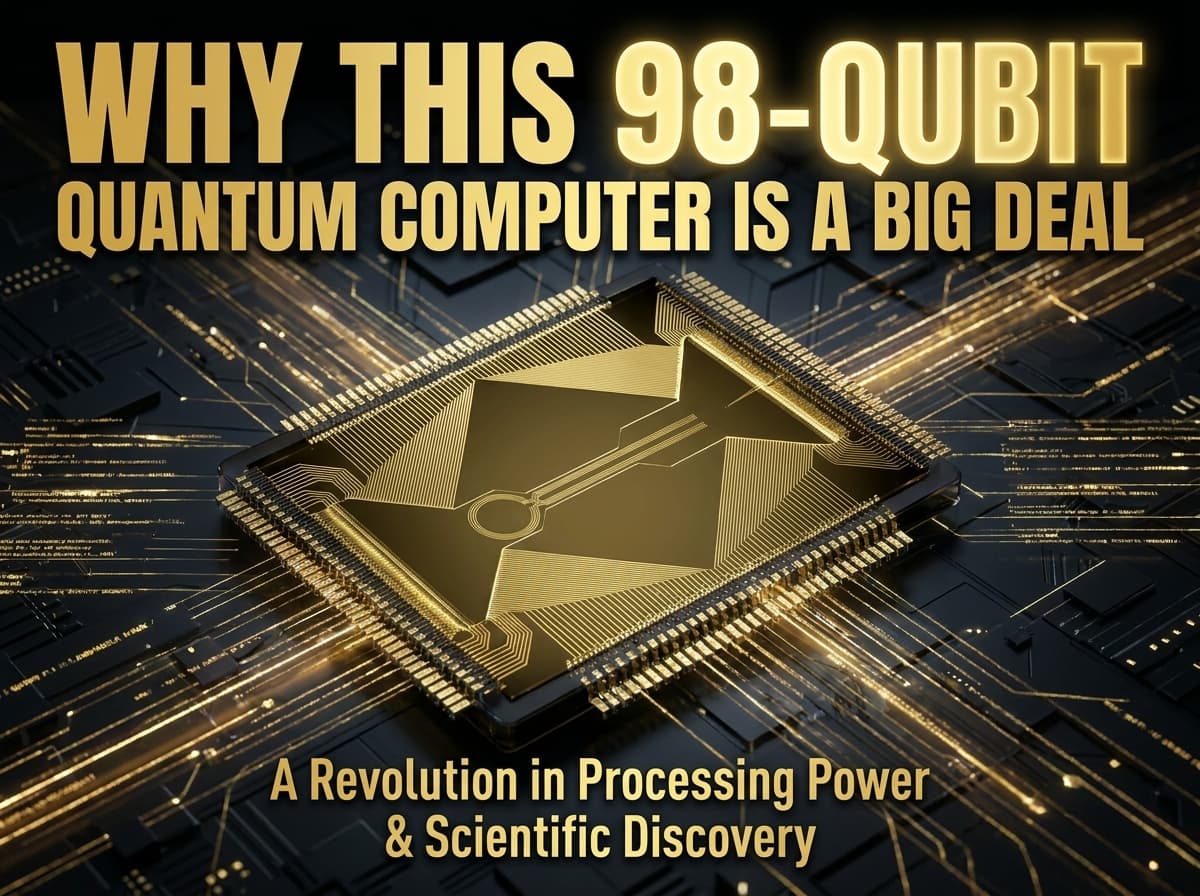
A new 98-qubit quantum processor has just crossed a threshold that researchers have been chasing for decades. Built by a team of physicists and engineers at Quantinuum, the H2 processor doesn’t just boast an impressive qubit count on a spec sheet—it has demonstrated error rates low enough to run complex algorithms that classical computers cannot simulate in any practical timeframe. The achievement, detailed in a landmark paper and verified by independent benchmarks, signals that the quantum computing industry is finally exiting the era of noisy, experimental toys and entering the age of useful, fault-tolerant machines.
Breaking Free from the Noise
For years, the central obstacle in quantum computing has been noise. Qubits are exquisitely sensitive to their environment—temperature fluctuations, electromagnetic interference, even cosmic rays can knock them out of their delicate superposition states. Most quantum processors to date have been “noisy intermediate-scale quantum” (NISQ) devices, capable of short calculations before errors overwhelm the results. What makes the 98-qubit H2 processor revolutionary isn’t just the number of qubits, but the fidelity with which they operate. Quantinuum’s trapped-ion architecture achieves single-qubit gate fidelities of 99.997% and two-qubit gate fidelities above 99.8%—numbers that place it in a different league entirely from superconducting competitors. At these error rates, the machine can execute circuits thousands of gates deep without collapsing into gibberish.
Why 98 Qubits Is the Magic Number
Ninety-eight qubits might sound modest compared to IBM’s 1,121-qubit Condor chip or Google’s claims of even larger systems. But raw qubit count has always been a misleading metric. The true measure of a quantum computer’s power is the number of logical qubits it can sustain—error-corrected qubits that behave like perfect, noiseless building blocks. Quantinuum’s breakthrough lies in demonstrating that with 98 high-fidelity physical qubits, the system can generate multiple logical qubits that outperform their physical counterparts. In one stunning demonstration, the team encoded four logical qubits and showed they could perform operations with lower error rates than any individual physical qubit. That’s the tipping point: the moment when adding more qubits and error correction actually makes the system better, not worse. It’s the quantum equivalent of achieving lift-off.
Trapped Ions vs. Superconductors: The Architecture Advantage

The H2 processor is built on trapped-ion technology, a fundamentally different approach from the superconducting qubits used by IBM, Google, and most other major players. In Quantinuum’s system, individual ytterbium ions are suspended in electromagnetic fields and manipulated with laser pulses. This architecture offers several critical advantages. First, every qubit is identical—unlike superconducting qubits, which suffer from manufacturing variability that makes each one slightly different. Second, trapped ions can be shuttled around physically within the processor, allowing any qubit to interact directly with any other. This “all-to-all” connectivity eliminates the complex routing overhead that plagues fixed-grid superconducting chips, dramatically reducing the gate depth needed for algorithms. The trade-off has historically been speed—ion gates are slower than superconducting ones—but Quantinuum’s H2 closes much of that gap with parallelized gate operations and optimized laser control.
What This Means for Real-World Problems
The immediate implication is that quantum computers are now inching toward problems with genuine commercial and scientific value. With multiple error-corrected logical qubits, the H2 can begin tackling small-scale versions of molecular simulation, optimization, and materials science problems that were previously out of reach. One early demonstration involved simulating the ground-state energy of a nitrogenase enzyme active site—a notoriously complex quantum chemistry problem directly relevant to understanding how to produce ammonia fertilizer at room temperature, something nature does effortlessly but industry requires enormous pressure and heat to achieve. Classical supercomputers choke on these simulations because the quantum mechanical interactions scale exponentially. The H2, even with just a handful of logical qubits, produced results that aligned with experimental data to within chemical accuracy—a feat that drew gasps at a recent quantum chemistry conference.
The Road to Fault Tolerance
Perhaps the most significant aspect of the Quantinuum announcement is what it implies about the trajectory ahead. By demonstrating that its architecture can scale from noisy physical qubits to error-corrected logical qubits without hitting a fundamental wall, the team has provided the strongest evidence yet that fault-tolerant quantum computing is an engineering challenge, not a physics puzzle. The H2 platform is designed to be modular, with multiple processor units that can be linked together via photonic interconnects. Quantinuum has publicly stated its goal of reaching 1,000 logical qubits by 2030—a threshold that would unlock practically important applications in drug discovery, financial modeling, and cryptography. Whether that timeline proves realistic remains to be seen, but the underlying physics no longer looks like the limiting factor.
A New Phase of the Quantum Race
The 98-qubit milestone also reshapes the competitive dynamics of the quantum computing industry. While IBM, Google, and Amazon have poured billions into superconducting and neutral-atom approaches, Quantinuum’s trapped-ion platform has quietly delivered results that its rivals are still years away from replicating. The company, formed from the merger of Honeywell Quantum Solutions and Cambridge Quantum Computing, has pursued a deliberate, milestone-driven strategy that contrasts with the hype-heavy announcements that have characterized much of the sector. Investors are taking notice: Quantinuum’s valuation has soared past $10 billion, and partnership agreements with Merck, BMW, and JPMorgan Chase suggest that enterprise customers see practical utility on the near horizon. The quantum winter that some skeptics predicted has instead given way to a quiet spring, with the H2 processor as its most convincing bloom.