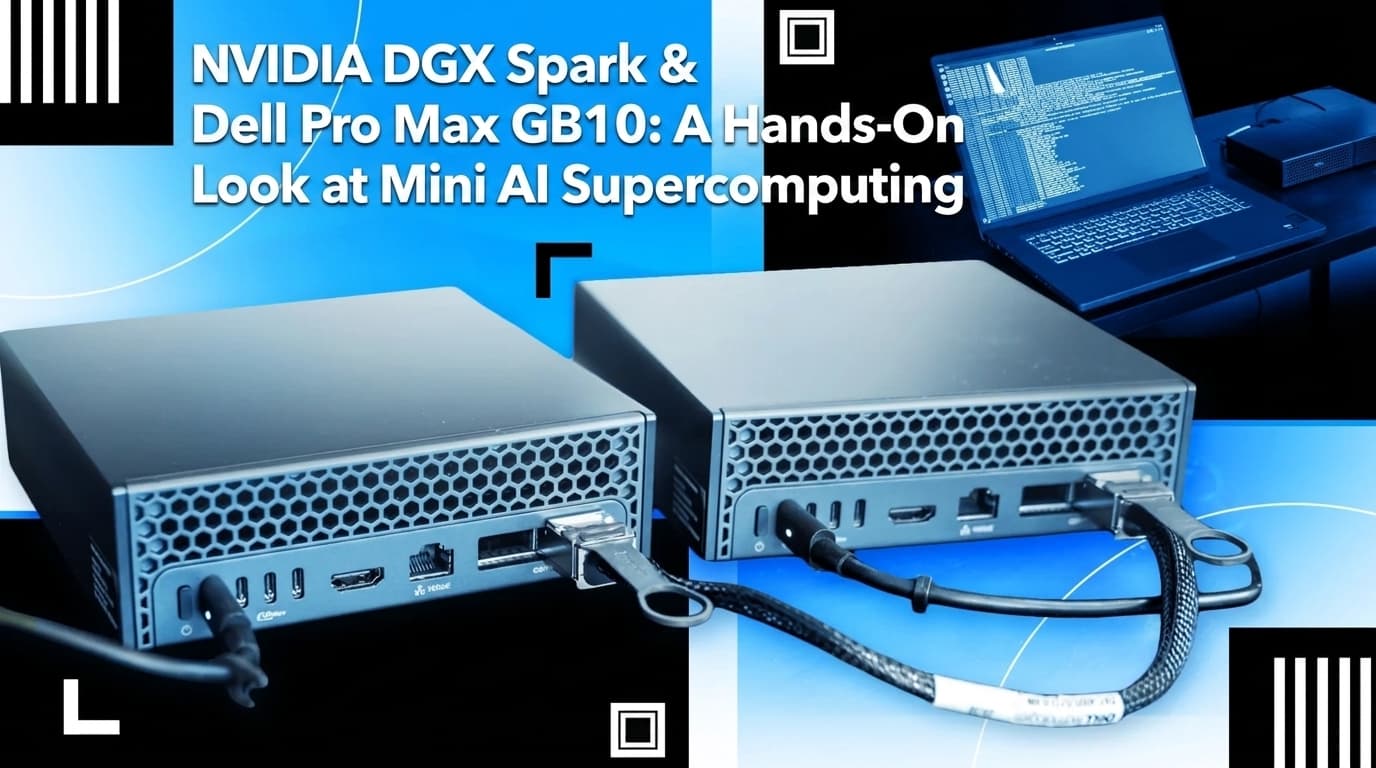
In the rapidly evolving world of AI hardware, NVIDIA’s DGX Spark platform and Dell’s Pro Max with GB10 variant represent a new class of compact, desktop‑ready AI supercomputers aimed at developers, researchers, and enterprises that want serious on‑premises AI muscle without relying on cloud infrastructure.
These machines shrink high‑end AI compute into systems small enough to sit on a desk, yet powerful enough to run large language models, vision‑language systems, and other resource‑intensive AI tasks locally.
What Is NVIDIA DGX Spark?
Originally unveiled by NVIDIA as Project Digits, the DGX Spark is a mini AI supercomputer built around the NVIDIA Grace Blackwell GB10 Superchip — a hybrid CPU‑GPU chip that integrates a 20‑core Arm CPU with a Blackwell GPU capable of up to 1 petaflop of AI compute.
DGX Spark’s design combines:
- A Grace Blackwell GB10 superchip with 20 Arm CPU cores and Blackwell GPU
- 128 GB of coherent unified LPDDR5X memory — allowing CPU and GPU to share one large memory pool
- Up to 4 TB of NVMe SSD storage
- Multiple high‑speed connectivity options, including USB‑C, HDMI 2.1, 10Gb Ethernet, and dual 200 Gbps ConnectX‑7 SmartNIC ports for clustering multiple units
- NVIDIA DGX OS (Ubuntu‑based), optimized for AI workflows and NVIDIA’s developer ecosystem
This hardware lets DGX Spark systems handle AI models with up to 200 billion parameters locally — something rarely possible outside cloud or data‑center infrastructure.
Dell Pro Max with GB10: A Strong OEM Variant

Dell’s Pro Max with GB10 is one of the first major OEM versions of the DGX Spark platform. Essentially the same class of machine, the Pro Max is designed to slot into existing development environments with enterprise polish and build quality.
Specifications include:
- NVIDIA GB10 Grace Blackwell Superchip — same AI silicon core
- 128 GB unified memory and 4 TB SSD storage
- Compact dimensions (~150 x 150 x 50 mm) and weight ~1.2–1.3 kg
- Robust connectivity: multiple USB‑C/display ports, HDMI 2.1, Ethernet, and SmartNIC support
- Pre‑installed DGX OS for an AI‑ready experience straight out of the box
In hands‑on tests and reviews, the Pro Max behaves much like the DGX Spark — delivering meaningful AI performance for prototyping, inference, and model testing — and its small form factor belies the serious compute capability inside.
Real‑World Experience: Desktop AI That Scales
In practical use, both DGX Spark and the Dell Pro Max offer a blend of convenience and power:
Local AI Modeling & Fine‑Tuning
With 128 GB of unified memory and full support for modern AI frameworks via NVIDIA’s software stack, these machines can handle models that would typically require cloud GPUs or large server racks. That includes:
- Large language models
- Vision‑language models
- Generative AI systems
- Complex data science tasks
This means developers can build, test, and tune high‑parameter models on‑site, reducing dependence on external cloud compute and enhancing data security.
Clustered Performance
Multiple units can be linked via 200 Gbps SmartNIC connections, effectively doubling model capacity for large‑scale experiments or multi‑node workflows.
Developer‑Focused Software
Running NVIDIA DGX OS and full NVIDIA AI tools — including CUDA, JupyterLab, and optimized libraries — these systems integrate seamlessly with the broader NVIDIA ecosystem that many AI teams already use.
Strengths & Limitations
Strengths
- Desktop‑ready AI power previously limited to racks or cloud services
- Large unified memory suitable for high‑parameter models
- Enterprise software and tooling support
- Networking and clustering capabilities
Limitations
- Price remains high compared with typical desktops
- Not designed for general‑purpose computing, like gaming or everyday office tasks
- Software licensing (like NVIDIA AI Enterprise) may not always be included and can add cost
Who Should Consider These Machines?

DGX Spark and Dell Pro Max GB10 are best suited for:
- AI researchers and developers
- Data scientists with large model requirements
- Organizations needing on‑premises AI for privacy or regulatory reasons
- Startups and labs without easy access to data center resources
Casual users or those focused mainly on typical productivity tasks will find few benefits compared to traditional workstations or cloud AI services.
The Future of Desktop AI Compute
What makes DGX Spark and systems like the Dell Pro Max noteworthy is not just raw performance — it’s the shift in where serious AI work happens. Instead of defaulting to cloud GPUs or centralized servers, developers can now bring high‑end AI compute to their desks, reducing latency, improving data control, and enabling experimentation that was previously impractical at this scale.
As AI continues to demand more power and flexibility, compact platforms like these could become essential tools for teams that want to innovate without forfeiting control or speed.