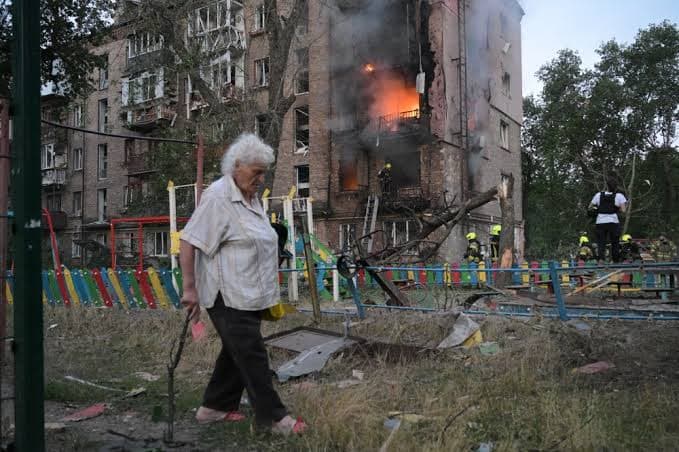
Kyiv endured one of its most ferocious aerial onslaughts in months as Russia unleashed a complex, multi-wave attack combining cruise missiles, ballistic missiles, and swarms of explosive drones early Wednesday. Air raid sirens wailed across the capital for more than five hours as Ukrainian air defenses scrambled to intercept the incoming threats, with debris and shockwaves shattering the pre-dawn calm in multiple districts. The assault left at least six people injured, ignited fires in residential buildings, and served as a brutal reminder that the war’s frontline extends deep into the heart of Ukraine’s civilian life.
Ukraine’s Air Force reported that Russia launched a total of 18 missiles of varying types—including Kh-101 cruise missiles fired from strategic bombers over the Caspian Sea and Kinzhal hypersonic missiles from MiG-31K fighters—alongside 24 Shahed kamikaze drones. Air defense units, reinforced by recently delivered Western systems, managed to intercept 15 of the 18 missiles and all but two of the drones, a success rate that officials called “remarkably effective” yet insufficient to prevent all damage. Falling debris struck a residential high-rise in the Solomianskyi district, smashing windows and igniting a fire on the upper floors, while fragments damaged a medical clinic and several parked cars in the central Pechersk neighborhood.
“Russia once again attempted to terrorize the peaceful population of our capital while they slept,” Kyiv Mayor Vitali Klitschko said in a statement posted to Telegram. “Emergency services are on site. There are wounded, but by some miracle, no one has been reported killed so far. The enemy’s goal is to exhaust us, but they fail every single time.” City authorities quickly mobilized rescue crews, and utility teams worked through the morning to restore power to pockets left dark by the blasts.

The timing of the strike aligns with an intensification of Russian attacks along multiple fronts, both on the battlefield and against critical infrastructure. Military analysts note that the Kremlin has been stockpiling precision munitions and refining coordinated attack sequences to overwhelm layered air defenses—a tactic known as a “saturation strike.” By sending drones first to distract and deplete surface-to-air missile batteries, then following with faster cruise and ballistic missiles, Russia aimed to punch through defensive gaps. While Kyiv’s defenses held remarkably well, the psychological toll of repeated midnight barrages continues to weigh heavily on the 3.6 million people who remain in the capital.
President Volodymyr Zelenskyy addressed the nation shortly after the all-clear sounded, praising the air force’s performance and reiterating calls for more advanced systems from allies. “Every intercepted missile, every downed drone is a saved life. But we need more—more Patriot systems, more air-to-air missiles, more long-range capability to destroy launchers before they fire. Our partners must understand that air defense is not charity; it is a shared shield for global security.” His remarks came as a fresh package of U.S. military aid, including additional NASAMS and HAWK missile batteries, was reportedly being prepared for transfer.
International condemnation of the attack followed swiftly. The U.S. ambassador to Ukraine, Bridget Brink, called the strikes “barbaric and futile,” while the European Union’s top diplomat decried the deliberate targeting of residential areas as a potential war crime. NATO Secretary General Mark Rutte confirmed that accelerating air defense deliveries would top the agenda at an emergency meeting of the Ukraine Defense Contact Group later this week.
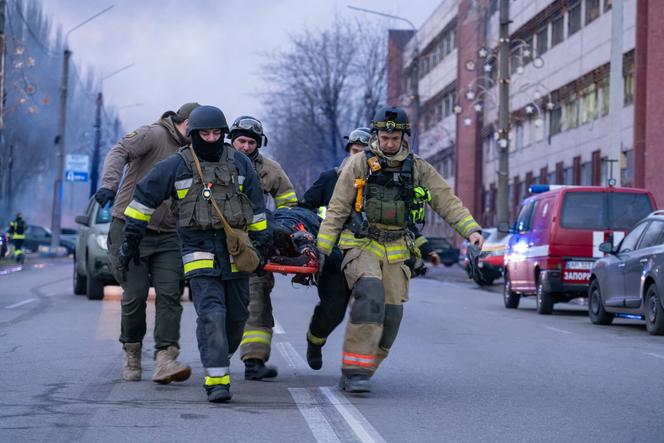
For ordinary Kyiv residents, the night was one of adrenaline, fear, and grim routine. Social media is filled with videos of glowing orange tracer fire streaking across the sky, punctuated by the distant rumble of explosions. Families huddled in subway stations and basement shelters, wrapped in blankets against the damp chill. “My son is three years old, and he already knows the difference between the sound of a Shahed and a cruise missile,” said Olena Petrivska, a teacher sheltering at the Zoloti Vorota metro station. “That’s not something any child should learn.”
Despite the ferocity of the assault, life in Kyiv resumed with characteristic resilience by mid-morning. Cafes reopened, commuters streamed from subway shelters to their jobs, and clean-up crews swept glass from sidewalks. The attack had scarred the city’s skyline but failed to break its spirit—a narrative that has defined the Ukrainian resistance since the full-scale invasion began over four years ago. Yet with each successive strike, the call for a decisive military advantage grows louder, and the gap between valiant defense and lasting security remains all too real.